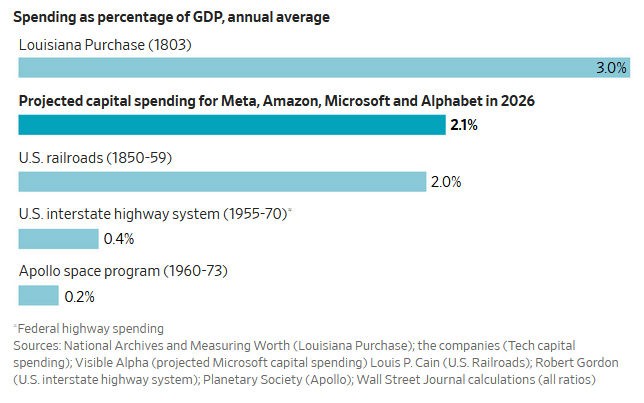
This week I was reading about Silicon Valley’s investments in AI. Just four companies – Meta (Facebook), Amazon, Microsoft and Alphabet (Google) have pumped $670 billion into AI this year, equivalent to 2.1% of US GDP.
The Wall Street Journal points out that in GDP terms this is vastly more expensive than the moon landings. The most comparable figure is the 1850s build-out of America’s railways.
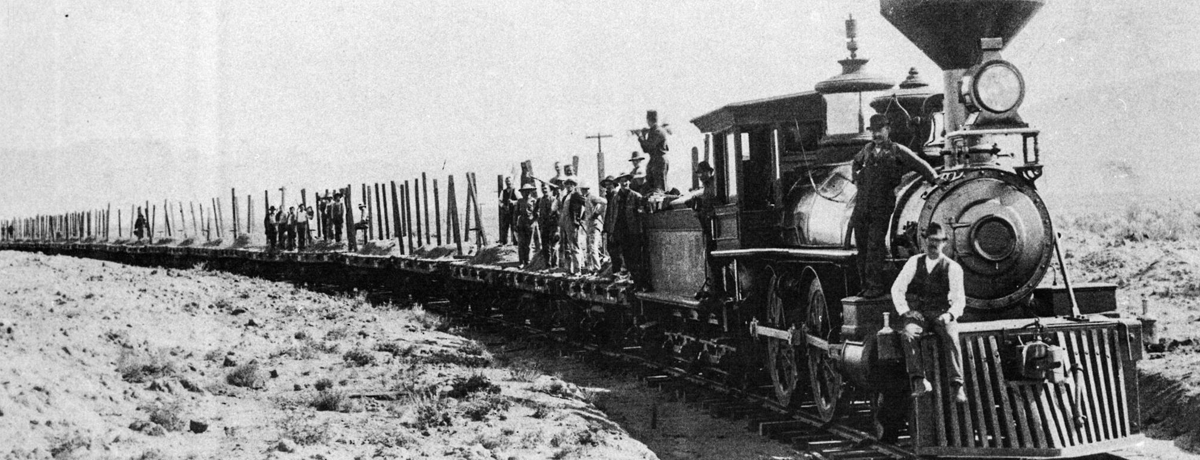
That prompts an interesting compare and contrast exercise. If you’ll excuse a somewhat freewheeling thought experiment, let’s consider the history and legacy of that railroad construction and our current rush into AI.
The first railway construction project in America began in 1827, kicking off a boom that was to carry on for fifty years. It was transformational. Railways opened up the vast interior of the continent, creating new opportunities on an almost unimaginable scale. New towns and cities emerged along the rail network as people moved in search of those opportunities. The railways reached into the West and eventually delivered the first trans-continental lines, while linking up the South played a role in post-Civil War reconstruction.
If AI is drawing in a similar level of capital, should we expect something equally transformative? The kind of movement of money will have consequences, one way or another. Will AI play a similar role in connecting humanity and enabling greater communication? Or will it prove divisive, exacerbating our existing struggle to communicate across difference?
The railways were more than infrastructure. They laid down patterns for America’s economic development, from breadbasket regions to coal mining towns. The network enabled millions of new jobs in these expanding sectors, and it hired lots of people directly as well. The railroads were second only to agriculture as a source of employment.
There’s no question that AI is setting economic priorities. 61% of all global venture capital went to AI last year – a striking distortion of the market, to my mind. And we’re only at the beginning of what AI will mean for jobs. There will be a few jobs in AI directly, and many more made obsolete by intelligent machines. Since wages are the main way that economic growth is shared, will AI be a boom that leaves out the majority of working people?
Creating a railway network across the continent was also important in nation building. Passenger travel and mail, and goods from across the country, made geographically distant communities visible to each other, with a growing interdependence through trade. The railroads prompted new institutions and organisational structures. The very first federal agency was created to regulate trade between states. The coordination of rail timetables led to the formalising of America’s time zones.
AI, on the other hand, is likely to play a complicated role at the state level. On the one hand it could erode the power of governments and nations, as corporations and their machines increase their influence. On the other, more authoritarian governments are already using AI to track and control their citizens, and this could increase to dystopian levels in the years to come.
America’s railroads were not for everyone, it should be noted. The railroad was a colonial project. The government granted millions of acres of land that wasn’t theirs to give, carving up indigenous territories and disrupting their way of life. When native Americans resisted the railroad, the companies could call upon the army to respond with greater violence, and some of the worst massacres of American history occurred during this time. The railway industrialised the culling of the bison that the Great Plains tribes depended on, driving both the bison and the tribes into extinction.
Who will AI exclude? Madhumita Murgia’s book Code Dependent powerfully demonstrates how AI can make things worse for those at the margins. And as human capabilities expand, the gap between rich and poor could widen in unprecendented ways. There are still hundreds of millions of people waiting for access to electricity, billions without internet access. Will AI entrench poverty and exclusion, or will it empower people to catch up?
As for violence, we already know that AI will serve military power. The Pentagon has signed deals with all the major AI firms. Amazon, Google and Microsoft and more are all licensing their AI tech to the US military. The nature of these deals is classified, but under the leadership of the warmongering Pete Hegseth, it seems highly likely that it will be a matter of shoot first and ask questions about accountability later- or never.
America’s rail network was unashamedly capitalist, hoovering up investment funding from America’s elites and investors across the Atlantic. Fortunes were made, and as lines consolidated it handed extraordinary monopoly power to a handful of winners. Bearded Victorians like Cornelius Vanderbilt, Jay Gould and J P Morgan became known as ‘robber barons’ for their cut-throat business practices.
We already know who the big figures in AI are – folks like Sam Altman, Larry Ellison, Mark Zuckerberg, Sundar Pichai. Some of them, like Elon Musk or Palantir’s Peter Thiel, are well on their way to robber baron status, unafraid to use their economic clout to undermine democracy and twist politics to their own ends.
The railroad was a massive money-making machine, but fortunes were also lost. First in wild speculation, later in duplicated infrastructure and unfair competition, and finally in the rise of roads, oil and trucking.
A lot of people will lose money in AI too. Fears about an AI bubble may have subsided recently, but the reality is that not every bet on AI is going to pay off. Companies cramming unnecessary AI features into their software may find them hard to sustain. And if the dream of general artificial intelligence proves ultimately impossible, it could turn out to be one of the deepest and most consequential money pits in economic history.
That’s more questions than answers in the end, which I suppose is unavoidable at this stage in the journey. What we can say is that this kind of investment is historically significant, that the change it drives will be profound, and that there will be winners and losers. Perhaps by being aware of the history of technological change, we can be more alert to the risks and the injustices, and act to keep them to a minimum.
 The Earthbound Report
So it looks like if you compare the total ‘build out’ costs over the years, AI looks set to dwarf those other investments, and looks truly unprecented in history – or have I misinterpreted something here?