My new food waste bin went out to the curb this morning. Like most of us in Luton, my family was given two blue plastic caddies last month for the start of food waste collection in the town. We’re one of the regions of the UK that hasn’t had food waste collected until now, and new government guidelines should finally be making that universal. The most recent figures show the UK throwing away over 10 million tonnes of food a year, and that will hopefully begin to fall dramatically.
Some countries have been well ahead of us on food waste, and South Korea is perhaps the world’s most ambitious nation on the topic. They recycle over 95% of food waste, thanks to a policy that makes complete sense but is hard to imagine politically in the UK right now – pay as you throw waste disposal.
The idea dates back to the mid-1990s, when Korea was struggling to find enough landfill sites for its rapidly growing cities and their consumers. Its solution was to pass new rules so that citizens could only throw trash away in official plastic bags, pricing in the cost of disposal and making it visible to households.
Needless to say, once people had an incentive to sort their rubbish properly and remove anything that could be recycled, they did. Recycling levels rose and total waste levels fell by a quarter over the next decade, inspiring the government to extend the scheme to food waste from 2013. The country went from 2.6% of food waste recycled in 1996 to just short of 100% today.
As households already do with their main bin bags, food waste has to be put into official bags, priced by local authorities. Residents of apartment blocks have a more convenient system: a food waste disposal machine that charges by weight. It’s charged at around 7p a kilo, and households scan a RFID chip to unlock the door and add the charge to their apartment’s service fees.
Seoul has 27,289 of these RFID units across its apartment blocks, covering over 80% of flats. Food waste in Seoul has fallen by a quarter since these were introduced.
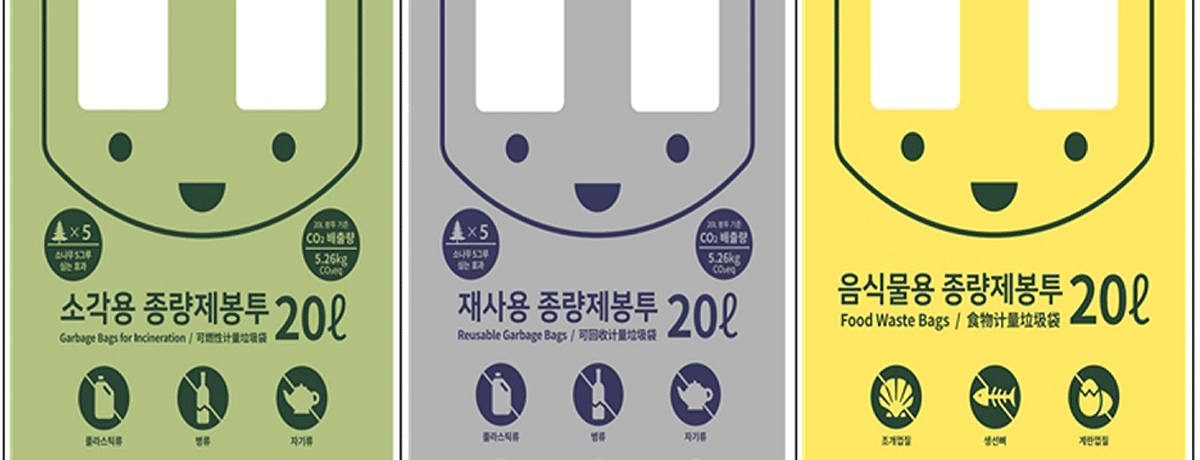
There are fines for non-compliance, but the system mainly relies on people doing the right thing because it’s easy. If you have a RFID machine in your apartment block, you can drop off food waste whenever you like. If you’re using the bag system, there are daily collections and so you don’t need to worry about putting waste out on the right day. Councils have tested and refined their official waste bags to make them easy to use – the ones in the header are from the city of Seongnam, where they made them wider, friendlier and with ties and handles.
Once collected, the food waste is processed for useful things – it’s been illegal to send food waste to landfill since 2005, so there is a well established supply chain. Much of it is dried and compressed into chicken feed pellets. Some goes to compost and some to biogas.
In the UK we now have recycling and food waste collection, along with stiff taxes on landfill to discourage it. The targets and penalties are aimed at councils rather than households. There’s no penalty for not bothering with sorting your waste, as some of my neighbours make clear on a weekly basis. Everyone pays the same, so there’s no incentive for reducing household waste. I think there’s a good case to be made for a pay-as-you-throw model, though unfortunately there are historical reasons why we are unlikely to see it in the UK in the foreseeable future.
There was a moment when pay-as-you-throw might have come to Britain. In 2007 the Labour government of the time was discussing it, prompting opposition parties and the tabloids to howl pitifully at these proposed ‘bin taxes’. Conservative politicians such as Eric Pickles spread scaremongering stories about the ‘bin police’, trash burning in the streets, and how people would have to lock up their bins at night to prevent paying for their neighbour’s rubbish.
None of these concerns are anywhere to be seen in South Korea, where you pay your contribution when you buy your bin bags and don’t worry about your neighbours. But once the idea was framed in this way, it became politically toxic. The incoming coalition government made a big populist play of ‘scrapping’ waste charges even though they didn’t exist yet (they defunded the pilot schemes, is what they actually did) and that’s the last we’ve heard of it. But it’s a good idea that others might want to use.
 The Earthbound Report