
When I hear the term ‘climate finance’, I think of banks, governments and and big institutional funders. I think about the UN, the IMF, and international conferences where multi-billion dollar funding streams are negotiated. It turns out I might have had it upside down.
Out of curiosity, I downloaded the latest Global Landscape of Climate Finance report recently. Care to guess what the biggest source of climate finance is?
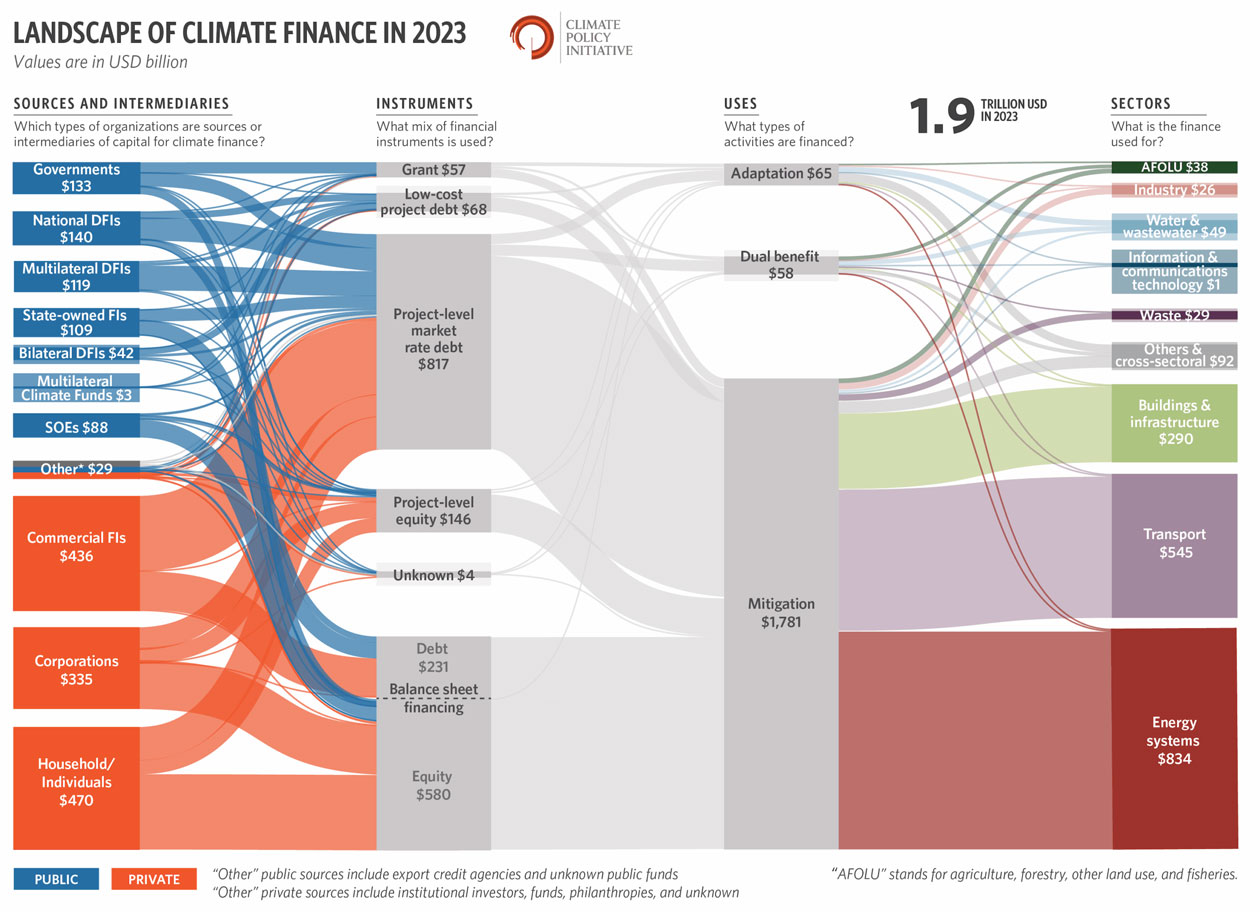
There’s a lot of information and a lot of jargon* in this graph. For the purposes of this article, I want to draw your attention to the left hand side at the bottom, and highlight this fact: the biggest source of climate finance is households and individuals.
Collectively, ordinary private citizens across the world contributed $470 billion in 2023, spending on things like energy efficiency, solar panels or electric vehicles. This is considerably more than the $335 billion from corporations, and over three times more than the climate finance from governments. Only the banks – listed as ‘commercial FIs’ on the chart – come close with their $436 billion.
What does this tell us?
First, it’s a reminder that our own money matters. The funding we put towards retrofitting our homes or changing the way we travel is counted as climate finance and is the biggest driver of change. We are far from insignificant.
Second, this graph suggests that some other sectors aren’t pulling their weight. Is it right and fair that households are contributing the most? Perhaps not, if we want to see those most responsible for the crisis paying the most to remedy it. In which case, we need more from corporations please. More from the banks who funded the rise in fossil fuels in the first place, and continue to profit from their extraction.
Third, and more positively, the fact that households are able to participate in climate finance to such a degree tells us that climate solutions are being democratized. Households can’t build nuclear power stations or high speed rail. But more and more people can install solar panels. The rise of plug-in solar in Germany, or small rooftop systems in Pakistan, shows how solar isn’t a middle class luxury any more. It’s affordable and practical, and 21% of the climate finance from households is going towards small scale solar.
Likewise, e-bikes and low cost Chinese electric cars have made cleaner vehicles accessible to more and more people. Household spending on battery electric vehicles was $180 billion in 2023. While Western Europe dominated climate finance from households in the past, a growing percentage is coming from middle-income countries.
There’s a lot I could dive into in the finance report, including the gap between what is needed and what is currently available. But I had underestimated the role of ordinary households. That’s the bit I want to emphasize, because unless you’re reading this from the halls of power somewhere, it’s where you and I come in.
How we spend our money is a vote for the world we want to live in.
* FIs – Financial institutions, DFIs = Development Finance Institutions, SOEs = State owned enterprises.
 The Earthbound Report