
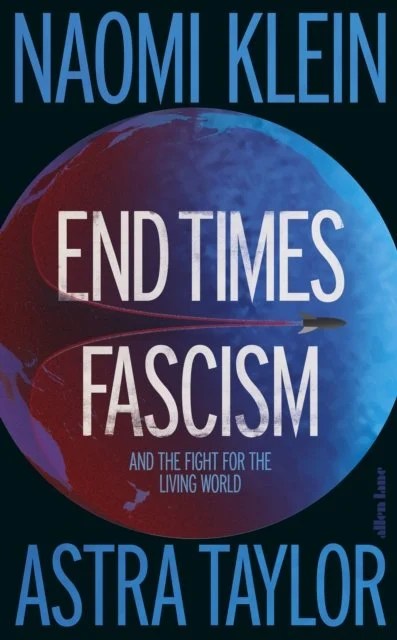
End Times Fascism deserves some kind of award for the most depressing book title of the year. I’ll admit that my first reaction was ‘pass’, but I read a truly eye-watering book earlier this year called Promise me You’ll Shoot Yourself. Written by historian Florian Huber, it is compiled almost entirely from diary entries by ordinary Germans as the reality of the Nazi project dawns on them. If there’s one lesson to draw from that era it’s that you don’t look away when fascism is on the rise.
A lot of commentators have tied themselves in knots over the idea of fascism. In some circles it’s worse to imply someone is a fascist than to actually be fascist. Klein and Taylor helpfully reset the conversation by framing it as a recurring response to crisis. It’s not something we ‘go back to’, but a phenomenon that spirals through history. It re-emerges in different forms and it doesn’t look the same each time.
“If we are waiting for soldiers goose-stepping in formation, we’ll miss the venture capitalists and their automonous weapons. If we are looking for yellow stars, we’ll miss the facial-recognition databases and the algorithmic threat ratings.”
In a helpful re-framing, they argue that revolutions are an uprising of the weak, who hope to transform society. Fascism is the revolt of the strong. Their aim is not to transform but to defend – whether that is nation, family, religion, or existing wealth and power structures. They weaponise existing discontent, create alliances around it and turn it against a scapegoat.
This is a fabulous distraction technique for capitalists. People feel disenfranchised and excluded, but with the right story that anger and resentment can be directed downwards. The problem is not the billionaires but the immigrants and the Muslims, the trans folk, the weak, the woke and the empathetic.
Our present version of fascism, the book suggests, is an alliance between religious, tech and nationalist interests, and “every part of its machinery is built for profit.” While the people driving it aren’t more dangerous than some historical figures we could name, the world itself is a more dangerous place. It’s a world with nuclear weapons, with AI, with gigantic inequality, and in the throes of an ecological crisis that can only be solved with global cooperation.
To make matters worse, there are people who have not just given up on fixing this world, but want to accelerate its end.
There is a strand of Christian theology that teaches that Jesus will return to earth in an apocalytic reckoning. For those that hold this view literally, news of violence and catastrophe can be interpreted as evidence of the end times. It’s a small step to move from mourning disaster to celebrating it as prophecy fulfilled. Another small step, and you can argue for instigating the war and disaster that will precipitate the messianic age. As the book demonstrates, there are people in the highest offices of the White House and the Pentagon who make this argument. See also Israel, where Netanyahu’s campaign against Gaza is officially called ‘The War of Redemption’ and which uses an AI targetting system called ‘The Gospel’.
There is no reason to work for peace if the better world lies on the other side of Armaggedon, and religious extremists aren’t the only ones pursuing that logic. The tech industry believes a version of this too. Sometimes the alliance is direct. Peter Thiel – founder of Palantir, AI partner to the Israeli military – gives lectures on the end times and says Greta Thunberg represents the antichrist. This would be hilarious if it weren’t exactly the kind of sleight of hand redirection we should be looking out for.
As Klein and Taylor describe, there’s a strong messianic streak to the tech industry’s AI fervour, which has “more in common with an ecstatic religious faith than with recognisable corporate projections based on science, engineering or markets.” Some openly describe the creation of super-intelligence as summoning a digital god. This god will usher in a new age of abundance, which may well lie on the other side of chaos and destruction. Just as the faithful are raptured from the apocalypse, the elites will ride out the destruction on private islands, luxury bunkers, floating cities or offworld space colonies.
For us mortals, largely disposable in this vision of the future, a natural reaction is to defend what we’ve got. The result is a rising nationalism, militarised borders, and culture wars against minorities of all kinds.
It’s not the only response, and the book closes with an alternative vision of the future. Fascism may spiral through history, but so do movements towards justice and cooperation. The people of Minnesota pushed back against fascist forces on their streets, showing us that solidarity and resistance is possible. A kind and inclusive politics isn’t naive and doomed to fail, as Zohran Mamdani demonstrated in New York, and Hannah Spencer showed us in Manchester. The story told here is “not one of end times, but of better times; not of separation and supremacy, but of interdependence and belonging; not of escaping, but staying put and staying faithful to the troubled earthly reality in which we are enmeshed.”
Where others see an escape to a technological or religious paradise, we can practice a politics of ‘hereness’, which has just as much a claim to the future. In a pleasing echo of this website’s title, they close with an appeal to a “proudly earthbound” politics – let us live on earth as if we mean to stay.

