“We should not construct new buildings from scratch,” says the first line of Aaron Betsky’s Don’t Build, Rebuild. He’s an experienced architecture critic from the Netherlands who has spent his career travelling the world and studying buildings. The ones he is drawn to today represent an architecture that “does not impose itself on the land as new but that reveals, opens, and reuses the world we have inherited in an imaginative manner.”
There are two good reasons for reusing buildings. The first is that construction has an enormous environmental impact. In an age of climate change, we need to keep emissions in check and should think twice about the carbon footprint of new steel and poured concrete. The second reason is that new buildings are always commissioned by those that can afford them, which means the towns and cities we live in are shaped by the richest. Opening up the spaces we already have can create places that are more welcoming, and where everyone can belong.
Betsky’s not an absolutist about this and new things will continue to be made, but it doesn’t need to be the default. Neither does it mean a slavish commitment to keeping everything the same, and he teases out the differences between preservation, renovation and reuse. The architecture profession has nothing to fear from a world that prioritises reuse: as the book goes on to show, there are endless possibilities for creative expression and imaginative ideas within a reuse context.
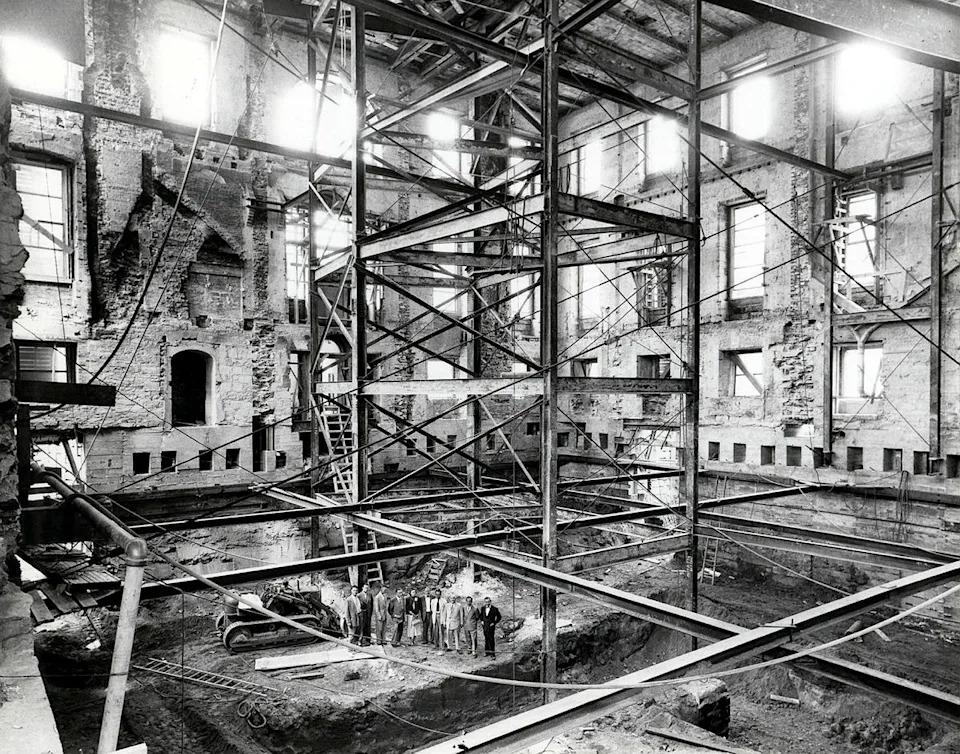
Besides, it’s nothing new. A brief history chapter looks at how people have always broken down and reassembled what they found around them, such as the Roman columns reused in Italian buildings. I was reminded of St Albans Abbey in my hometown, built out of stone harvested from the ruins of the Roman city of Verulamium. Even well known buildings may in fact be reused. This photo of the inside of the White House in 1952 shows that what stands today is an entirely different building inside that iconic facade.
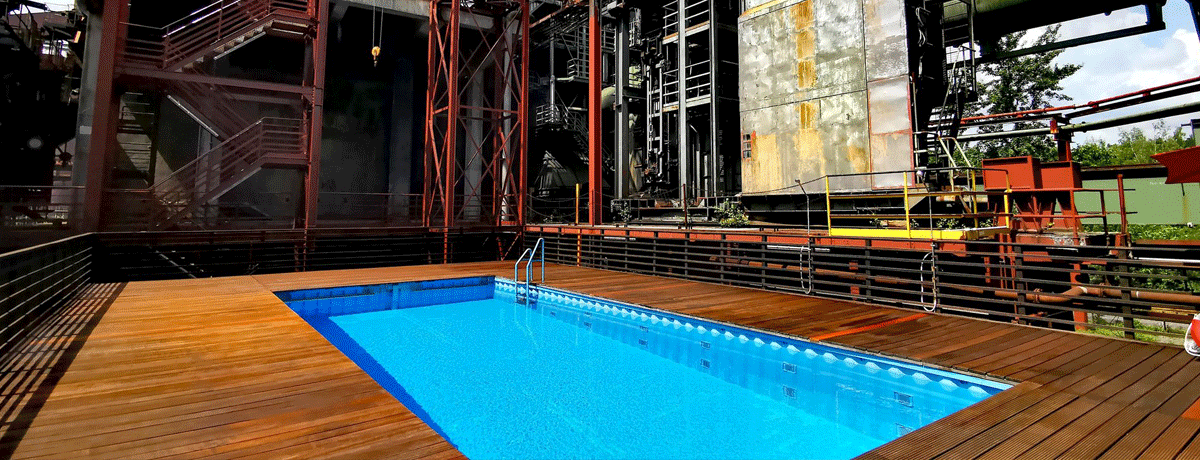
That photo isn’t in the book, and it’s one of a great many things I looked up for myself along the way (see last week’s post on BlueCity for another). The book is packed with fascinating examples of warehouses and factories, workshops and railyards repurposed for housing or community centres. Some of them are high profile, such as the Tate Modern gallery in London, installed inside the shell of a power station. New York’s High Line linear park features, and the Shougang steel mill that served as the backdrop for the 2022 Winter Olympics. Others were new to me, like the public swimming pool in an old coking plant in Zollverein, Germany.
There’s room for more informal aspects of reuse as well, including squatting, with a section on Christiana in Copenhagen or DIY reuse projects in Manchester. Betsky writes about ‘dumpster diving’ and bricolage approaches with their cobbled together aesthetics, “architecture as hunting and gathering”. It doesn’t need to be permanent either, and a chapter on ‘ephemeral architecture’ investigates Burning Man and other festivals. Most impressive of these is Kumbh Mela, the Hindu festival that is held every 12 years and requires a temporary megacity on the banks of the Ganges. 660 million people attended over the month-long event in 2025, the busiest day peaking at 76 million people on site and earning it the distinction of the biggest gathering of human beings in history. Yes, I had to put the book down and read about that as well.
Reuse can be done at landscape scale and not just buildings, and I particularly enjoyed this chapter as it covered parks made out of highways, flyovers and railway lines, something I’ve written about before as an excellent way to create more inclusive and human-centric cities. It also covered ‘daylighting’ buried rivers, something we know about here in Luton, and Yu Kongjian‘s sponge parks, of which I am a big fan.
How do we shift towards this circular economy vision for buildings? Betsky wants to see reuse taught in architecture schools, resisting the siren call of monument building. The construction industry needs to evolve a complementary twin in the form of a deconstruction industry. Demolition is cheap and create huge quantities of useless waste. Deconstructing buildings is slower and more expensive, but saves materials for incorporating into new projects. The more buildings are built with dismantling in mind, the easier it will be for future generations, with buildings become material banks for reuse.
That’s a hopeful thought, pointing us towards an architecture that is forward looking while honouring the past. As Betsky says, “keeping a building is an act of optimism.”
- Don’t Build, Rebuild is available from Earthbound Books

