A few years ago there was a flurry of internet hype about solar roadways – imagine a world where roads generated power for the streetlights! Or where solar-powered LEDs along the road replaced the white painted lines for no good reason! A lot of money was spent on this across various projects, the biggest being in France, where engineering firm Colas did actually build the first solar road with stick-on panels.
That was a decade ago. I don’t need to tell you what happened next. Perhaps it’s enough just to guess how long it took before that first solar road was quietly removed, the press and the transport minister nowhere to be seen. Across the Atlantic, the entrepreneurs behind the original viral crowdfunder are still going, but their latest update showcases their product as a solar playground for schools. They got there in the end – durable ground-level solar is a great idea as long as you don’t insist on driving trucks over it.
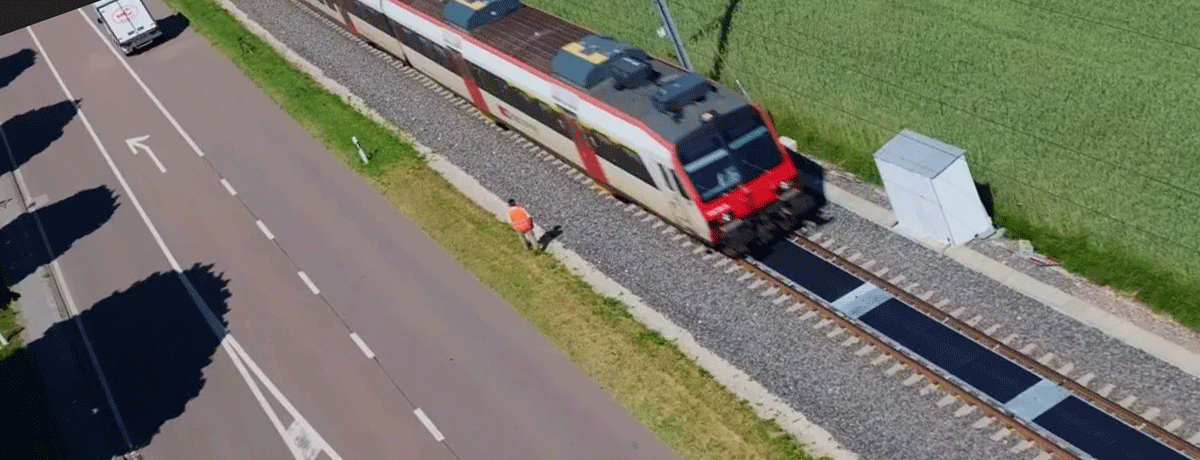
This came to mind when reading about Sun-Ways, a Swiss start-up that puts solar panels on railway lines. These go in-between the rails, so there are no wheels going over them. There is a lot of vibration though, and a lot of dust. And you have to remove them every time you do routine maintenance on the line. So why bother?
Sun-ways have a couple of main arguments. The first is that if we want a rapid expansion of clean energy, we need places to put solar panels. Often they get put in fields, potentially (and unnecessarily) competing with agricultural production. You can put them on roofs, but that’s thousands of individual bespoke installations, making it slow and expensive. The space between rails is wasted space, and there’s a lot of it. It has one owner to negotiate with: if the railway company wants to do it, you can unlock a lot of land for solar all in one go.
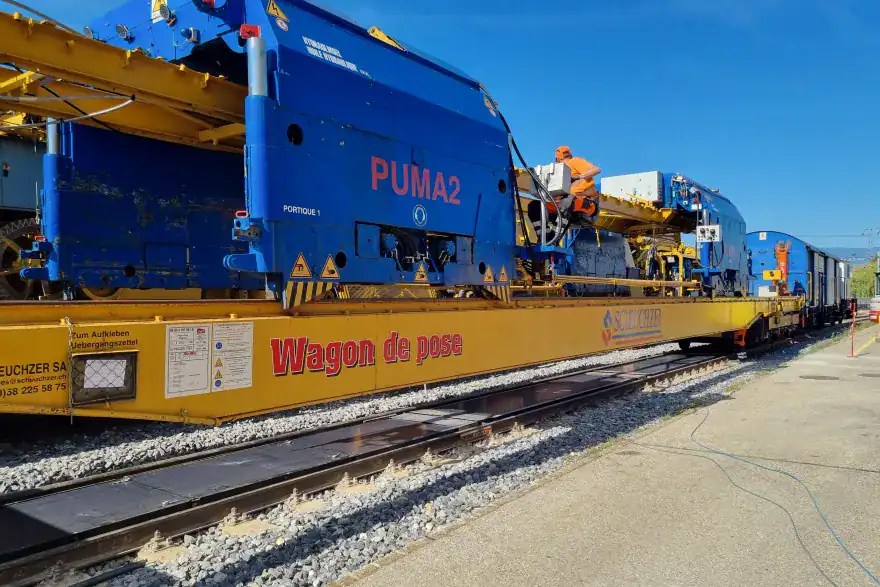
Second, it’s really quick to install. They’ve designed an automated installation rig that can be pulled by a train, based on existing track-laying machines. It can install a kilometer of panels in a day, and the same machine can lift them again for maintenance. It’s like a rolling production line for installing solar, making it so much cheaper to install than a rooftop with all its scaffolding and ladders.
Other benefits include the fact that they’re practically invisible, tucked away into existing infrastructure. You can also use them to power the trains themselves – an idea pioneered by Riding Sunbeams.
Like the solar roads, there’s a lot of interest in between-the-rails solar. The pilot project in Switzerland will be followed by a bigger stretch of track in South Korea. Japan is interested, along with China, Spain, France and Canada. A separate project is running in India, which is always doing interesting things with trains.
Also like solar roads, there’s a better solution in plain sight if you scoot the whole thing sideways by a few feet. Solar roads are a silly idea – but solar pavements or town squares would be great, and those more sensible applications got buried in the hype and the failure. Similarly, why focus on that slim line of panels between the rails when there are railway embankments that could accommodate far more panels? They could be angled correctly, as flat to the ground isn’t optimal. They wouldn’t need to be removed for maintenance. They’d be cheaper, because they won’t need the vibration mats and heavy frames to cope with trains passing above them. And you can still install them from a rolling flatcar, just one with a crane.
I’m happy to be proved wrong on this and find solar railways everywhere in a few years’ time. What we don’t want to do is try this and fail, and then never get round to the more obvious way to do it. Just as there are better ways to make a solar road, there are almost certainly better ways to make solar railways than lay panels on the tracks.
So should we put solar panels on railway tracks? Sure, though we should be alert to the way that consumer capitalism idolises innovation over proven solutions. Imagine we had two million dollars, and we spent half on panels between the tracks, and half on panels next to the tracks. In five years’ time, my money would be on the trackside panels as the ones that generated more energy, saved more money and worked out better.

