
I’m doing a lot of work on overheating at the moment, and have been visiting schools to help them understand why their buildings get too hot in the summer and what they can do about it. One of the solutions that keeps coming up is painting roofs white. It’s well documented that white roofs reflect away more heat, keeping temperatures lower on the roof itself and inside the building.
I always mention this as an idea, and I always follow it up with the caveat that I don’t know any school that’s done it yet in the UK. Maybe that’s because it’s a bad idea. Or maybe they can be first with something that’s about to catch on.
Reflective white buildings are of course very normal in many places. Compare this Google Earth image of central Athens, Greece, to a similar roofscape from London, England.

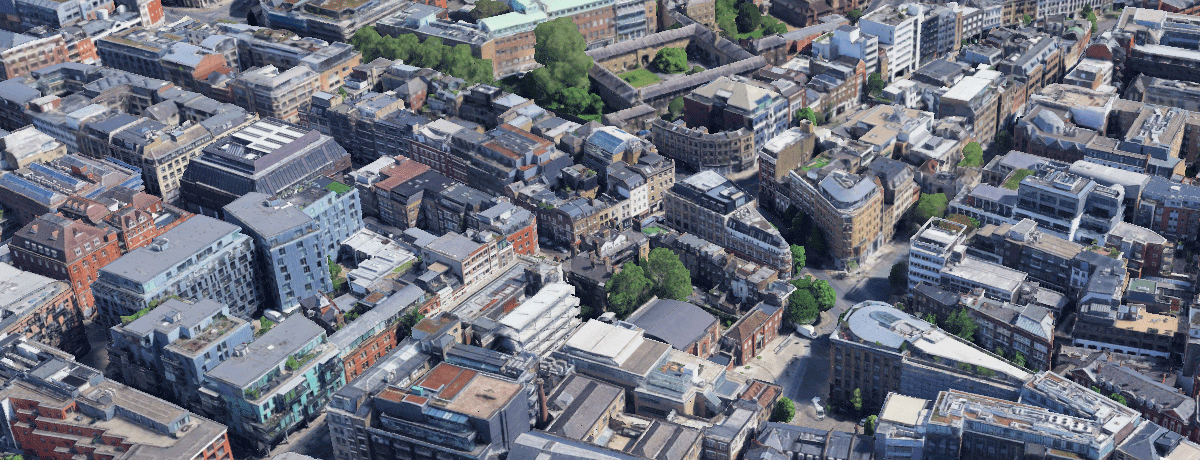
In Athens most roofs and walls are white and you can pick out the ones that aren’t. London is the other way round, with a much greater mix of colours and surfaces, and a handful of lighter roofs here and there.
Places have their own architectural traditions, and these respond to weather and climate, so we expect these kinds of differences. Average temperatures in Athens run several degrees higher. Like most places where roofs are usually white, it’s hotter all year round and drier. London is built to withstand rain and low winter light.
The trouble comes when climate patterns change and architecture doesn’t, leaving us with cities that were built for cooler times. With the UK experiencing temperatures over 40C for the first time recently, and the hottest summer on record this year, it’s clear that our buildings weren’t designed for these extremes. There are lots of adaptations we should consider, but among the cheapest and easiest would be to start painting roofs white.
One place we could learn from here is New York City, which has run the NYC Coolroofs programme since 2009. Initially operating with volunteers, it now offers work placements as well, and paints a million square feet a year. Roofs are painted for free for schools and community facilities, and at low cost for everyone else.
Nearer to home, Cool Roofs France has been championing the solution since 2015. One of their early experiments was a school roof in Paris that was painted white across half of it, so that temperatures could be compared in the two classrooms below. The classroom with the white roof was on average 2.5C cooler throughout the summer, with the biggest difference recorded at 4.8C on a particularly hot day. Cool Roofs France has its own range of paints, network of contractors and advocacy for adaptation, and they calculate that they have saved over 5 million Euros in air conditioning costs.
Perhaps it’s time for something similar in the UK.
We can start with schools. As I’ve written about before, most of Britain’s schools were built in the 60s and 70s with a modular steel frame system that hasn’t aged very well. They come with flat black roofs and poor levels of insulation under them. Summer overheating is reaching chronic levels, and while there’s no central government funding for adaptation yet, everyone can afford a few buckets of white paint.
Any downsides to consider? The same heat reflective properties will work against us in winter, reducing the free heat from the sun that we would have got from darker surfaces. Since Britain doesn’t get much sunshine in the depths of winter, the positive effect in summer will massively outweigh the negatives in winter.
There’s another positive to consider as well: because the roofs themselves are less hot, there is less expansion and contraction of materials. This, in theory at least, prolongs the life of a roof. Some white paints are also waterproof and could help prevent leaking – another chronic problem in British schools.
Like any climate solution, it needs to be done well. You need the right paint for the roof. Some are suitable for flat roofs and others aren’t. There are specialist paints for concrete, bitumen or metal roofs, and even for painting glass skylights to reduce heat while still letting in the light. Specialist paint suppliers such as Rawlins can advise on this.
It’s the wrong time of year for this now, but come the spring, I think it’s time to start painting some roofs white. I’ll start with the black roof above my office, so I’m not recommending anything I wouldn’t do myself. I’ll let you know how it goes.


Hi thanks for this post.
I think one of the main reasons for not painting roofs white in the UK is that the roof surfaces are not suitable for painting – paint systems for masonry (clay tile or concrete) only last a few years, peel away easily (especially when exposed to rain, which they will be frequently), and the peeled paint chips enter the stormwater runoff which could be causing more environmental damage than the heating effect, not to mention the embodied carbon of paints, and the environmental impact of any leftover paint at the end of the painting process. Other roofing materials effectively can’t be painted at all – they come as a finished waterproofing layer, and painting them might risk trapping moisture, degrading the roofing material and lowering its life.
Therefore while I think there are probably situations where painting roofs white is the answer, I think there’s probably more potential to be asking questions around this such as: when reroofing existing buildings, could this be done using a lighter colour material? and Should our planning system be more open to lighter coloured roofs in locations where this might not have previously been acceptable, like conservation areas (of which there are many in London)?