
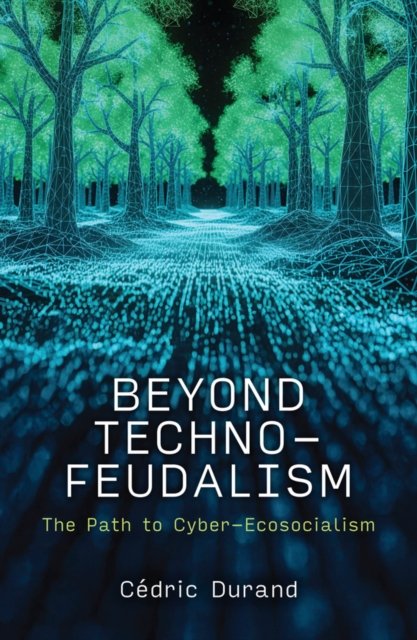
Cédric Durant is a French economist with a special interest in digital capitalism. He was invited to present a series of lectures for the thinktank La Boétie Institute, and those have been expanded into this short book, Beyond Techno-Feudalism: The Path to Cyber-Ecosocialism.
Before we get to any beyonds, a word on ‘techno feudalism’. You may have encountered the term. It’s been kicking around in peer-to-peer theories of the internet for a while, and was popularised by Yanis Varoufakis more recently in his book on the subject. The central idea is that what is unfolding in the world of the big tech companies is not a healthy competition between dynamic free market actors innovating their way to greatness. It’s more like a digital landgrab, an enclosure of data and information that hands control to the likes of Amazon, Google and the other tech giants.
As Cory Doctorow’s book Enshittification describes very well, Amazon has built a system with such huge monopoly power that every online retailer has to play by their rules. Google controls search and advertising. Apple dictates terms for software developers through its app store. And so on, with the threat of far worse to come as AI reshapes the way we earn and spend.
The control that big corporations have over our lives is less like capitalism and more like feudalism. The lords of old owned all the land, and made the peasant class subservient through their inability to relocate. The digital lords own all the data, monopolising the software and systems that we are increasingly dependent on.
I’ve written about this before from a personal point of view. Google’s AI search has taken the wordcount of this website and serves it to readers without sending them to me, which I guess is a digital version of the local landowner turning up on his horse and claiming my wheat harvest. Less traumatic no doubt, but still enough to plant seditious thoughts.
Anyway, events are moving fast and there is a limited window to do anything about this, argues Cédric Durant. Several big companies have floated the idea of launching their own currencies, which Durant suggests would dramatically reduce political elbow room for government and society. That’s the point at which control may slip away entirely, with corporations having a bigger influence on our life and work than governments currently do.
It doesn’t have to be that way, and there is an alternative if we choose to take it: a technological revolution that is emancipatory and ecological, engineered for environmental and social goals rather than public profit. That’s what he calls cyber-ecosocialism.
Socialism is often associated with low-tech, perhaps a hangover from the clunky technologies found behind the iron curtain, perhaps because of the crossover between socialism and simple living environmentalism. It doesn’t need to be, and a passing familiarity with the history of sci-fi will tell you that the Soviets dreamed of high tech futures too. Durant suggests that we shoudn’t turn away from powerful technologies such as AI, but that we should use them more strategically so that they serve everyone.
That means planning: “set a goal, and then organise the means to achieve it”. That shouldn’t be controversial, especially if the status quo is to let rich people throw money at big corporations fighting each other for dominance. That’s a wasteful and destructive way to go about things, and we can do better.
The last sections of the book get into defending the idea of techno-feudalism, and we don’t get much detail on what a cyber-ecosocialist future might look like. And as is often the case, there’s a branding problem. If you were to ask people if they wanted cyber-socialism, a lot of people would hesitate. If you asked if they wanted digital technology that serves everybody, rather than just the rich, they’d like the sound of it. So I’m not sold on the name, but it’s very obviously a stupid idea to leave trillionaire fascists in charge of developing the world’s most powerful technologies. If we’re going to have AI, it needs to work for all of us, and I hope it’s not too late.
- Beyond Techno-feudalism is available from Earthbound Books

