One of the books that shaped my outlook on the energy transition was Chris Goodall’s The Switch. It’s central argument is that the economics of renewable energy had shifted, and solar power would be the cheapest and most obvious power source for most of the world. Gradually, and then faster, it would displace coal as the cheapest form of electricity. Minus the far north and its gloomy winters, most of the world would eventually be solar powered.
That felt like a stretch of the imagination ten years ago, and it now looks more likely – enough for the noted pessimist Bill McKibben to have written his latest book in praise of solar. “For the first time, he writes, “I can see a path forward. A path lit by the sun.”
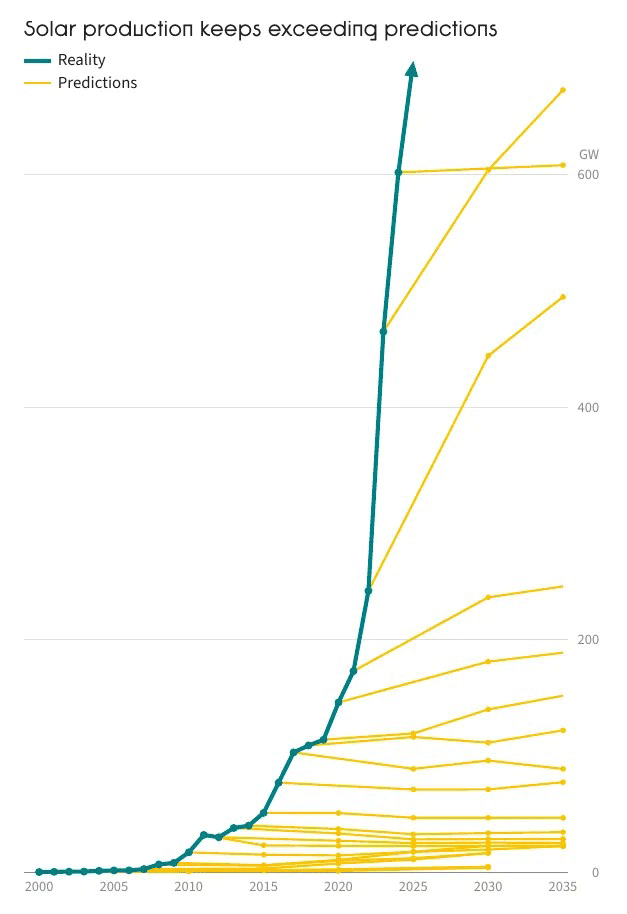
Auke Hoekstra is another energy commentator who spotted the potential of solar power before everyone else. For years he has been updating this graph, which shows the growth of solar production against the predictions of the International Energy Agency.
It was quite funny for a while to see how hopeless the agency was at predicting the future. Then it became more concerning, and began to look like they were talking solar down for other reasons. They finally began to catch on from around 2020, finally upping their projections in the direction of reality, but the deployment of new solar has still run well ahead of their expectations.
What does this look like in practice? It looks like the explosion of solar ownership in the form of plug-in solar in places like Germany or the United States. It looks like the boom in Pakistan, where people have protected themselves from an unreliable national grid by fitting solar. We could see what’s happening in Bangladesh, where millions of households have got electricity for the first time in the form of a small solar array. Or Nigeria, where solar panels are apparently a popular wedding gift as couples marry and start a home together.
Yes, there are plenty of vast fields full of solar panels as well, where it is being pursued at grid level. But what’s interesting is that the shift towards solar is something we can all participate in. It’s not something that relies on vast capital, on governments doing it for us. Solar is advancing at the macro and the micro level, changing grid infrastructure at the top and an empowering consumer choice for individual households at the bottom.
That means there’s a shift in political and economic power moving hand in hand with the change in technology. The power of the fossil fuel companies and their investors will erode. The importance of companies with large reserves of oil and gas will ebb. Power will shift downwards, decentralising and democratising.
Before we get carried away, it’s important to remember that solar power is a small part of a global energy system that is still massively dependent on fossil fuels. If we look at primary energy consumption, solar has a long way to go before it breaks into double figures. At the global level, renewable energy is still being layered on top of fossil fuel consumption and isn’t yet displacing coal and oil use.
As always however, the raw figures show us a point in time. The trend is where the story is, and the story is of rapid increase from a very low base. Solar is now growing exponentially, doubling in size every two to three years. If you understand the mathematics of exponential growth, then you will know where things are going. As The Economist spelled it out a couple of years ago: “Solar cells will in all likelihood be the single biggest source of electrical power on the planet by the mid 2030s. By the 2040s they may be the largest source not just of electricity but of all energy.”
The IEA have been providing a twenty year case study in underestimating solar power, but it is changing the world. Slowly, quicker, and then suddenly all at once.

