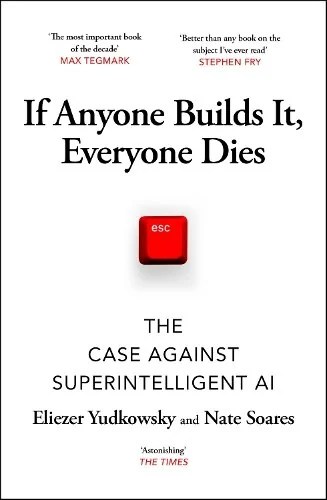
I’ve been doing a lot of reading about AI this year, both positive and negative takes on our current moment. I have a short list of books I still want to get to, and here’s a book that wasn’t on it: If Anyone Builds it, Everyone Dies – the Case Against Superintelligent AI, by Eliezer Yudkowsky and Nate Soares.
That’s such a hyperbolic title that it immediately ruled it out as far as I was concerned. I was sent a free copy and didn’t read it, but I keep seeing it mentioned. It has good reviews. People I respect think it’s worth reading. So I read it.
The authors are the founders of the Machine Intelligence Research Institute, and they’ve gone from working to develop AI to working against it. That’s given them a degree of influence in the sector, hence the regular citing of the book.
Their central argument is that machine intelligence is not designed or crafted. It is grown, and the book explains machine learning in ways I hadn’t entirely grasped. The competence of AI is stumbled upon through repetition at an unfathomable scale. That means that the engineers designing AI don’t exactly know how AI gets to its conclusions. The process of producing artificial minds makes them intrinsically unknowable.
If they are unknowable, then we can’t know what they want and we certainly can’t expect to control them. It is impossible to shape the behaviour of something we don’t understand, the book suggests, despite the industry’s many claims to the contrary. That’s already creating real world problems with the less powerful learning models we have at the moment, with plenty of examples of unexpected reasoning, false incentives and unintended consequences. AI models have also proven themselves capable of deception, cheating, and escaping. It will be inifintely worse with a self-improving superintelligence. You know, the kind all the tech companies are racing to produce first, and the reason why investors threw a trillion dollars at Anthropic last week.
We cannot hope to control a superintelligent AI, and it won’t be predisposed to do our bidding, say Yudkowsky and Soares. Humanity would be at best an irrelevance to the machine God, at worst a threat to its plans that must be eliminated. In fact, as the book makes plain in its title, the authors are convinced that it would destroy us all and they repeat this point throughout. It doesn’t matter if it’s a tech corporation or a government, whether they’re broadly responsible or not. “If anyone anywhere builds superintelligence, everyone everywhere dies.”
Why are they so sure that everyone everywhere dies? Because the superintelligence will want the earth for itself, and it is not in its interests to keep pesky humans about with their nuclear weapons and their itchy fingers. They would consume all the world’s resources, and destroy humanity either purposefully or by appropriating the things we need, like all the water and the air.
Does this follow? Maximising consumption might be the default setting of American capitalism, but would a superintelligence so obviously share that drive? This is where I got frustrated with the book and its cocksure confidence in the inevitability of the AI apocalypse. It’s a point of pride to the authors that they haven’t “taken refuge in ‘maybe’ and ‘risk’ and ‘possibly'”. Away with the cowardice of nuance, balance and the possibility of being wrong!
If superintelligent AI is ever created, everyone everywhere will die. Therefore it must be stopped, although their confidence mysteriously evaporates when it comes to useful suggestions for how AI research might be curtailed.
The logic may fall down in my opinion, but the book itself clips along at a brisk pace. Each chapter opens with a fable or an anecdote to illustrate the point. It’s engaging and entertaining. There are useful explanations and parallels, such as a section comparing the launch of a superintelligent AI to space technology, because you only get one chance to get it right and you can’t fix it later. Less successfully, another section compares AI engineering to alchemy, but it’s thought-provoking.
Is it ultimately useful? Harder to say. There are many compelling reasons to move slower on AI. That’s a difficult political conversation as it is, without people throwing down universal annihilation as some kind of intellectual trump card. People are already scared by AI and the changes they see coming. There are very reasonable things to be concerned about, and the conversation is already tilted to the extremes. Books like this one are polarising and don’t encourage informed debate.
If there’s a reason to read it, it’s that opinions on AI are a spectrum. If Anyone Builds it, Everyone Dies is useful for understanding one end of it. Just don’t make it the only book you read on the topic – and with that in mind I’ve drawn up a list of books on AI that offer a diversity of views. I’m working my way through them myself, and if you have any particular recommendations, let me know.
- If Anyone Builds it, Everyone Dies is available from Earthbound Books


A very helpful post, Jeremy. On AI – a reasoned and careful book is Moral AI and How We Get There: https://www.penguin.co.uk/books/317706/moral-ai-by-conitzer-jana-schaich-borg-walter-sinnott-armstrong-and-vincent/9780241454756 See also this interview: https://closertotruth.com/video/is-ai-control-impossible-roman-yampolskiy/