I was looking on world mapper and found some interesting things.
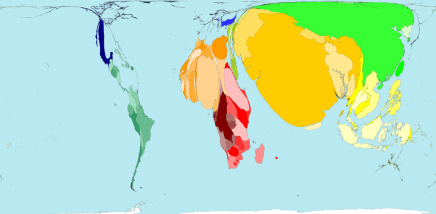
The map above shows the countries size according to the number of people living below the poverty line. The fatter the country. . . poorer it is.
Absolute poverty is defined as living on the equivalent of US$2 a day or less. In 2002, 43% of the world population lived on this little. This money has to cover the basics of food, shelter and water. Medicines, new clothing, and school books would not be on the priority list.
When almost an entire population lives on this little, it is unsurprising if undernourishment is high, education levels are low, and life expectancy short. In both Nigeria and Mali, 9 of every ten people survives on less than US$2 a day.
South America has a relatively small poor population, yet 39 million people have less than US$2 a day in Brazil.
The next map shows the complete opposite of the previous one. In this case, the fatter the country, the richer it is. Territory size shows the proportion of worldwide wealth found there when GDP is adjusted for local purchasing power. (Just have a look at Africa)
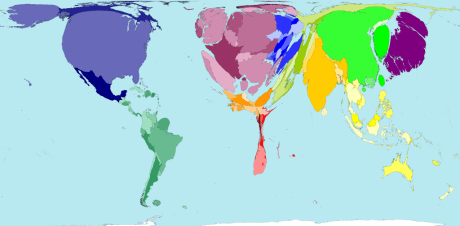
Purchasing power is a measure of what can be bought in the territory in which that money is earned. It is cheaper to live in some places than others.
Taking differences in local costs into consideration, this map shows that 46% of world wealth adjusted for purchasing power is in North America and Western Europe. The regions with the most purchasing power per person are North America, Japan and Western Europe. Despite the lower prices found in Central Africa, the people living there still have the lowest purchasing power. The proportion of world wealth found in Central Africa is greater when measured in purchasing power than when measured using exchange rates.
—————————-
Just some maps to put the distribution of the planet’s money into perspective.
 The Earthbound Report