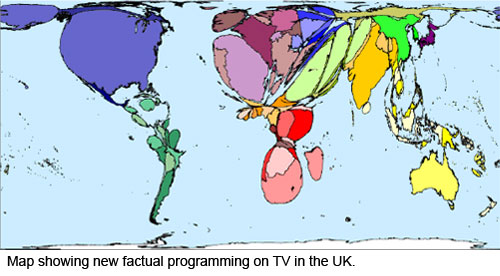
We all know that what we see on television is hardly representative of the real world, but even factual TV leaves a lot to be desired in its choice of subjects. A recent report (pdf) analysed all the hours of factual television on British TV in 2007 (documentaries, travel, wildlife, and so on) and plotted them on a map where the size of the country shows the amount of coverage. This is what you get:
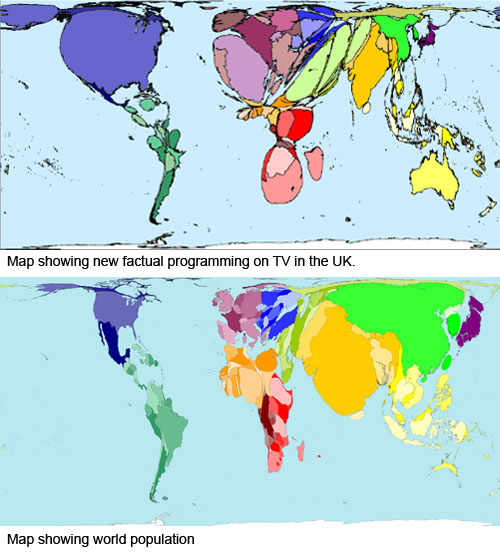 As this is international coverage, the UK has been left off the first map. One of the first thing you notice is the size of the US: even when you leave out Hollywood movies and American dramas, the US dominates out TV coverage. So too does Europe, especially Ireland and Spain – must be all those property programmes about second homes in the Spanish sun.
Obviously coverage on TV will reflect our various political and cultural alliances, and our interests as a nation. That’s to be expected. It’s when you compare this view of the world with the world population that you begin to see the problems.
Look at the way China is represented on TV, and their actual importance in the world. These are figures from 2007, and no doubt the Olympics will fix that for 2008, hopefully for good.
Likewise India has far less coverage than it deserves. South America is under-represented on TV, Brazil and Mexico in particular. The Middle East, unsurprisingly, is dominated by Iraq and Afghanistan. Australia receives far more coverage than its population size warrants.
Something rather interesting is happening in Africa, where most of the continent is non-existent, but South Africa, Zimbabwe, Kenya, Uganda and Madagascar all feature fairly large. Why? Because most factual coverage of Africa is nature documentaries, that’s where you’d film them. As someone who keeps a close eye on Madagascar, it’s nice to see them appear so big on the map here, but this is only because of the lemurs. I can count the number of non-wildlife related items I’ve seen on TV on the fingers of one hand – the chef Keith Floyd talking about Malagasy cuisine, a cyclone, and a totally inaccurate BBC news report on some political trouble a few years ago.
Our television has an obvious bias towards the West, while human population is actually largest in the East. What we see on TV gives us a false view of ourselves and exaggerates our importance.
It wasn’t always this bad, according to a joint report from Oxfam, Polis and the International Broadcasting Trust, which came out last week. International coverage is in decline. As the major channels believe factual programmes about other countries don’t perform well in the ratings, and ratings are increasingly important with competition for advertising, they’ve been running fewer programmes. At the same time, the main broadcasters have launched extra digital channels in recent years. International material is now more likely to appear on, for example, BBC4 rather than BBC1.
A scan of the hours of factual programming confirms this, with BBC1,BBC2 and ITV showing fewer programmes about the developing world in 2oo7 than in previous years. ITV is the worst, showing just 5.1 hours of programming: “With the exception of news coverage” says author Phil Harding, “most of the world outside Britain has disappeared from one of the country’s most watched broadcasters.”
“Understanding the world and taking an active interest in it has never been more important to our political, cultural, econonic and environmental health” says the report, but we are in facing a ‘great global switch-off’ as international coverage disappears from our screens.
What can you do about it?
The report makes a number of recommendations, including making the BBC’s international news channel available in the UK, a more global role for BBC’s iPlayer, and measuring success with broader indices than viewer ratings.
- On an individual level, get in touch with the TV stations. If you see something you like on ITV3, write to them and suggest ITV1 viewers might like to see it. The BBC in particular make it easy to respond, and even have a weekly programme dedicated to viewer feedback. When you see something good, say so. The broadcasters, with no evidence either way, believe international documentaries are unpopular, but they’ll show more if they know we value them.
- You can also email the Secretary of State for culture, media and sport, Andy Burnham, through Oxfam’s website.
- Read the report, ‘The Great Global Switch-Off‘.


 The Earthbound Report
You said ‘South America is under-represented on TV, Brazil and Mexico in particular.’ but Mexico is geographically part of North American continent…
Indeed – apologies to Mexico!
I’m not from Mexico, but I thank you for apologies on Mexican behalf. 🙂