 On Tuesday, a group of European scientists made an announcement at the Wellcome centre in London: the first clinical trials have been approved for an HIV antibody produced by a genetically modified plant. The story was picked up by a few news outlets, but it’s a bad week for any kind of announcements and it hasn’t got the attention it deserves. As you may have noticed, the press is busy right now.
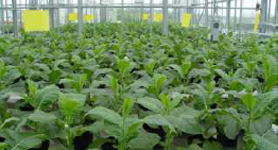
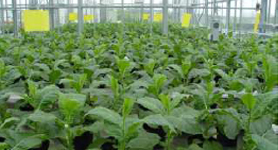
What the scientists have done is isolated an antiviral agent called P2G12. They have then transplanted this into a tobacco plant, and grown a crop of the GM modified plants in a greenhouse. The plants are then harvested and the leaves are shredded and processed to produce the antibodies.
Growing drugs through plants has huge advantages. It is between 10 and 100 times cheaper than the standard methods of creating HIV drugs. Making the tobacco variant in the first place is complicated, but once created, it’s a low tech solution. It’s a simple process and is endlessly transportable and scaleable. If the trials are successful, it could be highly significant for poorer countries. No need to import anti-HIV drugs at vast expense, or build expensive labs and factories. You’d just need some processing instructions and a packet of the seed.
This is the first trial in Europe of a GM-plant derived drug. It’s been a long time coming. Bio-engineered drugs are one of those things that have been predicted by promoters of GM for years. We haven’t seen them because all the things that make this such an exciting breakthrough are bad for business. Pharmaceutical companies aren’t interested in developing simple, scaleable technologies, as they’d never recoup their costs. Instead, this has been achieved through EU funding for a research consortium called Pharma-Planta.
I’ve written before about GM foods, and generally speaking I’m sceptical about biotech. Not because of the science, but because of the power it can hand to corporations, and because it is an unnecessarily complicated solution to what are often simple problems. When it is recommended as the solution to feeding Africa, for example, it is an overhasty conclusion. We should end subsidies in Western countries, provide better seed and discounted fertiliser, and share irrigation and rotation techniques. We should create local grain exchanges, better storage facilities, and micro-insurance schemes for farmers. We should guarantee a fair price and eliminate the speculation that destabilises world food prices. Let’s talk about those things, and then let’s see if there’s a role for GM.
As usual, the question with biotech and GM is ‘who does it serve?’ If it serves the corporations and their shareholders, let’s approach with caution. If it serves poor farmers and those who can’t afford HIV drugs, then I’m in favour. And those don’t have to be mutually exclusive either.
 The Earthbound Report
I am full of admiration for the series of articles on your website, with their carefully researched facts and balanced views on topics that should concern us all. As you suggest, the GM derived AIDS antibody story received little attention from the media and I am glad that you highlighted it here
It is with some difficulty that I am writing to disagree quite strongly with the views that you express on GM foods, as generally I find it hard to oppose the opinions that you express here. You say that one of the reasons for your dislike of GM foods is that it is dominated by large corporations. Is this not true of the great majority of foods, medicines, phones, movies, etc. that we consume every day? Surely it is capitalism, or at least its excesses, that you are against? Is it reasonable to oppose GM on this basis when the majority of products and services, both here and in the third world, are controlled in the same way. In any case, the vast majority of GM research is carried out in academia and not in biotech companies, although I accept that the implementation of successful research might well find its way into the hands of corporations.
You make your second point by knocking down a premise that I have never heard from any responsible scientist, namely that GM is “the solution to feeding Africa”. The world, as you point out to us regularly, is facing many potentially catastrophic problems, not least of which are overpopulation and climate change. In these circumstances, surely we need to have an open mind about any possible contribution to feeding our populations in a sustainable way. Whilst I am sympathetic to the solutions that you propose, some of them are a little fanciful in the world in which we now live (although I would prefer to live in your world), and the enormity of the problem is such that we do need to look at all ways of relieving it. If it is possible to modify crops to resist drought and pests, is this something that should be opposed because we don’t like the sort of companies that will inevitably try to gain control of their distribution, or because we feel we would rather talk about ending subsidies some time in the future? Time is of the essence in identifying all contributions that are available to resolve poverty and hunger.
We need a fairer and better world to end poverty and hunger, but please do not close your mind to any form of realistic and sustainable contribution that can be made whilst we wait for nirvana.
Sorry, I haven’t been clear enough there. I support GM technology for Africa where it is used well and alongside other measures, and there are some great projects and partnerships where this is happening. I should write about more of them.
What I object to is GM being used as a silver bullet, or when simpler, cheaper options are ignored. As a case in point – one frequently cited example of GM for the poor is ‘golden rice’. Many poor people can only afford the most basic diet of rice, and suffer from a Vitamin A deficiency. So golden rice was developed, as a strain of biofortified rice that contains Vitamin A. That’s great, except that was the problem the rice, or was the problem the diet? Surely it’s easier to help people to grow carrots and diversify their diets, than to spend millions developing a new strain of more nutritious rice.
I object to this because it’s a waste, but also because it presupposes a technological answer from a Western point of view. Did anyone ask those disadvantaged people what they wanted? If you had, I bet their complaint would have been that they couldn’t afford vegetables, not that rice wasn’t nutritious enough. Perhaps that’s why, ten years after it was developed, golden rice is yet to take off in any serious way.
The same problem applies to other technology-based development projects, such as ‘one laptop per child’. The aim here, much talked about on technology blogs, is to develop a laptop that is cheap enough to give one to every child in the developing world. Again, that’s great – but wouldn’t it be better to teach children to read first? And wouldn’t it be cheaper and simpler to do that with an old fashioned book?
Unfortunately, big claims for GM are commonplace. As one example, I got particularly wound up by this one from Sir David King a couple of years ago: “The problem is that the western world’s move toward organic farming – a lifestyle choice for a community with surplus food – and against agricultural technology in general and GM in particular, has been adopted across the whole of Africa, with the exception of South Africa, with devastating consequences.”
That’s utter nonsense – first that we’ve moved towards organic farming (3.9%) of the UK’s agriculture at the time King said that, and second that Africa has adopted organic farming to copy us. It has always farmed organically, and only does so today because the world has consistently failed to bring the green revolution to Africa.
When we finally do get the green revolution started in Africa however, GM will be part of it, no doubt about that.
Thanks for responding, and for confirming your support of GM when, as you say, it is used well. It would be great if you did write about some of the more successful projects from time to time, as your ability to influence the debate would be considerable in the context of the reservations you express on GM and your wide ranging ethical concerns.
I accept that not every GM project will be well directed or implemented, but this does not distinguish them from aid and support programmes in general. To paraphrase your argument very unfairly, I do not think the solution to African hunger is to convert the local population to a staple diet of carrots. I also think that I could have a reasonable stab at guessing what a starving, disadvantaged person might say if asked, although I take your point about consultation.
I think you are a little unfair on Sir David King, a man who had considerable influence on the government of the day in persuading it to take issues such as man made climate change and sustainability seriously, just as Sir John Beddington has influenced the current government. Although more limited in effect than I suspect either of us would like, the position would be very much worse without them. I agree that the quote is not King’s finest moment, but you do not give it a context. I do not know the quote but could he have been having a go at the growing use of land in Africa for the production of cash crops for profit in Europe?
I fully respect your views about technological solutions to African and other problems and agree that we should be cautious about them. It is, however, important that we should alleviate problems where we can, providing the application of technology is ethical and sustainable.
Keep up the good work. I don’t know where you find the time and energy but thank goodness that you do.