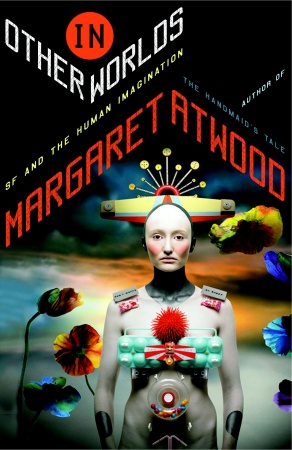
 This week I’ve been browsing a book my wife got me for Christmas, Margaret Atwood’s In other worlds: Science fiction and the human imagination. It’s a diverse collection of the novelist’s lectures and articles on SF, superheroes and mythology, but here’s a pertinent thought from the mix:
There are two kinds of ‘more’, says Atwood in the course of a discussion on transhumanism.
“The first is, of course, the echoing ‘more’ pronounced by Oliver Twist when he is being starved in a foundlings’ home by venal officials. That ‘more’ is the legitimate response to ‘not enough’. It’s the ‘more’ of real need…
The second ‘more’ is in the film Key Largo, in the remarkable exchange between the Humphrey Bogart character and the Edward G Robinson evil crook. The crook is asked what he wants, and he doesn’t know. Humphrey knows, however. ‘He wants more’, he says. And this is what the crook does want: more, and more than he can possibly use; or rather, more than he can appreciate, dedicated as he is to mere accumulation and mere power.”
When it is a response to scarcity, more is good and growth saves lives. It is when ‘more’ becomes an end in itself that it becomes a problem. That distinction is vital to the message of this blog, which can otherwise be misinterpreted as anti-progress or callous towards the poor.
Being wary of ‘more’ doesn’t mean we aspire to an equally abstract ‘less’. Between those two kinds of ‘more’ is ‘enough’, and that’s where we need to find our balance.
 The Earthbound Report
We see the insatiable quest for ‘more’ as being based in greed – and indeed sometimes it is. However, more commonly it is based in a false belief that the more ‘stuff’, ‘status’ etc we have the safer we’ll be. It’d be nice if that were true but it isn’t.
Once we reach the level of ‘enough’ we have to take our chances and no matter how much more we have past that level, our safety doesn’t increase. Perhaps if we squared up to that we’d feel less driven to want ‘more’ and less justified in looking for it?
I think that’s true, and the drive for more could be motivated by fear as much as greed – fear that our ‘enough’ isn’t quite ‘enough’ after all. Good point.
creatingreciprocity has voiced the very point I have frequently tried to express – that we do need to face up to the fear driven selfish side of human nature if we are ever to work on it. Perhaps it is not a viable proposition on a scale greater than anything more than personal recognition – there’s been goodness knows how many books on the subject! Those who do not recognise it will always want more, whatever their motivation. And when they get more they have the power to get even more and then almost inevitably get addicted – like the ‘power corrupts, absolute power, absolutely’.
Ps.
I find it very difficult to distinguish between more ‘as an end in itself’ and ‘profit’. Where does one begin and the other end? Help appreciated?
That is a good question about profit vs. ‘more’. I don’t think there is any real problem with profit per se, I think it depends on whether the profit is an outcome or an end. When it’s an end then everything is sacrificed to attain it – and that is seen as a legitimate goal as once again there is a belief that ‘more’ will confer security and safety (same hypothesis really!).
On the other hand, if it’s an outcome then it can be used productively as there is no fear around using it. One way or another it’s just ‘stuff’ (even money is ‘stuff’) – we need to control it and use it productively not fear it and let it lull us into a false sense of security. Then whether we have ‘enough’ or a ‘profit’ will be immaterial (no pun intended!).
Thank you ‘creatingreciprocity’ for your input. It goes without saying that money can be put to good use regardless of how or why it has been accumulated.
My point really is that Jeremy says ‘WHEN it (more) is a response to scarcity, more is good and growth saves lives. It is when ‘more’ becomes an end in itself that it becomes a problem’. So, I’m saying, WHEN do we see ‘more’ or ‘profit’ ever PRODUCED at it’s source (in principle) for scarcity of fundamental needs? We see it produced for motivations other than this ( these motivations are a seperate debate) and no amount of SOME of it being used for good purposes will ever justify the damage that PRODUCING it creates –
This ‘stuff’ is not as you say ‘just’ stuff. It is actually taken from the hand that feedeth – OUR earth. Then MOSTof the ‘gain’ from the earth is turned into the unecessary ‘benefits’ and relative ‘needs’ at all the levels of wealth, and for further insult on the earth MUCH of it is dumped onto our good earth which has no design for removing or replacing it by it’s natural cycle that we do indeed rely on. The more we continue, the deeper into the mire we go. The ‘goods’ we are reaping and the profit we are taking are in reality miles away from a healthy balance of the world’s books REGARDLESS of any amount of good that we do put so little of it to. We will thereby always be in the ‘red’ and, therefore, in our attempts to improve the problems, we only defer the outcome of not balancing the world books (isn’t this also seen in our governments?).
Hence, ‘more’, or ‘profit’ never gets justifed in principle. We can never justify it in its present form and it does not happen in principle in the form Jeremy justifies it on. Of course, we do not stop trying to improve matters but it will only be temporary UNLESS we can tackle the real cause behind all this desire for ‘growth’, ‘more’ and ‘profit’. We cannot do that until we acknowledge what the real cause is. It is indeed, fear over-riding integrity. We fail miserably at acknowledging this on a level that would be necessary. I do not see how this can ever be done except on a personal level, the best we can do is work on ourselves and work to encourage it in our systems. We do have systems which attempt to help us to do this, but they are much ignored simply because being human they do contain much error!
I won’t labour on any more. Talking with you and others has helped me to consolidate my own understanding. I hope it help others.