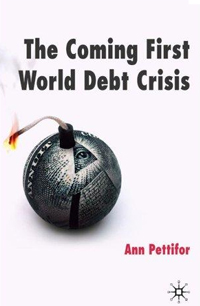
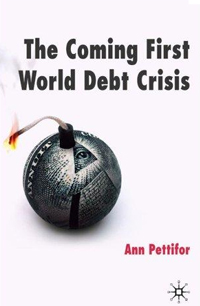
 In 2008, the Queen posed a question at the London School of Economics: how come nobody saw the economic crisis coming? She received a variety of answers, both on the day and at later discussions. No doubt economists take some comfort in debating that question, but the fact is that plenty of people saw the cliff the global economy was heading for. Nouriel Roubini, Joseph Stiglitz, Paul Krugman, and many others wrote with clarity about the housing bubble, the dangers of securitisation and the lax regulatory regime. But perhaps no-one nailed it as specifically as Ann Pettifor.
The Coming First World Debt Crisis came out in 2006, and is pretty much prophetic. Ann Pettifor was a debt campaigner with the Jubilee 2000 movement, and having spent years looking at developing world debts, turned to the overlooked issue of rich country debts. Her book spots a property bubble and an impending credit crunch, and foresees the costs of the crisis being passed to the taxpayer.
She predicts a financial crisis that turns into a sovereign debt crisis, and then into a crisis for democracy itself, with a prescience that is almost heart-breaking. Along the way there are some very useful notes on how banks create money – see the Positive Money campaign. There’s a great historical explanation of US Treasury Bills and the US’ unique place in the global economy too.
The biggest problem with the book is of course the second word of the title. The crisis isn’t coming, it’s well and truly here, and there’s a sense of stable doors and horses about it. I wanted to read it because if someone saw the problem from afar, perhaps they had some solutions in mind to prevent it happening. And while it might be too late to stop the crisis, at least we could take those suggestions on board in fixing things.
So what solutions does Pettifor propose? A new definition of usury is one big one: “usury is the practice of exalting money values over human and environmental values; of creating money at no cost and lending at rate of interest.” She describes how much of finance is parasitic, extracts money from the poor to deliver it to the rich, and makes a claim on the future. Fundamentally, banks have the right to create money, and they charge extraordinary sums for something that costs them nothing. This sort of usurious behaviour needs to regulated out of existence, putting finance back in its proper place as the servant of the economy and not the master.
Re-regulating the financial sector is a primary concern, and most of all, creating a healthier culture around money. Sizeable chunks of the book are dedicated to the ethics of banking, and the responsibilities than lenders need to accept in return for the privileges they enjoy.
The other reason I wanted to read the book is that I heard Ann Pettifor give a talk at the Greenbelt festival a couple of years ago, in which she proposed a jubilee for indebted developed countries. It was an outdoor lecture and it was raining and windy and just about the worst possible conditions to have to give a talk, but I heard enough to set me thinking. There’s not as much in the book about jubilee as I expected, but it gets a mention and I will refer to it when I get around to writing up my thoughts on the subject. I am increasingly convinced that a Jubilee-style debt write-off is the only way out of the current debt crisis.
It may be too late for the warnings in The Coming First World Debt Crisis, but there is still much to learn from this wise, angry, well informed book.
- Ann blogs at Debtonation.org
 The Earthbound Report
Do you mind if I quote a couple of your posts as long as I provide credit and sources back to your site? My blog site is in the very same area of interest as yours and my users would really benefit from some of the information you present here. Please let me know if this alright with you. Thanks!
Yes, you’re welcome to re-produce any posts you find useful. See the re-publishing link at the bottom right of the page here.
The greatest private fraud of human history.
Who are the great fraudsters who are becoming the murderers of the human kind? How does the economy “illness” threaten Democracy and the freedom of people?
http://eamb-ydrohoos.blogspot.com/2012/01/global-…
———————————
By knowing what happened in indebted Greece, where loan sharks created “bubbles” and the current inhuman debt, one can understand the inhuman plan in total …understand where this plan started just to bring all states at the same end …understand how this type of plans are established…
by PANAGIOTIS TRAIANOU