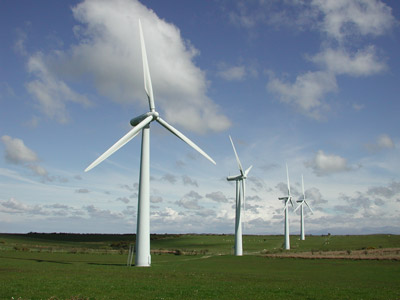
It’s been a bad year for wind energy in the UK. First there was the attempted rebellion against wind in the House of Commons, with 100 Conservative MPs trying to quash subsidies for onshore wind turbines. Then last week saw Donald Trump announce a £10 million fund for fighting wind power. The anti-wind power lobby is alive and well.
Lord Lawson’s comments on the matter are typical: “Wind power is about the most stupid way of generating electricity you can imagine. It produces very expensive electricity even when the wind is blowing at the right speed, which is only 25 per cent of the time.”
He’s wrong on both counts. Wind power is neither uneconomic nor inefficient. Let’s look at both.
Is wind power expensive?
Research from Bloomberg shows that people consistently overestimate the cost of wind, guessing that it costs almost twice as much as it does in reality. At the same time, people tend to underestimate the price of new coal, which is twice as expensive as the public perception.
 In some areas of the world, the cost of electricity generated from wind is now very close to gas and coal. The US, Brazil, Sweden and Mexico are getting $68 per megawatt hour. That’s just one dollar more than coal at $67 per MWh, and not a million miles from gas at $56 MWh. And before you ask, that excludes wind subsidies, but includes capital costs and turbine maintenance. Bloomberg expects onshore wind to achieve ‘grid parity’ with fossil fuels by 2016.
While that’s good news in itself, the other important factor to remember is which direction prices are going in. The cost of wind power has fallen dramatically, and the price of new wind turbines has halved in the last 30 years despite the rising price of steel. Wind power is gaining in efficiency as it is more widely adopted, benefiting from a major R+D push, new economies of scale and increasing global competition.
Fossil fuels are headed in the opposite direction, with increased global demand and declining reserves pushing us to more expensive non-conventional sources. Consequently, the price of gas and coal is on the rise.
Looking at these two trends, which is the better investment for the future? And that’s without even considering climate change and CO2 emissions.
Is wind power efficient?
The childishly obvious point that wind critics like to make is that the wind only blows some of the time, making wind turbines highly inefficient. They’d have a point if we were planning to switch entirely to wind power and didn’t have a national grid, but we’re not and we do. The performance of wind turbines varies enormously, and depends on the technology used, the siting and the weather. On average, they tend to add up to around 30% efficiency.
That sounds bad until you remember that our nuclear power stations are generally on for about half the time, and so are our coal power stations. The average base load efficiency of the UK’s power generating facilities was 48% in 2009. All power stations are on some of the time, and off at other times, depending on demand. That’s how it works, and we have a national grid to manage it. Wind power is part of a broader energy strategy that includes a variety of power sources, so it really doesn’t matter
The other factor in efficiency is how a power station performs when it’s on, how good it is at turning its fuel into electricity. Coal, gas and nuclear power stations all work by generating heat, and then use steam turbines to turn it into electricity. A coal power station is only 36% efficient, which means that most of that increasingly expensive coal we shovel into it is wasted. Nuclear power plants have a thermal efficiency of 39%, and gas 47%. Considering that sort of performance, it’s pretty daft to suggest that wind power is inefficient – wind is free, so there’s no waste at all.
—
In short, wind power is neither inefficient nor horrendously expensive. The costs of wind power are falling, while the costs of fossil fuel generation are rising. It’s really not a difficult decision.
 The Earthbound Report
But Coal, gas and nuclear have a large advantage over wind, when you need them to be on they can be turned on. If you have a generation shortfall and you need extra power from your wind turbines there is nothing you can do.
The efficiency of wind is largely due to the size of turbine you build the larger your blades the greater the area of wind they capture, this is why small turbines are so useless. The Bloomberg report points out the cost of wind turbines has to be adjusted for the cost of the raw materials, these costs are likely to rise. Slide 16 of the Bloomberg report is not showing the cost of wind turbines decreasing, if anything they are increasing! So I’m not sure where you get your optimistic assertion wind costs are falling. The disadvantage of wind, nuclear and solar is the costs are front loaded, you have to take out a loan to pay for the plant but after that is running costs are minimal. Coal and gas stations are cheaper to build but you have to continually pay for the gas and coal (assuming you can source it, but that’s another issue).
I’m still not sure myself if wind generation is a good idea, if we knew how long these turbines would last and the servicing costs of them we would have a much better idea.
If they can be made to last 50 years our grandchildren will be very grateful, if they will all be broken in 15 then they are a waste of space. As the costs are front loaded these things have to last and I think the decisions we need to make for future energy production are the most difficult our country faces.
Now I’ll finish with a quick thank you to those far sighed people in the 1970’s who built most of our nuclear power stations and of course the Victorians for their sewers and railways.
I had a feeling you might comment on this post. You’re right about some of these things – yes, we need other forms of power that are more flexible to turn on when we need them, but as I pointed out – we have a national grid, and nobody is suggesting we shift entirely to wind.
Besides, you can’t just switch on a gas or nuclear power plant. Coal is the only one you can bring online at short notice.
Bloomberg’s latest Wind Turbine Index shows prices have fallen back to 2005 prices after rising for a few years. Over the 30 year period I mention, they’re still half the price. And the cost of turbines is not the same as the cost of wind energy, as turbines are becoming considerably more efficient all the time, and there are economies of scale as wind becomes more widely adopted.
You say sourcing coal and gas is ‘another issue’, but it’s absolutely not! The cost and reliability of the fuel source is one of the biggest factors to bear in mind as we build our energy infrastructure for the future. Did you miss the graph of gas prices? Nobody’s going to thank us in 50 years if we put all our money in gas power plants.
Gas plants have been slated as backup generators for when the wind won’t blow and can be turned off and on at short notice.
I don’t understand your fixation with efficiency of wind turbines? If you want to make a case your going to have to use hard numbers, using terms like “considerable more efficient all the time” are meaningless. Considerably more efficient sounds like it could be 50% better, but I doubt you get more than 5-10% more electricity out of existing designs. Squeezing more efficiency out of existing designs will almost certainly drive up the complexity and cost of the product.
By “another issue” I thought my previous post was long enough, but if we believe we will be unable to source these products in the future then we really will be in trouble. You can’t make wind turbines without steel and you need coal to make steel. Which brings me back to my original point are wind turbines built to last?
I’m not fixated with the efficiency of wind turbines, I’m just responding to the criticisms I regularly read. And I choose not to put in the figures because I don’t want to be overly technical and boring, but since you ask, in 1984 there was 0.3GW of installed wind power in the world, and there’s now 240GW. Over that period, wind power has become 7% cheaper with every doubling of installed capacity. Turbines themselves have become 34% more efficient.
Wind turbines have a life cycle of 20-30 years. The towers are made of steel and can be recycled. The blades are glass fibre composites and can’t be recycled.
My final comment, there is no reason why past efficiency increases, if after you account for the increase in size will be seen in the future. When they are all broken if 20 years time can we afford to replace them?
It’s a fair question, but it’s no reason to be sceptical of wind power – in 20 years time, will we be able to afford gas? Will we be able to afford the maintenance on our nuclear power stations?
Wind technology hasn’t run its course yet either. There are plenty of new prototypes and ideas out there, from airborne or floating turbines, spherical or funnel-shaped designs. There’s no reason to think innovation has stopped and all that’s left to do is make them bigger.
But if you don’t want to support wind power, that’s your prerogative.
Thanks for the timely post – it’s certainly very alarming how powerful and vocal the anti-wind power lobby has become. Have you been reading the Guardian ‘special report’ on wind power over the last few days? Just wondered if you had any comment on the article on the oppposition in Wales and National Grid’s plans? http://www.guardian.co.uk/environment/2012/feb/28/windfarms-and-pylons-opposition-wales