
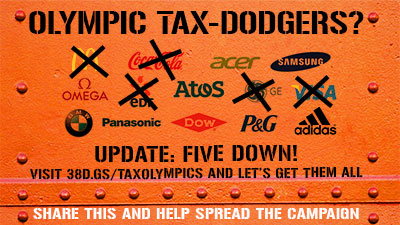
 The start of the Olympics is just days away, and the hype is reaching fever pitch. So is the whingeing which comes so naturally to us here in Britain, which is why I’ve declined to comment in any detail on the various campaigns against the Olympics or their sponsors. I’m going to make an exception for this story though, as it’s good news.
As you may know, big sports events come with an increasing amount of small print for the hosts. One modern invention is tax breaks for sponsors during the course of the games. It applied in South Africa, and it was offered to Olympic partners in London this year. Ethical Consumer magazine have the lowdown on it if you’re interested, but essentially it turns the Olympics into a temporary tax haven for the sponsors and competitors.
The 38 Degrees campaign group picked up on this and began petitioning the sponsors to pay their taxes after all. McDonalds, to their credit, promptly announced that they would not be claiming their tax break. Coca-Cola, General Electric, EDF and Visa all followed. This is good news. Of course, it would have been better if they hadn’t lobbied for it in the first place, but better to do the right thing under pressure than not at all. These sorts of campaigns raise some interesting questions about the big grey area of corporate sponsorship.
In the last few years, there have been a string of protests about corporate sponsorship, particularly of the arts. BP has been singled out for its patronage of the Tate, the National Portrait Gallery, and various other venues. Protestors have been quite imaginative and very messy in expressing their displeasure. Reclaim Shakespeare have recently been occupying stages before performances and denouncing oil company sponsorship in a pre-show mini-drama.
I’m no fan of oil companies and it would be great if these galleries were funded by other means, but I hesitate to endorse these kinds of protests outright. Why shouldn’t multi-billion dollar companies put some of their massive profits into something socially useful? Isn’t that what we want them to do? I’m not sure we can rant at corporations for being bad citizens, and then deny them the opportunity to give something back.
Sponsorship is essential to most of our cultural events, and plays a bigger role now that public funding is being cut back. It’s unreasonable to oppose corporate sponsorship entirely, but there are limits and we should be aware of them. I’m only really scratching the surface of this, but here are a few of the things I think we should bear in mind:
- Sponsorship has to be appropriate. Adidas, for instance, is a sports company and a fitting partner for the Olympics. McDonalds and Coca-Cola are junk-food companies and have no business being associated with sport, health and performance.
- Sponsorship should not be used to secure an unfair advantage. The Olympics needs sponsors, but we shouldn’t be re-writing the tax laws on their behalf. Neither should we be applying bizarre brand exclusion zones to ‘protect’ their investment. Sponsoring a big event gets you massive exposure, and that’s your reward as a business. It shouldn’t buy you special privileges.
- Event organisers need to be aware of the message that their sponsors are looking for and exercise some judgement. I’ve got no problem with an oil company sponsoring Shakespeare. I have got a problem with an oil company sponsoring the Wildlife Photographer of the Year exhibition, and yet both BP and Shell have lined up with the show in the past. You can see why the oil companies would want to be involved. Quite why the exhibition team think it’s a good idea is beyond me.
- Some companies are going to be beyond the pale, but it’s up to event organisers to draw their own lines according to their values. I could name companies that I wouldn’t take a penny from, but no doubt my list would be different from yours. Organisers need to live with their decision and any bad press that comes with it, so they need to think about this a little harder sometimes.
- With greater exposure comes greater scrutiny. If a company wants to put itself in the spotlight, that’s a great opportunity for campaigners to highlight their misbehaviour. It’s entirely appropriate for Adidas to sponsor the Olympics. It’s also entirely appropriate to use their involvement to expose their shabby labour practices.
It’s hard to draw up universal principles for corporate sponsorship, as context is so important and it needs to be on a case by case basis. Anyone got any other suggestions for navigating the murky waters of corporate sponsorship?
 The Earthbound Report
‘So is the whingeing which comes so naturally to us here in Britain’.
What do you mean exactly, here?
Only that complaining is a something of a national pastime, and the Olympics is gripe number one at the moment. Well, that and the weather.
Are you commenting, as a British ‘national’, from ‘here in Britain’ or commenting on this fact? I could see this second option, could be seen as a somewhat flippant comment, perhaps, to some.
Don’t worry, I’m making a tongue in cheek statement, not attempting to analyse the British psyche. And it’s the former – I am British and commenting from Britain.
I think that before we begin to try to navigate the muddy waters of corporate sponsoring, we need to clear our glasses – Do you really think they take the opportunity to give something back? Remove those rose coloured spectacles Jeremy and we may see more of what is lurking in those muddy waters. I think the mud goes much deeper and that your points are valid but only to make the mud smell sweeter!
They’re doing it as a way of promoting their own businesses, of course. Corporations don’t sponsor things out of the kindness of their hearts, but even if they do it for the wrong motive, it is still giving something back.
The fact is, plenty of cultural events, sports, and community projects only happen because somebody sponsors them. Sometimes that’s local businesses, sometimes it’s big corporations. Since those events and projects are good things, I actually think sponsorship can be one of the healthiest forms of marketing.
After all, companies are going to spend money telling people about their goods and services. They could spend it on TV ads or billboards, or they could spend it on things that are socially useful.
If we were to ban corporate sponsorship, it would simply force companies to keep every penny of their profits to themselves. Is that preferable? I don’t think so.
Jeremy, if we want to compete on the world stage, I’m sure that would not be preferable. I saw that the issues go deeper and felt that your choice of words could contribute to skewed thinking as the sponsors are not aiming to give something back in the usual meaning. It is necessary to make this point to proceed down my road of which devil is benefitting from another devil, but, I felt I would be straying from your agenda and so I tried to cover it lightly which has, no doubt, led to your further comment. My fault – sorry. (I often find that you want to navigate muddy waters and I want to clear them – yours is eminently more practical! I must try to see it sooner).
Not a problem – it’s always worth pointing out potential misunderstandings, so thanks for your comment!