
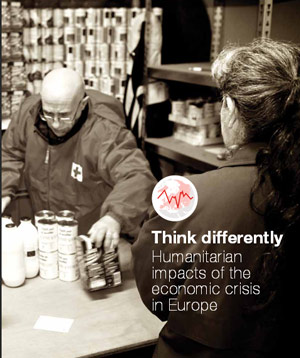
 There was a little bit of news that you might not have noticed this month. For the first time since the Second World War, the Red Cross will be starting a food aid programme in the UK. It’s not a big initiative, but it’s perhaps a symbolic one, a reminder that poverty in Britain is not going away.
The Red Cross announcement came a week or so after the release of their study into the impact of the financial crisis on poverty in Europe. It draws from 52 Red Cross and Red Crescent societies across Europe to see what needs they were meeting, and compile their observations on how their work was changing.
A few common themes emerged – more people hungry, more having trouble accessing healthcare, families struggling with rising prices and bills, unemployment. There has been a dramatic rise in the number of people using foodbanks, up 75% in over 20 countries surveyed.
One fact in particular stood out for me – in most parts of the world, poverty is falling, but it is rising in Europe. “More people are getting poor, the poor are getting poorer and the ‘social distance’ to climb back into the mainstream has become farther.”
Not all countries are doing the same, it should be said. Poverty levels have fallen in some countries and risen in others. It’s not possible to generalise across the whole region, and Britain has its own story. However, as I read the report, I couldn’t help but notice aspects of poverty that are missing from our national debate.
One important observation from the Red Cross branches across Europe is that there are large numbers of ‘new’ poor. In Italy for example, an estimated 150,000 small businesses have gone bankrupt since the beginning of the downturn. These are people who have fallen out the bottom of the middle class, as it were, tipped into poverty through no fault of their own. I’m not sure what it is like in Italy, but the tone of our national discussion around poverty in Britain does not recognise that category – it’s all about how to get people off benefits, rather than about helping people who have fallen on hard times.
Another observation from Red Cross programmes was that they were dealing with more people who were ‘working poor’. That is, people whose jobs did not pay enough to provide a proper standard of living, or who were underemployed. These families often struggled towards the end of the month, needing help with bills or food to tide them over until the next paycheck. This too is missing from the debate in Britain, where the media seems to forget that many people drawing on things like housing benefit are actually working.
This is actually quite serious, because work is constantly talked about as the route out of poverty. Both the media and the government appear to be working on the assumption that people on benefits are not doing enough to help themselves. The Joseph Rowntree Foundation notes that 61% of children in poverty have working parents. Finding work is clearly not enough – the challenge is to secure enough hours at a decent wage.
The Red Cross report is called Think Differently, and the choice of title is a good one. Government responses to the financial crisis have tended to focus on money and budgets, growth and the economy. People and communities can easily become secondary concerns – as long as GDP is rising again, we can proclaim that ‘the recovery is underway’. Realities on the ground may be quite different. Thinking differently about poverty means paying closer attention, asking more questions, and looking beyond statistics.
I’m aware that this post is a little unfocused, but the thought behind it is this: the Red Cross are providers of emergency aid. If they feel it is necessary to step in to provide food aid in Britain, when there hasn’t been a national emergency or disaster of some kind, that ought to give us pause for thought. And perhaps we ought to think about how to make their work unnecessary here in Britain – what underlying factors should we be addressing? How can we build community resilience so that people are better equipped to help themselves when things get tough? How can we ensure that the economic recovery reaches right through society?
 The Earthbound Report
Some very pertinent observations here, as always. It does seem odd that the government trumpets its efforts to help small businesses as a way into greater employment and prosperity when the reality is that multitudes of small businesses are going under. Similarly, the drive to get people into work of some description seems to entirely miss the point that huge numbers of working people simply cannot make ends meet and would be better off on benefits. If the government is serious about people being better off in work than out of it there are a number of big issues it seriously needs to address. Zero hours contracts is only one of them. But at the same time, many small businesses can only employ people sporadically, and for them zero hours contracts are indispensable. And setting a minimum wage would result in marginal companies being unable to employ further staff, or even going under altogether.
How does one find a way through all of this? I suspect that your recent article on the size of the wealth gap in the UK is not irrelevant in this context.