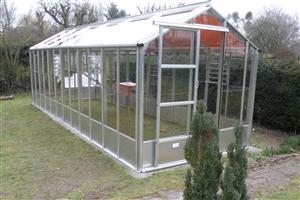
I’ve featured greenhouses before in my building of the week posts, including the passive solar greenhouses that are common in China. Here’s an other form of solar greenhouse, produced by a Cambridge-based company called PolySolar.
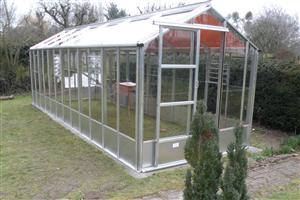
At first glance it is indistinguishable from a traditional British greenhouse. That unfortunately includes all the usual design flaws that make it an inefficient structure, such as glass on all four sides, and nothing to give the building thermal mass. So it’s not the design that’s of interest here, but the materials. This particular greenhouse was the first in the world to include transparent solar panels.
That’s the orange tinted glass on the roof. PolySolar’s first steps into transparent solar panels were all orange tinted. (Spotting their brand colour and a PR opportunity, Sainsbury’s commissioned canopies for a couple of their service stations). The second generation of PolySolar’s transparent panels are grey-tinted and have been used on building facades, skylights and bus-stops. The quest for complete transparency is ongoing, and requires a different technology.
Putting transparent solar on a greenhouse doesn’t significantly affect its performance, and the building will already be positioned and oriented for maximum sunlight. For those who can’t put solar panels on their roof, it’s a valuable alternative. It’s also a technology to add to the list of invisible forms of renewable energy.
I suspect this greenhouse is a forerunner of future construction. At the moment fully transparent solar panels are experimental and expensive, but that will change. It is only a matter of time before solar glass will be a standard building material, and the BBC won’t feel the need to report on someone getting a new greenhouse:
 The Earthbound Report
This is a fascinating glimpse into the future of building-integrated photovoltaics. The innovation of incorporating transparent solar panels into a traditional greenhouse design—despite its inherited inefficiencies—is a meaningful step toward merging aesthetics with function. PolySolar’s work highlights the potential of dual-purpose infrastructure, especially in space-constrained environments where rooftop solar may not be viable. It’s encouraging to see advancements like grey-tinted panels being adopted in everyday public spaces like bus stops and commercial canopies, showing that renewable integration can be seamless and even stylish.
What’s especially exciting is the role technologies like this can play in decentralized energy generation and sustainable agriculture. As transparent solar becomes more cost-effective and fully integrated into standard glass manufacturing, we’re likely to see these structures not just as novelty builds but as core infrastructure in green urban planning.
For those interested in the broader economic and market potential of these technologies, I’ve recently published an analysis on the Photovoltaic Greenhouse Market, discussing current trends, growth drivers, and future outlook:
🔗 https://alignstrategicimperative.com/industry/photovoltaic-greenhouse-market/
Looking forward to seeing how this space evolves!