
The EU has long term carbon targets to reduce carbon emissions by 95% on 1990 levels by 2050. Here is a graph showing performance on those targets across a range of sectors, new from the European Environment Agency last week. Spot the outlier.
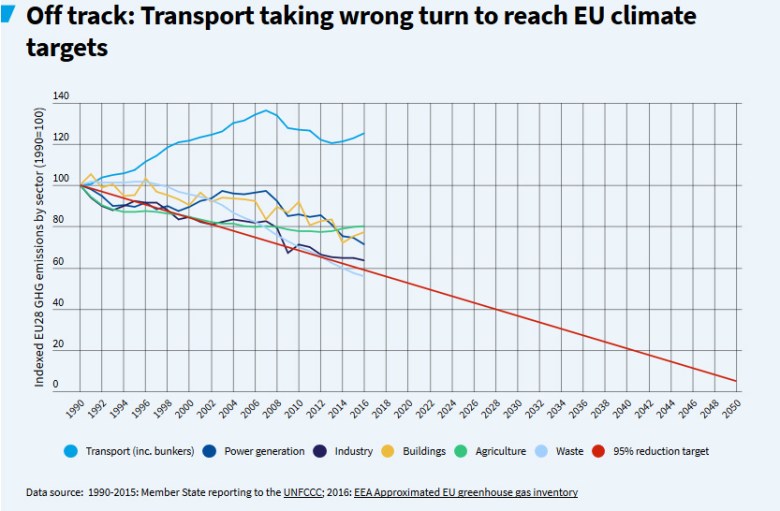
Aside from waste, none of the sectors are exactly on track, but most are headed in the right direction. All except transport, which is off on its own merry way. It’s a similar story to Britain, where the transport sector is the slowest to decarbonise.
This is a good demonstration of relative and absolute decoupling, and why the second of those is what matters. Transport is more efficient than it was, and there are more and more electric cars on the roads. That’s relative improvement. Unfortunately, any gains have been erased by rising demand. More people are driving and there are more cars and trucks on the road. If demand is rising faster than improvements in efficiency, then there is no absolute improvement and emissions remain stubbornly high.
These figures don’t include aviation, because that’s calculated elsewhere. The biggest problem by some distance is road traffic. Once again, tackling climate change means getting serious about car culture, and we cannot depend on incremental efficiency measures alone.
- Feature image by Dan Gold
 The Earthbound Report
I’m sure this is true. The answers are radical but well known amongst the likes of us but not Joe Public; localism not globalisation, travel as a last resort, a get-fit mindset, cars no longer a status symbol…pigs might fly. Meanwhile, cars get bigger and fatter, as do many people.
Transport (including bunkers). What are bunkers?
Bunker fuel users, which is shipping. Don’t know why it doesn’t just say ‘including shipping’ to be honest.