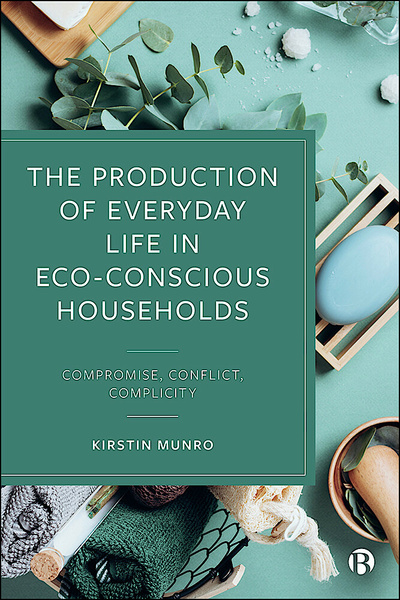
Green lifestyles are under-studied, suggests Kirstin Munro. We know the stereotypes. When it comes to really understanding what households actually do, how it works, what they think and how they negotiate their compromises – that’s more of a mystery. It’s important to study this, because environmental problems are so often blamed on consumer behaviour. If we’re going to talk about behaviour change, we ought to understand it better. We ought to know what’s possible, what’s realistic, and what’s effective.
Munro is a political scientist at the University of Texas, and for her research she has interviewed households in Portland, Oregon, often referred to as the greenest place in America. She focuses on families with small children, and as a parent running a sustainably-minded household myself, there are useful comparisons to be made.
One finding to note is that there are cliches about sustainability as a white middle class thing. No so when you actually look, says Munro. Environmental behaviour is more diverse than that, and the problems may be more to do with representation than reality.
There’s also diversity around the question of what sustainability is. Some people are concerned about ‘the environment’. Others are more focused on equity and justice. For some, health is the most important concern. Different motivations will lead to different priorities. Those thinking about the environment tend to pay more attention to energy efficiency for example. If health is the big priority, you might not think about your carbon footprint at all while making food from scratch, sourcing organic ingredients and mixing your own soaps and detergents.
These motivations bring their own compromises and contradictions. One participant insists on making their own deodorant but still drives an SUV. Another claims that their solar panels make them self-reliant and independent while forgetting that it was a government grant that paid for them. Munro notes these things without judgement, often letting her anonymised participants explain themselves in their own words.
The book focuses on waste because people have a lot to say about it. “Packaging is reviled” across almost all of the households, and several of them think that recycling is the most important thing they do. This is something that I hear regularly in the UK. (Waste accounts for 3% of household carbon emissions by the way.) Elsewhere there are significant differences between British cultural norms and American ones. Hanging your laundry outside is standard here, and a forgotten and radical practice in the US.
There are a few such differences that make the book less relevant to British readers, though plenty will resonate. There a few things that sound wryly familiar, particularly in the chapter on conflicts that arise in households. “David goes based on the spirit of what he thinks should be recyclable,” complains Dayna. “This is a big, long-term marital thing where David thinks that things he thinks he should be able to recycle at the curbside, if he puts it in the curbside recycling bin, even though it’s not recyclable it’s “sending a message” that they should be taking this thing. And I’m just like, you’re making people’s lives more difficult.”
There are some useful observations across the book, such as the shortage of time being an almost universal complaint. The frustration of not being able to get good information. The mental and emotional energy involved in many personal actions.
The book itself has a nuanced view of the value of these actions. “My informants frequently agonize over even the smallest decisions and feel guilty about not making the right sustainability choices,” says Munro, and many quotes back that up. “We never feel like we are doing enough,” says Jim, “and I never feel like I can solve any problem with choices I make in my lifestyle.”
Jim is of course entirely right – you can never do enough because structural environmental problems are not fixed with personal actions. As Munro notes, “the shift of responsibility for environmental risks from the state and corporations onto households is part of a larger pattern in late 20th- and early 21st-century United States.” By focusing on personal actions, corporations get off the hook – see this recent case study in deflecting attention from Easyjet. So one of the most important messages of the book, for me at least, is to keep directing people’s passion and enthusiasm towards work that really makes a difference.
- The Production of Everyday Life in Eco-Conscious Households is published by Bristol University Press and is available from Earthbound Books.
More nuance on the relevance of personal action:

Six reasons to take personal action on climate change
Personal actions are often the entry point into environmental issues. People become aware of an issue, ask what they can do about it, and find small steps that they can take. Because they’re often fads, these actions can appear much more important than they really are, and can even distract us from things that would…

What simple actions can people do to reduce their carbon footprints?
This is one of the questions I get asked most often. What simple actions can ordinary people do to reduce their carbon footprints? I expect you’ve heard it before. Let me reply with a question of my own: which simple household objects can I use to battle a T-Rex? None, right? If I need to…

Cutting my plastic use is not (just) my problem
Last week I reviewed Turning the Tide on Plastic, by Lucy Siegle, with its step by step advice on eliminating plastic. Yesterday I wrote about the Everyday Plastic Survey, which is all about inspiring ordinary people to take action on their plastic consumption. I fully support those sorts of projects, and yet I find myself…
 The Earthbound Report
One more point that deeply resonated with me was the idea of creating a community around eco-conscious living. Inspired by Munro’s insights, we joined local sustainability groups and attended community workshops on green practices. These connections provided us with invaluable support, tips, and encouragement to stay on track and continuously improve our eco-conscious lifestyle. https://www.ourgreenstreets.org/org/beechwood-wmc-seacroft-recycling-site/ Munro’s article also emphasized the significance of involving children in eco-conscious practices. As a parent, this was a priority for us. We engaged our kids in activities like gardening, recycling projects, and energy-saving initiatives. It was truly heartwarming to see them develop a strong sense of environmental responsibility and appreciation for nature. In conclusion, Kirstin Munro’s article “The Production of Everyday Life in Eco-Conscious Households” served as a confirmation that our journey towards sustainability aligns with a broader movement of like-minded individuals. It offered a valuable perspective on how eco-conscious practices can be seamlessly integrated into daily life. By making mindful choices, forming a supportive community, and involving our children, we’ve not only reduced our environmental impact but also experienced a deeper sense of fulfillment and purpose in contributing to a greener world.