Last week I was camping with friends, and we had a slightly disappointing outing to the nearby Hurst Castle. It’s an old sea fort built to defend the Solent and Portsmouth, and it’s been re-invented over the years to meet the threats of the age – a Tudor core, Victorian wings, and further additions from the world wars.
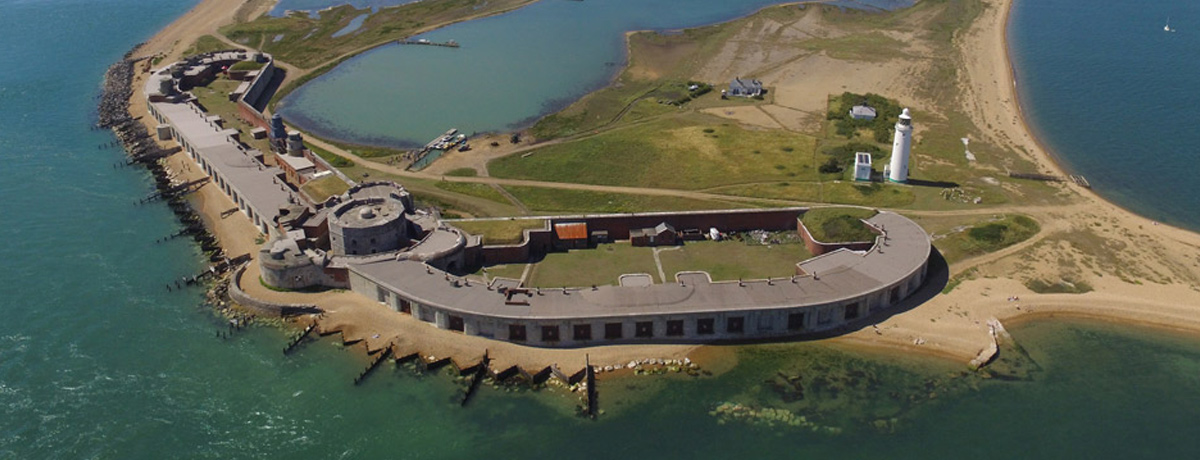
On our visit we were surprised to find it rather down at heel, much of it closed and roped off. Over a series of large information panels, English Heritage explain why: in 2021 a large stretch of wall collapsed into the sea (guess which bit from the ‘before’ photo above). It is now being repaired. Hurst Castle, says the signage, is at significant risk from climate change and rising seas. It needs special protection to preserve this apparently invaluable piece of heritage forever, and they need more money for this and similar sites. Please give generously.
As a climate campaigner I suppose I’m predisposed to notice these sorts of stories. I’ve written about how climate change is a threat to historic sites and this confirms it. English Heritage go so far as to say that Hurst Castle is “emblematic of the issues posed by climate change to our heritage.”
However, I got talking to a volunteer at the castle during the ferry ride back to the mainland. They explained that the site is owned by English Heritage, but run on a day to day basis by a local business and a group of volunteers. Both local groups had been nagging English Heritage “for years” about the erosion of the beach beneath the wall. These warnings were ignored, according to the volunteer, and it only got their attention when it fell into the rising sea.
Now, I’m in no position to judge that either way, so I’m not pointing any fingers. The reason I mention it is that it’s a good reminder of how every climate incident is local and global at the same time. Climate change is a global phenomenon, but how it is experienced locally is a combination of factors. At this particular castle, the wall collapse was a combination of changing tidal patterns due to development around the coast. Questions should be asked about the maintenance schedule and conservation funding. The strength of the partnerships running the site is a consideration, the communications between them and the lines of accountability. And yes, all of that is happening alongside the added risk of climate change and rising sea levels.
It so happens that on the day I visited the castle I was reading Climate Change Isn’t Everything, by Mike Hulme. I’ll review it shortly. One of his main points is that by over-emphasising climate change, we risk settling for simple answers. This might fit a narrative, but it lets people off the hook for failings elsewhere.
Sometimes this simple answer can obscure serious mis-management or injustice. A famine may have climate change as one of the causes, but the death toll will also be affected by crisis response, government competence, corruption, tribalism, poverty, and all sorts of other contributors. Fixing those things would save lives the next time there’s a famine, but we won’t get to those problems if we see climate change and stop looking.
We can’t ignore climate change, and nor should we exaggerate it. We need to bear in mind the combination of local and global, resist easy answers, and ask good questions. If there’s a flash flood on a high street that doesn’t have a history of flooding, we might want to ask about the role of climate change – but we should also ask when the council last cleared the drains.
 The Earthbound Report