I heard a comedy piece recently where a radio host asks who the ‘woke people’ are that his guest refers to. The phoner then ploughs through an increasingly irate list that begins with The Guardian, takes in pronouns, lawyers, children’s books, the RNLI and much else besides, and ends with avocados. It’s no more or less sensible than most conversations that use the word, which has become highly toxic.
If we were to take the original meaning, to be woke is to be alert to injustice. That’s not just important. To be alert to injustice is also deeply human – as you will discover if you give two children an unequal number of sweets. So if you’re going to declare yourself ‘anti-woke’, you should have a very robust explanation for it. At the very least, you need to define the term in the way you’re using it.
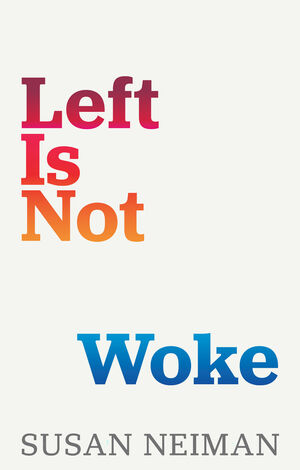
That’s very rare. Almost every use of the word ‘woke’ that I come across is lazy, derogatory and divisive, a catch-all for signalling that you’re not one of those people. Since that’s more common on the right, this book caught my eye. Here’s a book that’s unashamedly from the left, drawing distinctions with what is described as ‘woke’. Maybe there’s a grown-up conversation to be had here about this whole cultural phenomenon.
After all, many commentators treat these words as synonyms. People who are woke are on the left, and people on the left are woke.
Not so, argues Susan Neiman, an American philosopher who has spent decades writing about justice, morality and race. “What concerns me most here are the ways in which contemporary voices considered to be leftist have abandoned philosophical ideas that are central to any left-wing standpoint: a commitment to universalism over tribalism, a firm distinction between justice and power, and a belief in the possibility of progress.”
The book then goes on to explore these three central ideas. The left has always been about universal human dignity, with social rights as a foundation to individual rights. Identity politics can complicate this by elevating individual experience, resulting in “a politics of self-expression rather than social change.”
As soon as we’re beyond the introduction, the word ‘woke’ more or less disappears from the book. There are long sections on philosophical theory – “how did Michel Foucault become the godfather of the woke left?” asks Neiman, and takes forty pages to answer. Then there’s the assertion that modern progressives have ’embraced’ a Germans theorist called Carl Schmitt. Not someone I was familiar with, but it turns out he was a radical Catholic who believed that all politics was a struggle between good and evil. He was a Nazi and remained unrepentedly committed to the project for life. Despite Neiman’s assertions that people can be influenced by theorists without ever having heard of them – I’m sure they can – I just don’t see Neiman’s line between Carl Schmitt and ‘the woke’.
The discussion of theory goes on, with little reference to current events or context. Moving on from Schmitt, the chapter on justice and power elegantly describes how evolutionary psychology legitimised self-interest as a guiding political principle. Then it concludes by presenting Donald Trump as the pre-eminent example, the logical conclusion of a world that pursues self-interested power. But since Trump is neither left nor woke, this sheds no light on the central argument that the left is not woke.
I read to the end. The book is well written. There are some rather brilliant observations on how and why the present undervalues the progress bought by previous generations. There’s a great discussion of selishness and altruism, or what happens when competition replaces exchange as the ordering principle of economic thinking. But I kept wondering if and when the book would really get its teeth into today’s ‘woke’ culture, and I was still waiting when I turned the final page.
‘Woke’ gets only a cursory definition at the beginning, and there is no further engagement with it as a force in contemporary thought. We get passing references to ‘theories held by the woke’, or the ‘admirable impulses of the woke’ without ever naming them or citing them. I didn’t spot a single quote that backed up these ideas that woke people supposedly hold. Do ‘woke’ people not believe in progress? Are they more concerned with power than justice? Those are quite big claims, but there are no real world examples or quotes to prove the point.
What Left is not Woke does well is outline some distinguishing features of the left, a term that Neiman says she is “unwilling to cede”. What it doesn’t do is outline what ‘woke’ stands for, and therefore how it is different. It makes me wonder if it started out as a different book entirely, perhaps a book calling progressives back to what it really means to stand on the left, defending the term by reinforcing its distinctives and its philosophical heritage. Maybe somewhere along the line it was re-framed around the idea of ‘woke’ to make it more topical and more appealing. Maybe the title was changed. I don’t know. It’s hard to explain otherwise.
Ultimately, I learned some useful things about what ‘the left’ means for those who want to identify themselves by that political binary. But I’m none the wiser on the other side of the equation. Nobody seems to know exactly what ‘woke’ is, but it’s important for us to know that they are not it.
And so I find myself still asking the question from the comedy piece – what is ‘woke’, and who are these ‘woke people’?
- Left is not Woke is available from Earthbound Books UK or US
 The Earthbound Report
I thought you’d enjoy this framing: https://andrealearned.substack.com/p/wasting-climate-influence-is-as-bad .
I do appreciate the Earthbound Report! Ann
Thanks, I’ll take a look!
Erykah Badu, who was first to coin the term woke (in its current meaning) in her song ‘ stay woke’, explains what woke means: https://youtu.be/0YDKqKfXLxg?si=BrWcgLKh5HsqNype
Yes, Badu gave the term a new spin, though the phrase ‘stay woke’ was first used in a Leadbelly song all the way back in 1938.
It’s interesting that those who 5-6 years ago would proudly label themselves as Woke would today reject the term.
The non-materialist Left seem to consciously try to reject labels, seeing that once you define yourself (or are defined) you can be understood and countered. This was Chris Rufo’s insight in his fight against Progressive race and gender ideas. He determinedly put the labels of Critical Race Theory and Radical Gender Theory on those intentionally amorphous ideas. Creating a label gave him a hard target to attack rather than as previously trying to nail jelly to a wall (‘That isn’t Critical Race Theory it’s just racial justice, etc” was the refrain).
So I’m not surprised that you are still
unsure what woke means, that is the intention of those who called themselves it.
The definition I use is Matt Godwin’s “ A pseudo-religious belief system which is organised around the sacralization of racial, sexual & gender minorities and which prioritises subjectivity & lived experience over objectivity and empirical evidence.”
The idea that someone Woke is awake to injustice does amuse me as those who would fit the definition are only alive to injustice against those sacralised groups. The injustice of a woman losing her job for holding the belief that sex is immutable is one they are fast asleep to for example.
I’ve never described myself as woke, because its an African-American term that never felt mine to use. Not for fear of cultural appropriation, but just because it would be weird – like calling my friends homeys.
Woke is at least a hundred years old as a term, and it’s always meant being alert to injustice, particularly racial prejudice. You’re just giving yourself the right to make up definitions at will, as with CRT, which is fundamentally dishonest. You don’t like it when others do it (like with ‘neoliberal’), but it’s okay when your side does it. So I’m afraid you don’t get to point at other people and call them hypocrites.
You spend a whole review complaining about a book not defining ‘Woke’ then you have a definition all lined up.
It feels rather disingenuous that you and I know that at present there is more going on with the area that gets labelled ‘Woke’ than just “awake to injustice”. You exactly are doing that which I mentioned of trying to avoid any label. Matt Goodwin’s definition is based on observation of what is being practiced rather than wished.
It is true that I have complained about the blanket use of ‘neoliberal’ but there are two things I would say. Firstly Woke is a term the coined by the Woke to self describe rather than a label created by others, the second is that what’s sauce for the goose is sauce for the gander, especially against a group who do not value objective truth and is intolerant of disagreement.
As I say the present supposed awaken to injustice does not extend to those outside of certain groups. In fact it supports the carrying out of injustice against those who disagree. It’s clearly prevalent in the environmental & development sector with examples such as the Centre for Global Development unlawfully discriminating against Maya Forstater for her Gender Criticsl beliefs and even after being forced to pay her over £100k compensation refusing to accept they did wrong
The Green Party of England is at risk of going bust since so many cases of discrimination on grounds of Gender Critical belief are being brought against it. And Oxfam is putting out cartoons attacking JK Rowling and staff & volunteers are berated & bullied for expressing GC views.
I would want yo muddy the meaning of the term Woke given this intolerance it’s promoting.
My definition of woke is in the review, first line of paragraph two – I didn’t ‘have it ready’. Neither am I pretending that I don’t know that other people have other views on the word. I read the book because I want to understand the phenomenon better. Again, that’s in the review. Maybe you didn’t read it in your rush to the comments section.
Since the book was claiming to draw a distinction between ‘woke’ and ‘the left’, it needed to be clear about what both were. It did a great job of outlining what the left means, and a poor job of pinning down what the author thinks woke is.
‘Woke’ as you define it is very different from the way it was used when it was coined a hundred years ago, so the ‘self-description’ argument doesn’t stand. As I say, making up definitions for words and then throwing them at people is fundamentally dishonest.
So what would you call the trend by many on the Progressive left to treat certain groups as especially oppressed and to forsake the search for objective truth for subject and ‘lived experience’ with its bullying and intolerant effects as demonstrated by the persecution of people with Gender Critical beliefs in the environmental & development circles?
You don’t think it’s woke so what label should we give it (and as an as side you can say it you approve of the bullying)?
I’d say “the trend by many on the Progressive left to treat certain groups as especially oppressed and to forsake the search for objective truth for subject and ‘lived experience’ with its bullying and intolerant effects as demonstrated by the persecution of people with Gender Critical beliefs in the environmental & development circles” is too long and complicated a phenomenon to capture in one word. Especially since every day there are new things being added to list of what is termed ‘woke’.
In a grown-up conversation, we need to choose our words more carefully than that.
There are several things within the trend you name, which often have more specific terms of their own. Words like ‘virtue signalling’, which I know you’re a fan of anyway. Polarisation is another, driven in part by social media bubbles. And bullying is best called bullying.
I do have to say that you are not alive to the injustice of the discrimination against those people (mostly women) for the legitimate views by organisations in the environmental & development sector.
Is it you don’t believe in justice or are too scared to speak out?
It’s possible to recognise bullying and call it out, and also advocate for minority rights. It’s possible to listen to differing opinions, rather than demanding that some be cancelled. It’s possible to admit that you don’t have all the answers, but are open to learning from people who know more than you. That’s the kind of grown-up conversation I consider myself to be part of, and it isn’t helped by labelling and name-calling.
That is basically the opposite of Chris Rufo’s approach, which is about purposefully undermining honest debate and then relying on scared people to suppress the ideas you don’t like. He talks openly about this and boasts about how successful he is, so it’s not a mis-characterisation of his methods. That makes him a deeply cynical political operative, and we have no idea how much damage he will do in the long term. And yet you call him a hero of yours.
More fool you, and don’t lecture me about justice.
It may be possible to recognise bullying and call it out but it is very noticeable that despite several opportunities you have not called out the bullying those left wing gender critical feminists I mentioned have suffered. You have gone down the Corbyn form when challenged on Labour antisemitism of saying he condemed all forms of racism but never that explicit one.
So, one last time. Do you think the bullying and discrimination that has been thrown at people like Maya Forestater, Shahrar Ali, Rosie Duffield and Kathleen Stock, to name but few, by people on the environmental left is wrong and will you condemn it?
Yes, all bullying is wrong and I condemn the examples you cite and others like them, like J K Rowling. I have no problem with saying that and I’m not afraid to say so.
“Very noticeable” that I don’t call this out? Nonsense. I don’t write about these topics. You’re the one who keeps raising your culture wars Shibboleths in the comments, pushing me to takes sides in your polarised world. I wonder if you can see the irony of doing that, while accusing the ‘woke’ of being petty and self-righteous and all about virtue signalling.
I’m glad you explicitly condemn these cases of discrimination & bullying by the identitarian left against these good people. The fact this is happening in the space you work in would, I’d have hoped, moved your interest. The Green Party & Oxfam are both serial offenders, Maya Forstater is a development tax expert and despite losing the discrimination case and having to pay her £100k the Centre for Global Development has not accepted they mistreated Ms Forstater. This is still an issue among those you work with.
I am not the one who styles myself ‘awake to injustice’. You attack Chris Rufo while minimising the authoritarian, bullying reality denying and power abusing elements that are a large part of the progresssive left he is opposing. That is far more damaging to politics & society not only in degree but also in scale.
I trust you are standing up for headteachers and librarians who have been unfairly bullied out of their jobs by anti-woke crusaders.
I do. I just want them to follow the law but I’m against driving people out of their jobs for their views rather than their actions.
Of course there are fewer librarians & teachers driven out of their jobs in the UK because of their pro-Woke views than GC people so I have fewer opportunities to protest about that. Can you give me some recent examples?
Sure, mainly in America. But since you say Rufo is a hero of yours, and it’s his work that is driving people out of their jobs, then your support is worth less than nothing. Keep on cheerleading for Rufo in the UK, and the same abuses of power will be headed this way.
Chris Rufo is a response to the ideology that grips the progressive left in America and much of the UK, that rejects reason and compassion which you absolutely turn a blind eye to.
It’s an ideology that has created a climate of fear among many women.
Rufo may be driving people out of their jobs but many (I can’t say all) are because of them abusing their position to enforce a disputed and destructive ideology, because of their actions while the women in British you stay silent on have lost their jobs merely for what they believe. It’s far more defendable to hold someone accountable for their actions rather than their words.
The culture of intolerance in progressive circles happened under your nose and while you might have tutted under your breath you have said nothing.
You are desperate to position yourself as morally superior to me and yet this shows you stand on feet of clay.
“you have said nothing”. You don’t know me. Not sure why you think I’d write about your culture wars issues on a blog about sustainability.
You don’t seem to be able to separate “the progressive left” from its most annoying and rude voices. You’d be very upset with me if I did the same thing, and demanded that you apologise and denounce the most fascist elements of the right. In lumping everything together, you’re doing exactly what Rufo wants you to do. Which is why I say it again: more fool you.
I don’t have anything more to say on this, to be honest. I don’t like or use the word ‘woke’, so this all feels entirely pointless. If I do ever have to use it again, I’ll be sure to put a trigger warning at the top so you can steel yourself.
You found plenty of space to write about racial justice on your blog about sustainability but I’ll take your assurances that you are a doughty defend of wonen’s rights on trust.
I’ve written about the nexus of race and climate change, and also about the nexus of women’s rights and the environment.
But not about how many organisations in the sustainability/climate change space discriminate against people, mainly women, on their beliefs.
It doesn’t interest you, that’s fine.
Feel free to suggest blog post topics any time you like, or start your own blog to report on the things I miss.
Though I would point out the examples I first pointed out are all in the ‘Sustaibabilty’ sector so should have been on your radar beyond the culture war, but i guess there weren’t enough pixels to write about that.
Thanks for this very thoughtful review! I too feel that the term “woke” has been recruited by people on the political right to refer to any belief they disapprove of. It’s a convenient shorthand, as you say, for communicating that you are not one of “those people” who favor greater economic equality or social justice. I think most public figures today use the term to obfuscate rather than to illuminate, and so I suspect (and hope) the term will pass out of our everyday language soon enough, much the way “politically correct” did a generation ago.
Yes, it’s not a useable word in any way at the moment, and I tend to suspect the motives of anyone who is using it.