
One of the noted environmental books of last year was George Monbiot’s ReGenesis, which I reviewed positively here. In it, he argues that farming is the biggest driver of the biodiversity crisis and a major contributor to climate change – without ever managing to provide a secure and healthy diet for everyone. He then explores a variety of different solutions, and concludes that “we can produce more food with less farming.”
I thought it was a provocative but thoughtful book – but then I’m not a farmer or a staunch localist. To some, it felt like a direct and very personal attack on their way of life. The testimonial quotes for Smaje’s book give a flavour of the anger here. All these appear on the opening spread, so they’re the very first thing the reader encounters:
“Our countryside will be reduced to a monoculture of lynxy scrub and our food grown in vats,” says one. Monbiot is “constructing a dystopia of farms without farmers, food without farms,” says another. He’s a “jargon-filled, techno-worshipping agricultural futurist”. Another accuses him of being a promoter of “ecomodern theology”, and as one local food advocate decribes him, “our nemesis.”
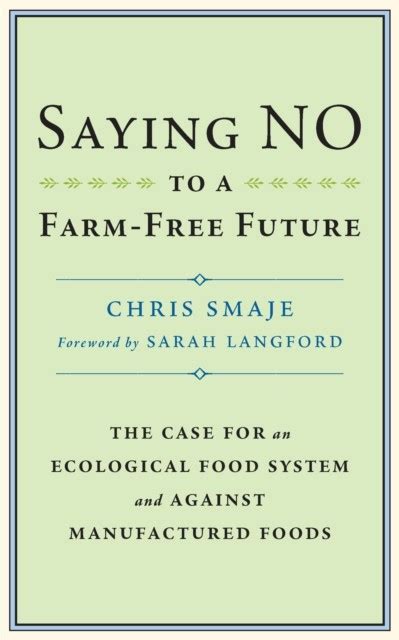
Strong and divisive words, and all those different voices praise Chris Smaje’s book as the true solution. It’s written in direct response to ReGenesis, and captures its polemical message in the title, Saying NO to a farm-free future: The case for ecological food systems and against manufactured foods.
Those who read my opening paragraph carefully may have spotted the problem here already, right in the title. We’ll come back to that.
Smaje shares many of Monbiot’s concerns on climate change, consumerism and destructive farming. He just proposes a different solution, and so his book does two things. It critiques the technologies proposed in ReGenesis, along with other ‘ecomodernist‘ ideas that Monbiot has been lumped together with. And then it outlines Smaje’s preferred approach to a sustainable food system. “The alternative is the efficient, productive, low-energy input, land-sparing and land-sharing” approach to agriculture, “grounded in the ecology of the mixed farm.”
The critique centres on the fact that manufacturing food without farming takes energy, and this is a fantasy at a time when we are trying to reduce energy use and transition away from fossil fuels. If it is to be done at scale, then manufactured foods will inevitably mean more corporate control of the food system. Monbiot wants this to be done more locally and on open-source principles, which Smaje says is naive. Of course it will end up corporately controlled.
Some important questions are raised here, though it felt to me that Smaje was seeking to debunk a technology that doesn’t exist yet beyond a single experimental company. We should of course be wary of technofixes. But declaring it to be impossible feels premature. We’re a few years from knowing enough to say.
Smaje summarises Monbiot’s vision as “electrified, manufactured food-powered vegan urbanism”, which is the opposite of the low energy, high labour, ecologically grounded ruralism that he both advocates and practices. We should be pursuing mixed farming, where animal imputs are used to benefit the soil and support growing plants. We should aim to meet food and fibre needs locally. This will need more workers on the land, and so we should expect urban depopulation as people return to the land.
What the book doesn’t do is prove that this can feed the world, which is what keeps Monbiot up at night. Smaje uses Britain as an example, which is fine. But could you feed Tokyo’s 39 million people with local food? If millions of its residents decided to become farmers, where exactly in the already well-used Japanese countryside would those farms be? Even if the population of cities such as Cairo of Lagos were halved by rural re-location, you’d still need a massive surplus of food from somewhere else. With over half the world’s 8 billion people in cities, I’m not convinced small farms serving local markets can provide everything we need and Smaje’s book hasn’t changed my mind. As I’ve argued before, what was practical in previous generations might not work in a full world.
Here’s the key thing though: just because small farms can’t feed the world on their own, doesn’t mean they aren’t valuable. They can’t do everything, but it would be crazy to say they contribute nothing. This is where the book falls down, in my opinion. It’s right there in the title: Saying NO to a Farm-Free Future.
Who exactly is calling for a farm-free future, for the abolition of farming?
Certainly not Monbiot, whose book very clearly calls for “more food with less farming,” not no farming. ReGenesis spends much of its wordcount visiting farms, and describing how fruit and vegetables and grains can be sustainably produced. The manufactured foods only applies to protein and fats, and so the critics seem to be fixated on a small part of the book. Monbiot says the solution that excites him most is perennial grains, not manufactured foods. And he specifically calls for “helping small farmers practice high-yielding agroecology”, which is exactly what Smaje wants.
Since the book’s publication, Monbiot has repeatedly clarified that he supports agroecology, and that it’s not an either/or. Smaje acknowledges Monbiot’s words here, and then says “I’m not convinced.” Basically, Smaje doesn’t take Monbiot at his word. Sure, “he’s insisted that manufactured food and agroecology are complementary,” but he doesn’t mean it. What he really wants is to keep people out of the countryside, because “Monbiot’s view is that people and nature don’t mix.”
This is a bit of a deal-breaker for me. You can’t engage constructively with someone’s ideas while accusing them of bad faith. That’s a disappointment. I was hoping that Chris Smaje’s book would ask probing questions and refine what sustainable food systems look like in our busy world, but ultimately what it does is demand that we pick a side in a false dichotomy.
And that’s something I can’t do. To those who keep asking if the answer is low tech or high tech, local or global, agroecology or manufactured, I’m afraid I reserve the right to say ‘both’.
- Saying NO to a Farm-Free Future is available from Earthbound Books
- So is Regenesis
 The Earthbound Report
Why is quantifiable fossil fuel input so rarely mentioned in the various ‘solutions to our food predicament’? Once you factor in how many fossil fuel calories are required to produce a single calorie of food (the ratio is very roughly 10:1 for industrial farming), I fail to see a future for food production without a significant increase in manual labour. That fact alone is set to completely shatter the demographics of an ageing and sedentary Europe.
Thanks, that’s very much how I see it. A shame – I feel it was a wasted opportunity.
Hi Jeremy, I am with you on this. What I don’t understand is how this has become such a divisive debate. Many people in the agro-ecology movement use the term ‘anti-livestock’ to label George Monbiot and this term mystifies me as if he randomly hated livestock. Wierd!
On the other hand, I do have some sympathy for the argument that it is unlikely that big business/finance will not control so-called alt-protein. I think if this was integrated into a climate transition mission framework a la Mazzucato with multi-stakeholder governance that ensured a focus on public purpose, then maybe this could be avoided. But this would mean Governments would have to take the ‘bull by the horns’ which clearly they don’t seem keen to do.
We need to have a proper discussion which unfortunately the Monbiot-Savory ‘debate’ failed to deliver. I do despair that we can’t seem to do this.
Yes, and it was very clear from the opening spread of the book how polarising and othering it has become. Lots of respected figures in agroecology lining up to say that Monbiot is basically the antichrist.
Maybe this is fuelled by the sense of betrayal, if they thought he was ‘one of them’ and has changed his mind. But as the testimonial quotes I included show, and the title of the book reinforces, it’s based on a very extreme and exaggerated interpretation of Regenesis. Smaje’s own justification of the book title is based on individual lines and insinuations in the book rather that what it actually says, which is that fruit, veg and grains are best produced through agroecology.
On the corporate control side, I think a lot will depend on the decisions made early on in the process. It reminds me of how Berners-Lee made the internet open-source from the beginning, perhaps the most consequential technology decision made in my lifetime. If Solar Foods do something similar, there is the possibility of localised protein production. If their research remains proprietary, it may never even see the light of day. If you were Cargill, it would be in your interests to buy them out and stash their research in that warehouse from the end of Raiders of the Lost Ark.
Thanks for your review … but I think it misses a lot of the key points. I wrote a brief thread about it here: https://twitter.com/csmaje/status/1701327611765375400
You can “reserve the right to say both” but reserving your right is of little consequence in terms of what you actually get, which is very unlikely to be both.
We will never again have an entirely local or an entirely global food system. It is both and it will be both.
Yes, that seems right: global and local are both here to stay. But that doesn’t necessarily say much. For example cars and walking are both here to stay. But encouraging walking can lower car use.
Encouraging and celebrating the local can take some power away from the global. Would you agree? Do you see that as a good thing?
Yes, that would be a good thing! And I agree that it doesn’t say much, as it’s kind of stating the obvious. I’m only insisting on there being a role for global because Smaje, and many of his readers, are so adamant that it’s an either/or.
I was reading a book by Satish Kumar recently, and he says that ideally 60% of goods and services would be local, 25% national and 15% global. I think that’s about right for somewhere like the UK, though it might be different elsewhere. We should be able to provide most fruit and veg locally, meat for those that want it. Grain is going to grow in some parts of the country and not others, so a significant portion is going to be national. And luxuries that require a different climate, like coffee or spices, will come from elsewhere.
Global trade is a good thing and localists should say that more often! You can have too much of a good thing, and if it crushes local production then it’s not working. But the answers lie in balancing both, not choosing one or the other.
There is a major alternative, even to current agroecology, which is being spearheaded in practice for the last half century by the Land Institute, in Salina, Kansas, involving a growing number of institutional partners and and already hundreds of thousands of farmers across the world. It is perennial, “natural systems” agriculture. Modeled on natural ecosystems utilizing for the first time in human history domesticated perennial cultivars (wheat, rice, sorghum sunflower, and others are already being grown by tens of thousands of farmers including 47,000 rice farmers in China and wheat farmers across the American wheat belt), based in rebuilding rural communities and ecosystems, remaking the school curriculum, preparing young people to be farmers using this revolutionary approach, rebuilding soils and communities, it seeks to remake agriculture from the bottom up, practically, philosophical and ecologically. It is not a hypothetical dream by fiction writers; it is being put into practice, on the ground, in schools and colleges, on farms, in communities already. All its seeds and knowledge, furthermore, is open source public, not corporate, license.
I’ve read both books, read positive and negative testimony for both but seen very little balanced responses that reflected how I was feeling on the topic until this article. Thank you for putting into words what I was unable to process myself. Perhaps my main takeaway from this situation is that the “Monbiot et al” side, if some people are insisting there are sides when it comes to food security, are more polite, as well as data rather than feelings driven.