There has been controversy over railways in Britain this week. About half an hour ago Prime Minister Rishi Sunak scrapped parts of HS2, the country’s already rather modest second high speed rail connection. Announced in 2013 and due for completion far away in 2040, it’s become an almost mythical project in its longevity and its infinite budget – currently estimated at somewhere near £100 billion.
For comparison, Indonesia announced the first high speed rail connection in the Southern Hemisphere in 2015 and it opened two days ago. It runs for 88 miles between Indonesia’s two biggest cities, cost just short of £6 billion and it is pleasingly called Whoosh.
One of the reasons HS2 is so expensive and slow is that it is being built as a brand new line. That requires land, which needs to be purchased and land-owners need to be compensated. Then there’s the planning and the consultations, which have run for years. There’s the environmental damage from clearing the land, one of the reasons that many (though not all) green groups oppose HS2.
You can of course upgrade an existing line, something that was ruled out for HS2 because it would be too disruptive. But putting aside the specifics of HS2 for a minute, just how far can you upgrade a railway line?
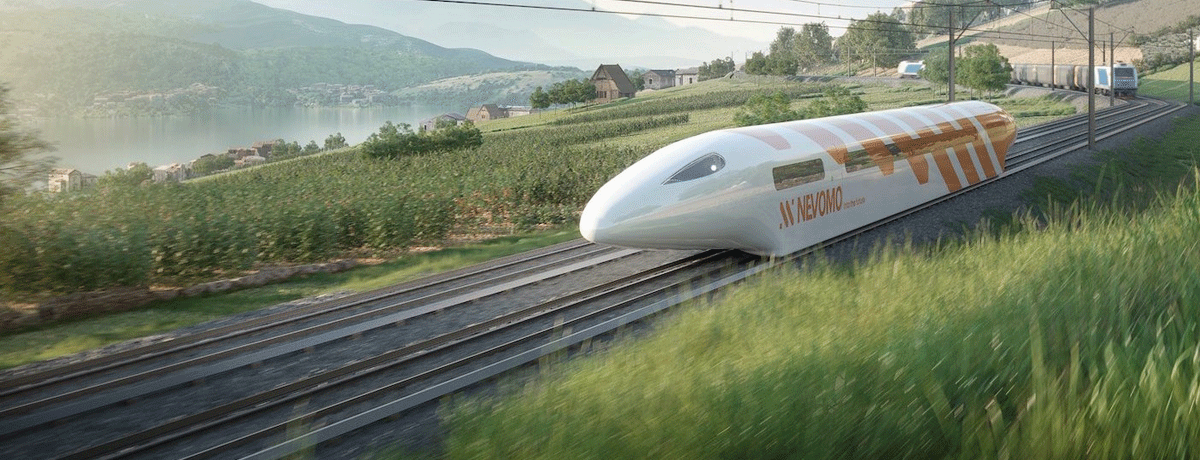
There’s a company in Poland called Nevomo who think you can go one better than high speed rail. Their research is about retrofitting railway lines for magnetic levitation.
Magnetic levitation, or maglev, is the most advanced railway technology in the world. It does away with locomotives and uses electromagnets in the tracks to propel carriages along at frictionless speeds. Despite being a proven technology for over a hundred years, high costs have restricted its use to a handful of lines in China, South Korea and Japan. That might change if Nevomo get their way.
Nevomo started out as a partnership working on Hyperloop, and they have brought the engineering expertise they developed to bear on existing railway infrastructure. Their plan is to retrofit railway lines and their rolling stock to a system they call MagRail, an electromagnetic upgrade to the rail system. The easiest place to start with this is at ports and cargo depots, where containers could shuttle around on trucks without needing an engine to pull them.
As the technology develops they would start to bring magnetic upgrades to inter-city corridors, allowing for faster and more flexible inter-city travel that would use both magnetic propulsion and levitation. In the long term, these new lines could seamlessly integrate with a hyperloop network.
There are a number of interesting things about this. First of all, it uses existing lines, which spares the huge land needs of new rails, and the loss of woodlands and habitats.
By re-using existing infrastructure, Nevomo’s sytem also cuts out the embedded emissions from building new lines, bridges and tunnels. This is an enormous saving in concrete and reduces the climate impact of rail travel. It also re-uses existing trains, at least in its initial phase as a bridge technology. This is an idea fit for a circular economy.
With all this re-use going on, there are considerable cost savings, and those savings continue into operations. Magnetic systems, with their frictionless running, are in theory lower maintenance and could prove cheaper to run.
I’m not the right person to judge the feasibility of all of this. Perhaps it’s too good to be true, and in a few years’ time nobody will remember it, another transport start-up that didn’t come to anything. But last month they achieved a world first and levitated a rail car on an existing track, showing that it’s possible. Nemovo has signed agreements with Duisport in Germany and SNCF in France to assess the technology and see if it could be integrated. It’s further along than it might appear.
Hyperloop itself may turn out be the very definition of a pipe dream. MagRail, which takes the best ideas from Hyperloop and retrofits it for the passenger and cargo rail networks we already have, may be a more practical, affordable and sustainable solution.
 The Earthbound Report