“Energy experts are calling for urgent government action to prevent a looming global environmental disaster,” warned a BBC news article earlier this year. The potential ‘environmental disaster’ they refer to is waste solar panels, and stories about them are very common.
You’ve probably seen them. If the journalist is being lazy, they probably called it ‘clean energy’s dirty secret’ – a headline that practically every news outlet has run at some point as if they were the first to think of it. What’s often missing from these stories is some perspective.
Before I go any further, are there going to be a lot of used solar panels to deal with? Yes.
Is that a waste problem? Not necessarily.
You can recycle solar panels. Landfill is not their inevitable destiny. As I’ve written about before, the world’s first recycling plant dedicated entirely to solar opened in France recently, and it can deal with the entire country’s waste PV panels as they get to the end of their working lives.
If we want to avoid a ‘mountain’ of used solar panels, we need to be following France’s lead. We can incentivise recycling and tax landfill so it’s not a cheap and easy option. We could fund research and development into efficient and cheap recycling methods for solar. We could use tax breaks and subsidies for recycling firms. We could use regulation that makes solar companies responsible for end of life panels. Ideally solutions would support a market for used PV panels that captures the materials in them within a circular economy.
Contexts vary and I don’t have a policy prescription in mind. The important thing is that those “calling for urgent government action to prevent a looming global environmental disaster” should be suggesting action along those lines – not calling for a delay or a rethink of the idea of clean energy. And here’s why: the stories about ‘clean energy’s dirty secret’ almost always focus on the waste from solar, and don’t put it in perspective.
Here’s a graph from a study that was published last week. It shows where waste PV falls in the context of other waste sources:
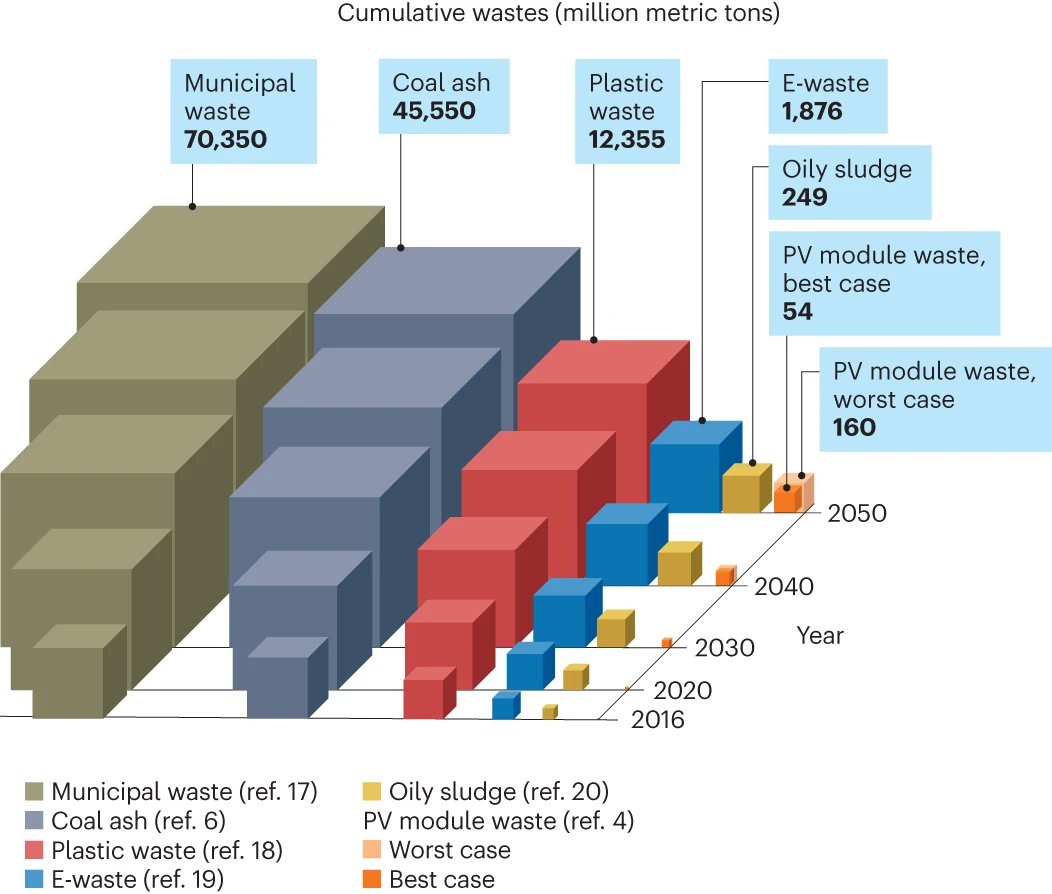
The graph here shows cumulative waste, with some troubling predictions for the amount of waste the world will be dealing with by 2050. Solar is the orange cubes on the right. Yes, there could be a big pile of used solar by then, and that pile will contain materials worth an estimated $15 billion – so let’s unlock that potential and reuse the materials!
The comparison in the graph that jumps out to me is between solar and coal. Coal-fired power stations produce vast quantities of ash, and it all has to go somewhere.
To take the UK as an example, 2014 was kind of the last hurrah for coal in Britain, and that year we had to deal with 3,800,000 tonnes of coal ash. Some of it was put into concrete or grouting. Some was used as a landscaping material to make embankments, or as bulk for land reclamation. That year was the high point of coal ash re-use, with around 70% used somehow and the remainder going to waste. In the years up to 2014, Britain was sending around two million tonnes of ash to landfill every year. Since we were producing more than we could reuse, year after year, Britain had a ‘stockpile’ of 50 million tonnes of coal ash.
So consider this: under a best case scenario, the total global solar PV waste would be 54 million tonnes by 2050 – around the same as the legacy coal ash mountain from the UK alone.
Under a worst case scenario there will be 160 million tonnes of waste solar panels by 2050. By that point there will be 45 billion tonnes of coal ash to deal with around the world.
It’s important to hold these comparisons in mind when we read scare stories about the waste ‘mountains’ from renewable energy. They’re molehills compared to the mountains of waste already created by dirty energy sources.
If we’re worried about waste, then coal should be the priority. And what’s the cheapest form of energy generation, the only one that’s cheaper than coal for most of the global south? Solar!
If governments don’t act to encourage recycling, there may be a big pile of discarded solar panels by 2050. But every used solar panel will have saved a much bigger pile of waste from the coal that it displaced, while lowering emissions and cleaning the air at the same time.
 The Earthbound Report
I have heard about the mountain of old solar panels several times, but I don’t think I have heard where they have come from. Is it from huge solar farms or from peoples roofs etc.
The other thing I haven’t heard is why they have stopped being used, are they broken, declining efficiency etc. Now I’m not an expert on these things, not even knowledgeable on them, but it seems to me that the best way to use solar panels that the original owners don’t want is to use them in a secondary market. Even if they are not very efficient they will probably produce more electric that a bare roof. It must be possible to have some sort of cheap or subsidised way to install older panels. I don’t think I have ever seen a second hand panel for sale.
Unless there is a good reason it seems like a win-win to me, less waste, more electric.
Jim
Some will be broken. Storms do damage panels from time to time, including high winds or even large hail. Most of them will be reaching the end of their life – panels installed in the late 90s and early 00s.
The problem with a secondary market is that the installation cost is a big part of the expense. PV panels aren’t very expensive (mine were around £200 each) and if you were installing inefficient end-of-life panels you wouldn’t recoup the costs of the labour, delivery, scaffolding etc.
You could arguably get some value for them if they were ground-mounted or sold to a DIY market for sheds and garages perhaps, but that wouldn’t be practical at scale.
The best thing to do is invest now in proper recycling facilities. As more and more panels reach the end of their life, those facilities will become more important – and make more money too for those with the foresight to get involved now.
Solar panel recycling will become more advanced and a market in itself. No reason to worry.