
Around this time last year I wrote about how we had got a battery system installed in our house. It was discounted as part of a community buying scheme, and we bought it to support our solar installation. With a year of data, I can now see what difference it has made to the amount of our own energy we can use.
The graph below shows the amount of free electricity we get from the solar panels, before and after installing a battery.
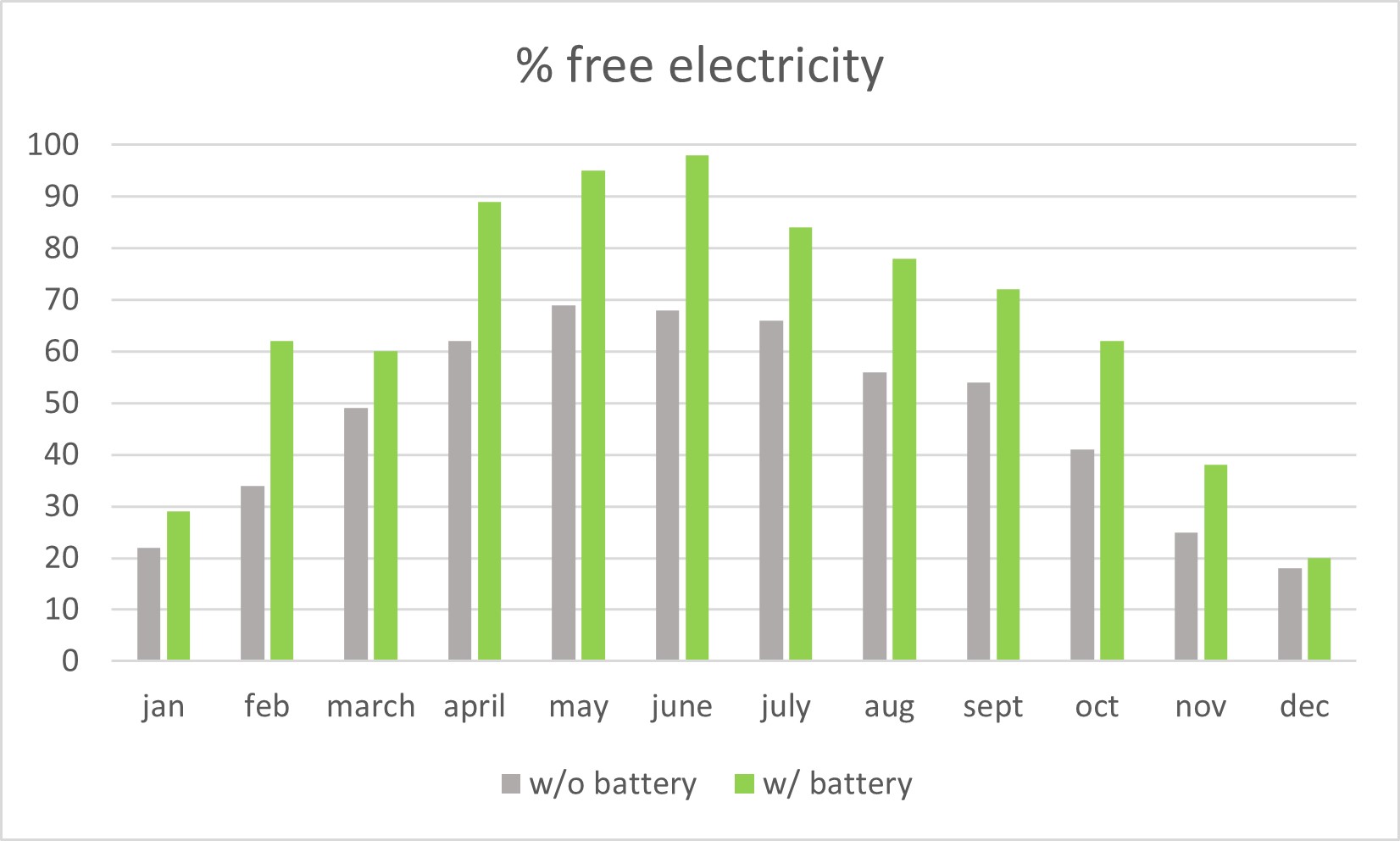
Before fitting the battery, we were getting around half our electricity from the solar and half from the grid. With the battery we’re now getting two thirds from the solar and one third from the grid.
Our usage here includes the electric car, which we charge from home. So the savings on our electricity apply to both the house and the car.

Like any solar installation this far into the Northern Hemisphere, there are big seasonal variations. Light levels drop to their lowest in December and the battery doesn’t make much difference then. From January onwards it’s making a contribution to savings, peaking in early summer where we were 98% self-powered. We’d hit those kinds of levels for more of the year if we weren’t charging the car, as the need to occasionally charge on a cloudy day is what keeps us from self-sufficiency.
As for what the long-term payoff will be and whether it’s ultimately worth it, time will tell. It partly depends on future energy prices. The price to buy electricity is so much higher than the price for selling surplus, even with the feed-in tariff, that the case for using our own power improved considerably in the last couple of years. That’s important for us as we plan to fit a heat pump at some point, and it will help to reduce the costs of all-electric heating.
I wouldn’t necessarily suggest that everyone who has solar panels needs a battery. If you have a tank, you can use the surplus to decarbonise your hot water. (We don’t have a tank in our small terraced home.) You can also treat an electric car as all the battery you’ll ever need, and put the surplus into it with a smart charger like the Zappi. But if you’re having solar fitted, it’s increasingly common for installers to offer a battery at the same time. That keeps costs down and it may be well worthwhile.

What I learned from getting an EV charge point
Yesterday the electrician was round to fit a domestic charge point to the front of the house. We can now charge the car without having to run a cable through an open window, which is just in time for the first sub-zero temperatures of the season. For the benefit of anyone else considering one, here…

How we insulated under our floors
Regular readers will know about my plan to get our house to an A rating by 2020, and net zero by 2025. I missed the 2020 deadline due to the government mis-handling the Green Homes Grant, but this week the underfloor insulation went in. I won’t be commissioning a new Energy Performance Certificate to confirm…

What I learned from having external insulation fitted
One of my current projects is to try and get our 1920s terraced house an A rating for energy efficiency by the end of 2020. Some of my plans haven’t worked – underfloor insulation was thwarted by a complicated and only partially accessible crawlspace. Solar heat storage came to nothing because we don’t have the…
 The Earthbound Report
Hi Jeremy, you might want to consider using the Octopus ‘Cosy’ tarriff as I think batteries really help if you have a air source heat pump. cheers Henry