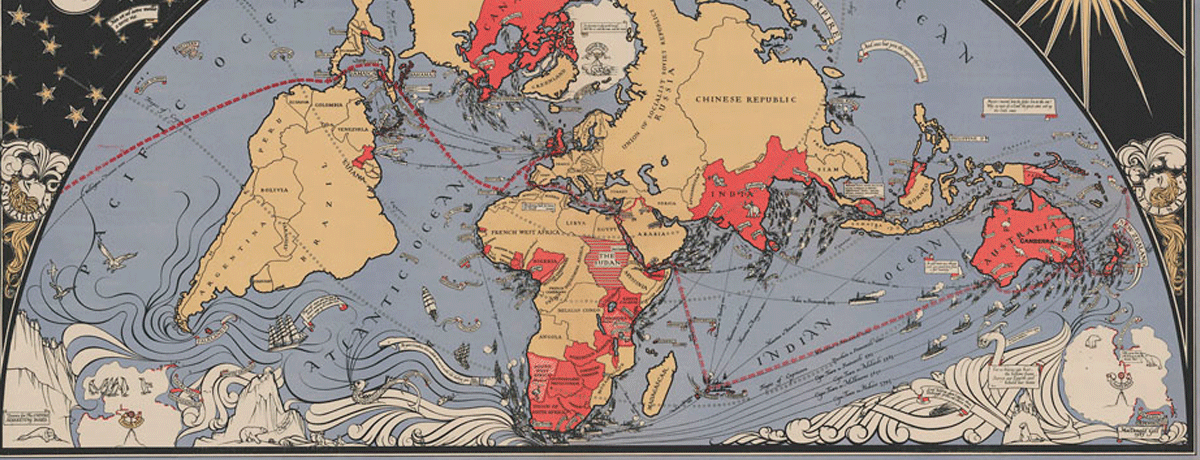
When I give presentations about climate justice, one of my central themes is that climate change is unfolding in a historical context. It isn’t happening in a neutral world, but one that has been shaped by events. It is occurring within the ongoing legacy of colonialism, and the unequal power structures of empire are shaping the impacts of climate change and how we respond to them.
Carbon Brief have just published a really useful piece of work that I may well be drawing on for future talks, looking at the distribution of carbon emissions when colonialism is taken into account. Colonial powers were responsible for what happened in their overseas territories. This has now been calculated for the first time, making it possible to re-allocate some historic emissions to where they belong.
India was part of the British empire, first governed by the East India Company and then under direct rule. Shouldn’t the emissions from that era be counted to the UK’s total emissions count rather than India’s? That includes emissions from deforestation, which in many colonies outweighs any emissions from fossil fuels or industry. Where forests were cleared for plantations, for example, those emissions belong squarely on the colonist’s carbon account.
Re-allocating emissions to include colonial rule increases emissions for former imperial powers, and reduces them in former colonies:
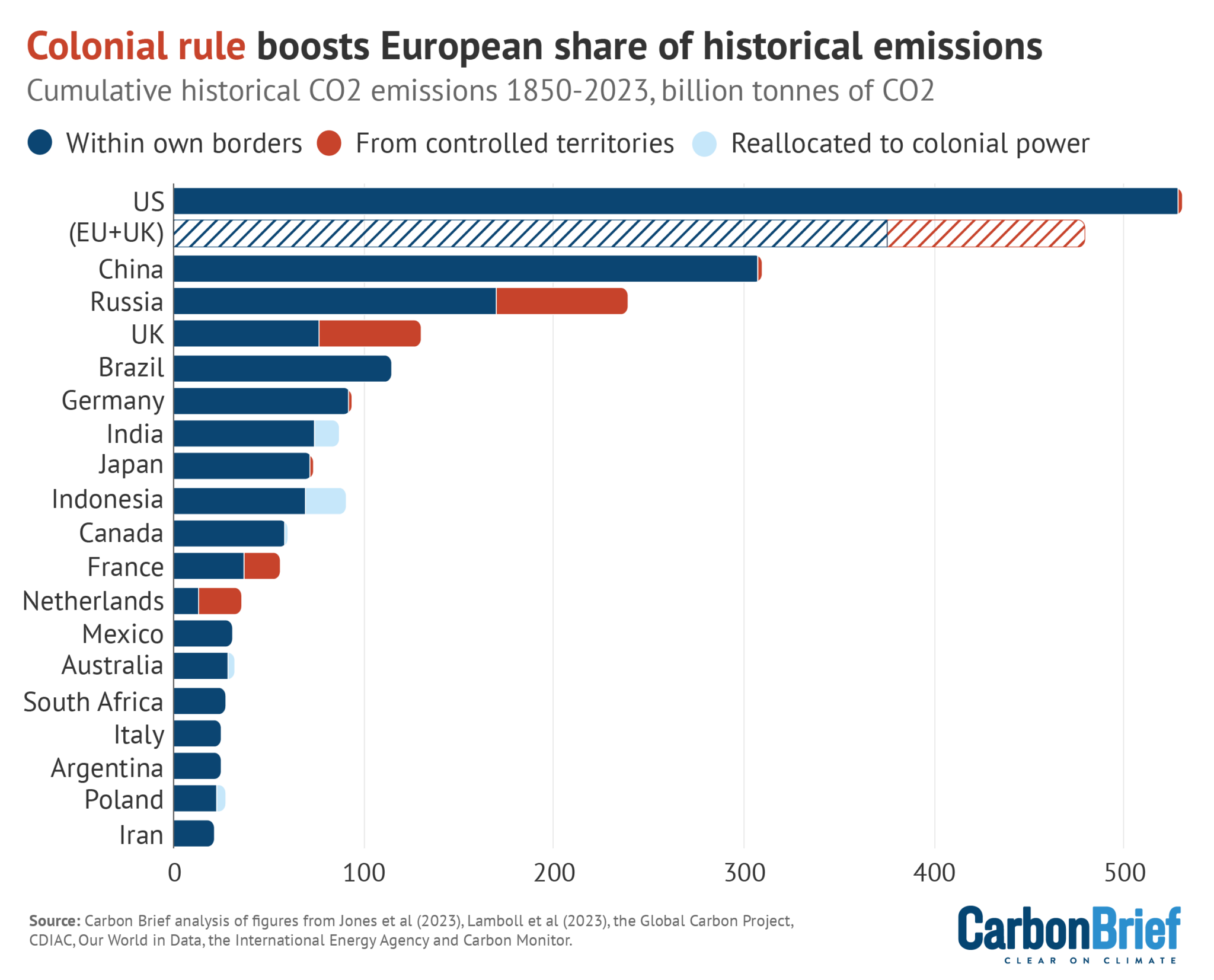
With the vast empire we insist on boasting about even today, the UK’s emissions are considerably larger here, adding a hefty 53.8 billion tonnes of greenhouse gases. Russia’s emissions rise too, as a result of its control of the USSR.
Emissions in Indonesia are reduced, on the other hand. A generous share of its carbon account is handed back to the Netherlands, reflecting the massive deforestation that occurred to plant tobacco during the colonial era.
“Historical responsibility is ethically complex,” the Carbon Brief authors acknowledge, “but it is clear that colonial powers had a significant influence on landscapes, natural resource use and development patterns taking place under their rule. It would be hard to justify ignoring this completely.”
 The Earthbound Report
I found this interesting, and it seems somewhat relevant here:
https://www.theguardian.com/environment/2023/dec/07/visualised-how-all-of-g20-is-missing-climate-goals-but-some-nations-are-closer-than-others