
Last year Prime Minister Rishi Sunak congratulated himself for scrapping plans to make households sort waste into seven different bins. The plan mainly existed in Rishi’s mind, which made if very easy to scrap. But it does raise an important question – how many bins is the right number?
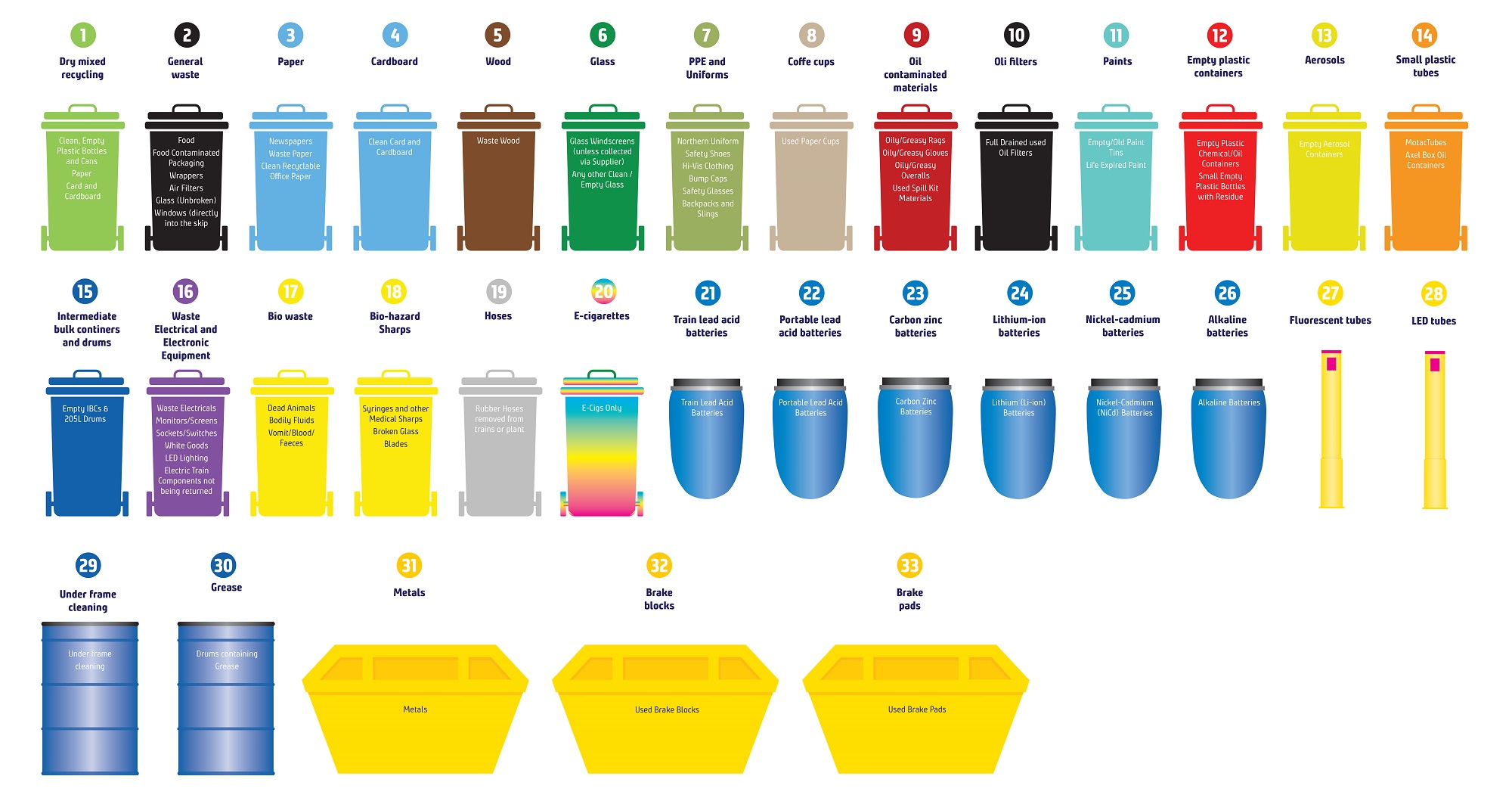
I ask because I had a press release recently from the Northern rail company, who currently sort their waste into a total of 33 different bins. Rishi would spontaneously combust at the thought of it.
Why 33? Because a train company will have a lot of specific forms of waste. Like grease, hoses and oil filters. Some are entirely specific to trains, such as the ‘train lead acid batteries’ that presumably nobody else has. Here’s their list, including a very colourful bin for e-cigarettes, as I guess all the other colours were taken by the time that vapes were invented.
Waste segregation matters because the more specific you can be with a waste stream, the easier it is to recycle. A good clean waste stream delivers high quality recyclate, whereas mixed waste can only really be sent to an incinerator or to landfill.
Ideally citizens would all scrutinise their plastic packaging, clean it and sort it into individual grades. We’d diligently separate different colours of glass, and saw off the metal end of Pringles tubes with the bread knife so they can be recycled separately. We don’t, because most people don’t have time to endlessly sort everything into increasingly specific piles, so there’s a trade off for convenience. The easier it is, the more people will do it, so all recycling schemes are trying to find the balance between quality and scale. Technologies that can do some of the sorting for us have made the whole thing much easier, and funding for sorting machines is what Rishi should be thinking about if bin proliferation concerns him.
Businesses are able to negotiate the balance differently, so Northern’s 33 bins don’t need to be burdensome. They’re not stuck with the lowest common denominator solutions that councils have to find for household waste, and they can train staff to handle waste correctly.
Neither is it likely that anyone at Northern is navigating all 33 bins. If you work on cleaning the trains, you’ll mainly be sorting consumer waste and will have no need for the skips full of brake blocks. If you’re working on maintenance, you won’t be concerned with coffee cups and newspapers. Ideally you have the waste processing you need for your job, well located within the work flow, and you won’t even notice.
This is certainly how it works in households, where we find the waste solutions we need for our lifestyle and family members. This is so normal that we don’t really give it a great deal of thought, but if we were to put together all the different locations, stores, boxes and bins we use as we process waste for disposal or reuse, it would almost certainly be more than 7.
Out of interest, I started thinking about the ones in my own house. For a start, there are the official ones:
- General waste ‘black bin’
- Mixed recycling ‘green bin’
- Garden waste ‘brown bin’
- Glass box
Then there are a whole range of other places and ways that waste is informally sorted within the household. Some things are saved for reuse or for passing on so others can reuse them. Other waste sites serve as holding posts for things that have to be disposed of more carefully. Here are some of them:
- Compost bin under sink, for conveying to wormery or garden compost
- ‘Bag of bags’ (everyone has one of these, right?) for reusing plastic carrier bags
- Sharps box for needles, separate one for used insulin pumps
- Box in a drawer for used printer ink cartridges, ready for re-use
- Box in drawer for used batteries, emptied periodically when at the supermarket
- Scrap paper file
- Shredded paper reserve for wormery
- Shelf of used paint tins in shed for when I can be bothered
- Good quality scrap wood pile for DIY projects, intermediate scrap wood pile cut into strips for the rocket stove, junk wood pile for taking to the tip.
- Box in the loft of empty honey jars saved for Mum, and handed over every now and again for her bees to refill
- Basket of out-grown clothes, toys, etc destined for the charity shop, dropped off every couple of months. Another bag of higher quality out-grown stuff in the loft for passing on to younger nephews and nieces.
- Multiple piles of books (don’t get my wife started), sorted by theme for passing on in relevant places
There are probably others, and they change with our household circumstances. There was a happier time when we didn’t need the sharps bin. I was delighted to be rid of the nappy bucket. I’m sure you have your own little processes in place.
So how many bins is the right number? It’s kind of impossible to say. The better question for a politician to ask is how many bins a council should provide, which is what Rishi was on about. But waste processing goes well beyond the official set of bins. As Northern testify, and my own household, we all use multiple solutions to process the waste that we generate. The important thing is to be mindful of waste, deliberate about reducing it, and efficient in the ways we reuse and recycle.
 The Earthbound Report
Well it would certainly help if we could more fully understand what we can or cannot recycle apart from the obvious such as glass jars and most plastic bottles
I don’t know how it works where you are, but where we are, the municipality provides recycling bins and should also provide a flyer saying what they do and don’t take. For some things, I’ve had to search the local government’s website, but they usually do provide the info somewhere. Good luck!