A couple of weeks ago a friend wrote to me about their frustration that climate change was scarcely visible in the election. How could something so important be so overlooked in the conversation? I replied that you could probably say the same about education, healthcare, the constitution, Brexit, and a number of other things.
To me it feels like this election has been about reactivating the possibility of change, rather than specific policies. The Labour party seems to get this, and just called their manifesto ‘Change’. The subtitle is ‘my plan for change’, and the first sentence is ‘this election is about change’. Got it.
With the results in and the new government at work already, it’s worth asking now what we’ve actually won. In particular, what green policies are in that manifesto and what can we expect in the coming months? Here are some highlights.
Clean energy: The headline promise from Labour is on clean energy, and the formation of a publicly owned energy company. It shall be known as Great British Energy, because gone are the days when you could just call things British Gas, British Airways or British Telecoms and the greatness was implicit. GBE will have a remit to reduce energy costs, create jobs and improve the country’s energy security. It will be funded in part by windfall taxes on the oil and gas industry, though the plan is to give the sector confidence and release more private finance for clean energy.
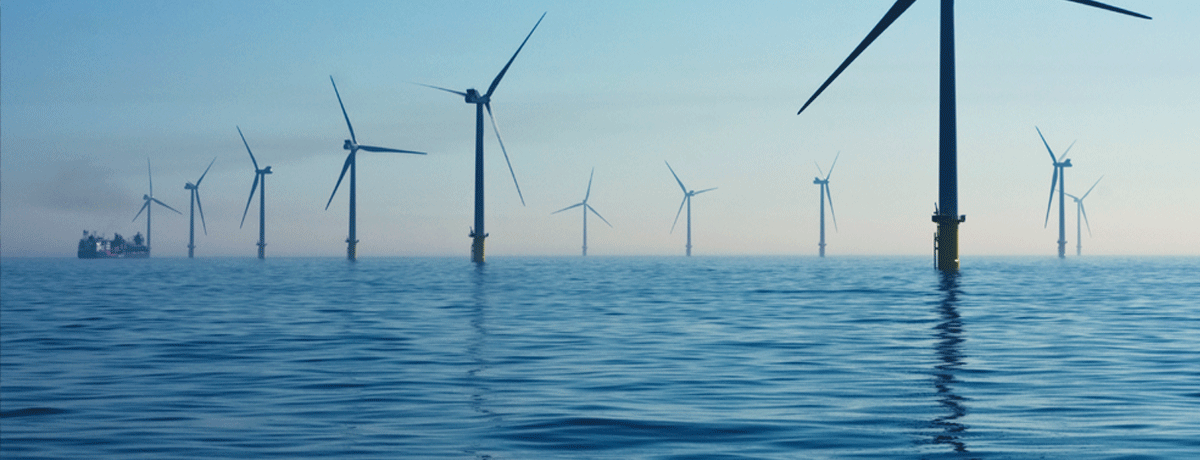
Borrowing the ‘mission’ terminology popularised by Mariana Mazzucato, Labour have set a target to complete the transition to zero carbon electricity by 2030. That will include nuclear power and the Small Modular Reactors so beloved of politicians. It also means the return of onshore wind. Wasting no time on this, the planning ban was lifted yesterday, inconsiderately requiring me to update this post that I had written and scheduled over the weekend.
Electric cars: What have we got on transport? Well, Labour pander to the motorists here by beginning this section with the observation that “cars remain by far the most popular form of transport”, and they won’t be challenging that. They didn’t last time they were in power either. But they plan to invest in charging infrastructure, and they’ll restore the 2030 date for the phase out of fossil fuelled vehicles – one of the Conservatives’ good ideas that they then panicked about and revoked.
That’s all fine, but of the better options they could have chosen, there is one passing mention of active transport and nothing specific on cycling and walking. This is a shame, because after Covid Boris Johnson’s government made some promising noises on active transport after Covid. They were promptly drowned out by Rishi Sunak’s Mister Toad impression, and all the co-benefits of a real active transport strategy are sitting there waiting for a politician to pick them up.
Nationalised railways: The word ‘re-nationalise’ has been deliberated avoided, but there are plans to take the railways back into public ownership as contracts expire. While this might have been a radical idea ten years ago, the Conservatives had quietly begun the process with the creation of Great British Railways. If it’s done well, it could mean more affordable train travel and a more integrated system.
Buses get a look in too, with plans for more locally owned bus services. I don’t expect any action on aviation, beyond throwing some money at sustainable fuels.
Better homes: The manifesto includes “steps to ensure we are building more high-quality, well-designed, and sustainable homes”, and “places that increase climate resilience and promote nature recovery.” For existing homes, there’s the Warm Homes Plan. This has a sizeable £6.6 billion earmarked for grants and low interest loans for home improvement, making homes warmer and cheaper to run. I look forward to the roll out of this programme, as it would be almost impossible to do it worse than the Green Homes Grant and the Green Deal before it.
Those planning an inverse treehugging movement where people glue themselves to their gas boilers will be disappointed. Labour get ahead of the scaremongers and explicitly promise that “nobody will be forced to rip out their boiler as a result of our plans.”
Nature restoration: The manifesto includes three new forests and the ubiquitous tree planting – even the Reform manifesto includes tree planting. There are plans to clean up the country’s rivers and make water companies pay for pollution.
The green economy: We are promised investment in the new economy, including a billion for green hydrogen, funding for carbon capture and storage, support for battery manufacture, and support for the circular economy. There’s something called the Green Prosperity Plan, which immediately loses points for not being called the Great British Green Prosperity Plan, but we’ll take it anyway.
One benefit of Labour’s philosophical approach to climate change is that jobs and skills become more important. In their support for the green economy, Labour hope to direct new jobs towards areas that have been left behind, including “industrial heartlands, coastal areas, and energy communities.” To protect these jobs, a ‘carbon border adjustment’ will price in the cost of carbon when goods are imported.
The end of fossil fuels: Perhaps the most profound measure in the Labour manifesto is the phased withdrawal from fossil fuels in the North Sea. They foresee a just transition that winds down production over time, with infrastructure re-purposed for carbon storage. No new licenses for oil and gas will be issued, and none will be revoked either. It will be slow, a matter of decades, but it is a notable change in direction. The Conservatives, if you remember, had (meaninglessly) written it into law that they had to maximise extraction of the North Sea reserves.
In a nod to Scotland’s role in fossil fuels, Great British Energy will have its headquarters there.
How much of this will happen, how fast they get round to it and how well it’s done are all open questions. There’s a lot on the to-do list beyond environmental issues, and so this is all about the possibilities ahead. We shall watch this space.
 The Earthbound Report
Better to soend mire time learing and adaptiing to living with less energy than converting to green energy.
Am glad nobody will be glueing him or herself to a gas boiler to prevent Labour’s ripping it out of a home. Ha!