
Thursday this week was Earth Overshoot Day, as calculated by the Footprint Network. Overshoot Day marks the point in the year that humanity uses up the resources that the planet can renew every year, and goes into overdraft.
You can spend more money than you earn each month, but it stacks up as debt. It’s a similar situation with natural resources. We can use more than the planet can renew, but we pay for it in deforestation, soil erosion, depletion of fish stocks and declining wildlife. The environmental equivalent of a bank overdraft is called an ecological deficit, but overshoot is easier to say. This year the global Overshoot Day falls on the first of August.
Overshoot Day is usually presented as a moment for hand-wringing over the state of the world, and I have written such posts in the past. In reflecting on it this week, I’ve come to the conclusion that there’s more to the story. Let me give you two reasons why we might come to view Overshoot Day more positively.
First, not everyone has an Overshoot Day. Global averages always mask an inequality in consumption that makes it unfair to talk about ‘humanity’ as a whole. Lots of countries don’t have a deficit at all, and produce more resources than they use. Those of us living in consumer economies depend on those producer countries to keep the show on the road. Here’s a map, also from the Footprint Network, of environmental surplus and deficits. Only the countries in pink or red actually have an Overshoot Day.
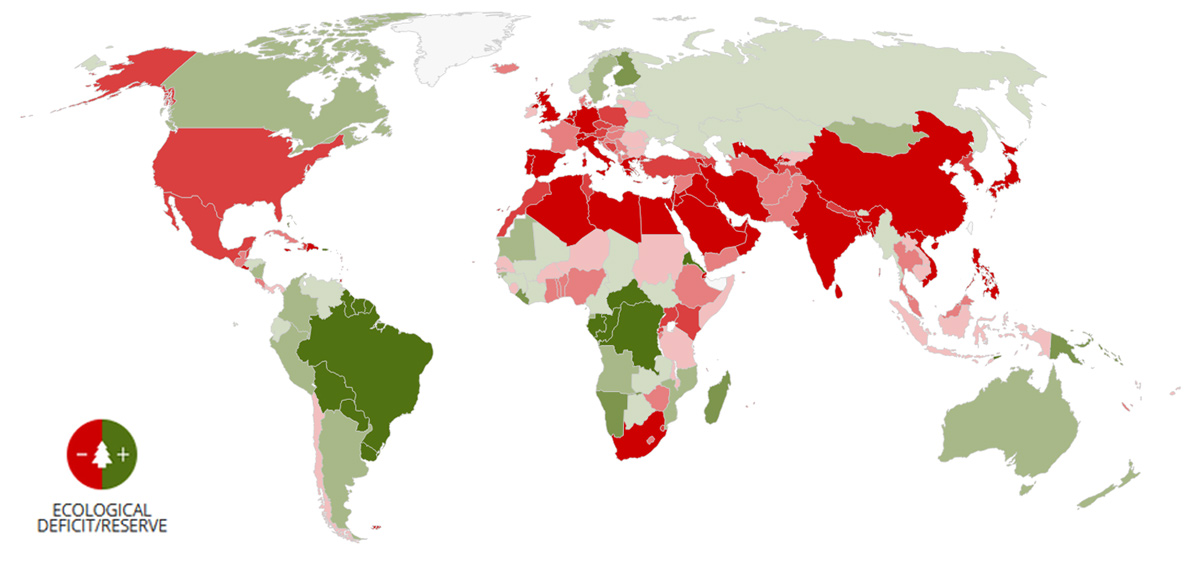
As you can see, countries with huge amounts of land don’t overshoot: see Canada, Australia and Russia. Neither do poorer countries where people aren’t getting enough, which is why so much of Africa is in surplus, though there’s nothing to celebrate there. Most promising are the parts of the world that provide a good standard of living without ever going into overshoot. Note Scandinavia here, and almost the entire continent of South America.
What this tells us that Overshoot Day is not a global problem – it’s more localised and more specific than that. Solutions will look different in various parts of the globe – reducing consumerism in some places, increasing it sustainably in others. And most importantly, there are places that clearly demonstrate that a sustainable way of life doesn’t mean a return to the stone age.
A second hopeful observation can be found in the way that Overshoot Day has moved over time. It first shifted into unsustainable territory in the early 1970s. Since then, the date has crept down the calendar and today it falls on the 1st of August. But look – it was August 1st in 2018 too.
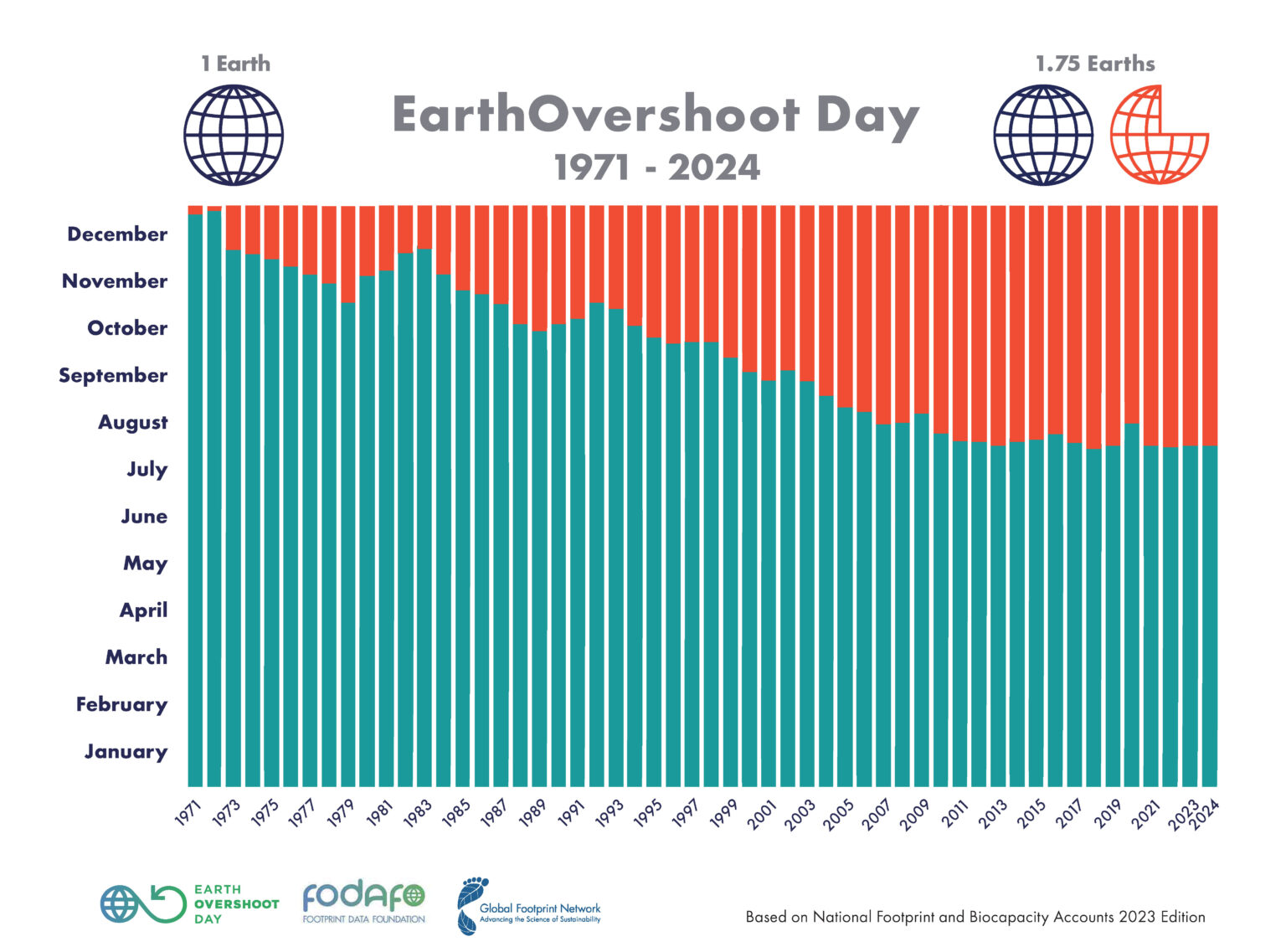
Obviously using up our resources by the summer is spectacularly unsustainable, so I’m not hailing a great triumph here. But look at the pattern in the graph above. There was a dramatic increase in consumption throughout the 80s, 90s and early 00s. It began to plateau in the mid 00s and has now paused. It took just six years for Overshoot Day to drop through September. We’ve now been in August for almost two decades.
In other words, we are no longer accelerating towards disaster. We’re holding steady (still towards disaster), and perhaps in the next couple of years we will begin reversing the decline. Maybe next year we’ll begin to move that date back up the calendar.
If that sounds overly optimistic, consider that since 2010 a billion more people have been added to the global population. The number of people living in extreme poverty has fallen, and a significant number of places have been reclassified as middle income countries. A lot of progress has happened without increasing environmental decline. Why? Because in the last ten years we’ve seen the ramping up of renewable energy and circular economy practices. Land restoration and reforestation are picking up the pace and rebuilding environmental capacity. In other words, we’re winning.
Well meaning people write me grumpy letters when I say things like this. There’s an instinct in green circles to poke holes in good news because scaring people with bad news is so integral to the culture. But good news doesn’t lead to complacency. It’s motivating.
Don’t get me wrong: things are in a terrible state, there’s no doubt about that. There’s a long way to go and progress can be overturned. But the environmental movement is in a different place today than it was ten years ago. Our task now is to finish what has been started, to accelerate the change and include more people in its benefits, to complete a transition that is already underway.
At some point in the near future, Overshoot Day will begin retreating back up the calendar. At that point its significance will flip into reverse: it won’t be a marker of decline any more. It will track our progress towards a sustainable future.
 The Earthbound Report
Great blog on this one Jeremy as I have follow each Overshoot Day each year with you… I am also in a similar mindset that we can’t keep on with doom and gloom as there has to be a new way to report on information. I try to use a good blend of optimism and realism – something that is generally positive but grounded in realism and not utopian and blindly optimistic or too dark and heavy in realism… Thanks for keeping up with the many years and progress of advocacy and communications of climate action and social justice!
Thanks d’Arcy. There’s a fine balance to be walked. Things are obviously bad and we can’t pretend otherwise, but I find it frustrating how often we hear people complaining that ‘nothing is being done’. Lots is being done! Some of it is working, and if it keeps on working and we can scale it up, we win.
Hello Jeremy
Many thanks for this, as always your insights are so interesting.
I have been asked to do a small piece for my local parish magazine to encourage our community to keep recycling and indeed recycle more, could I have your permission to use your first 2 paragraphs from this piece to start the article?
Then I am going to take two items that can be recycled and hopefully show the reduction in energy use and in the use of resources if we recycle, or even better don’t consume in the first place.
I will quite understand if you feel that the whole article belongs together.
many thanks Jill Shuker Volunteer and Trustee: Sussex Green Living
Of course, you’re very welcome to use those paragraphs!
Jeremy, thank you, you are a beacon of hope.