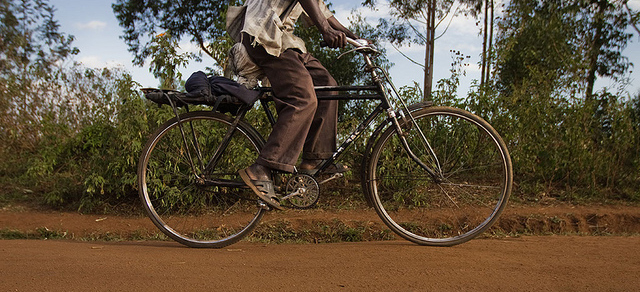
We travel the road to human development at the speed of a bicycle, argued Ivan Illich, who saw the humble machine as one of humanity’s finest ideas. You can keep your ChatGPT and your genome sequencing. For opportunity and empowerment, there’s no technology as powerful as a bike and everybody should have one.
That’s what Illich thought, and he’d have been encouraged by the results of a pioneering study in Zambia. Bike ownership has been assessed in a randomised controlled trial for the first time, and World Bicycle Relief published the results last week.
The study was conducted with 1,488 participants across 19 communities in rural Zambia, where most people do not have reliable transportation. Living in more remote areas, people are cut off from schools, healthcare or employment. Walking distances are often long and there is no alternative – except for bikes. To test the difference a bike could make, half the participants were given bikes and half were not, allowing for clear comparisons. The test group included ordinary adult citizens and 261 community workers. At the end of the trial, the control group all got bikes too so that nobody was left out.
Measurable differences emerged over the course of the year-long study. Households with bikes had 43% higher monthly incomes. The effect was higher for women, who made up a majority of the participants. The new mobility raised women’s self esteem and independence, with bike-owning women reporting an boost in life satisfaction.
There was an economic impact: with new access to markets and saving an average of 4.2 hours a week on travel times, business owners with bikes saw higher revenue. This was significant enough to offset the decline in incomes that many Zambians experienced during the trial, which took place during a drought. The rise in income allowed people to spend more. Average consumption was 24% higher in households with a bike, and they ate a more varied diet.
There were health benefits, both in accessing and in delivering healthcare. Those with bikes were more able to get to clinics, and community workers on wheels got to 63% more patients, improving healthcare access without hiring any more staff.
Education wasn’t covered here as the focus was on adults, but previous studies with young people have shown how bikes can reduce absenteeism and drop-out rates. Students saved an hour a day travelling to school, which raised participation in clubs and gave them more time for homework. There was a measurable academic impact, with students with bikes scoring better on maths tests.
“The study provides robust evidence that bicycles can significantly improve access to essential services, boost economic productivity, and build resilience in some of the world’s most underserved communities,” say World Bicycle Relief, and you can read the full report here.
 The Earthbound Report
Nice!