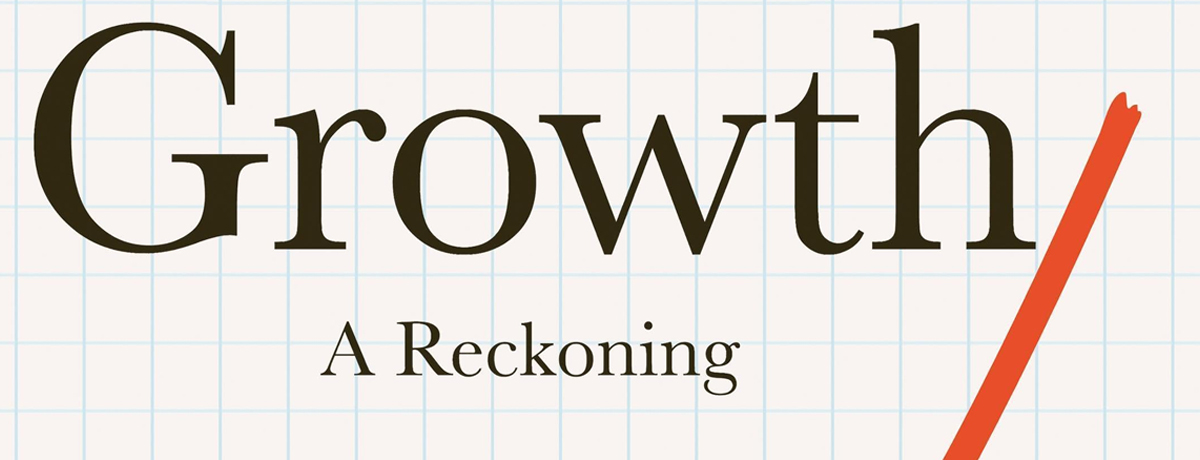
There is no political spectrum when it comes to growth. There is one God and one creed. In her brief tenure as Prime Minister, Liz Truss declared that she had “three priorities for our economy: growth, growth and growth.” In opposition that same year, Keir Starmer set out his radical alternative: “We need three things: growth, growth, growth.”

Economic growth can be transformational in the right circumstances, and it’s easy enough to see why politicians want to champion it. And yet we know that growth has been historically inseparable from energy and material use, and therefore from environmental destruction. Growth in a capitalist system drives inequality, and the unrestrained pursuit of it can undermine local economies and communities. We can’t live with it and and we can’t live without it, and so growth is a genuine dilemma.
Describing it as one of our “most treasured and most dangerous ideas”, economist Daniel Susskind sets out to investigate this dilemma in Growth: A Reckoning. He begins with history, describing how static life was in the past. Centuries went by with no material improvement in people’s lives. No progress, no expectation that things might be better in the future. It’s easy to take this for granted on the other side of a huge wave of growth-driven progress.
This boom ran for two hundred years before anyone really spotted what was going on and how it could be measured. Then, once growth could be calculated through GDP, politicians and economists slowly began to shape policy around it. For all its ubiquity today, it’s a very modern obsession and one that Susskind endorses entirely. Not only do we need more growth, we need to ‘unleash growth’ and drive a second industrial revolution’s worth of it.
The book does engage with degrowth critiques, with a series of points that start off fair, and then tip into increasingly strong language as the chapter goes on. He takes degrowthers to task for saying that degrowth isn’t recession – it is, he says. He berates them for equating growth with capitalism. And then he goes in to bat for infinite growth on a finite planet. Nonsense, he says of the degrowthers’ maxim. There are “no meaningful limits to growth” because resources can be endlessly combined in new ways. Ideas are infinite, and anyone who says otherwise has a stunted imagination.
This is true in theory and I’ve said as much myself, but it’s only true in the abstract. In practice limits are experienced locally and specifically, as growth gets locked in through resources and the infrastructure to extract them. When a fishing industry collapses because fish stocks are exhausted, or a city runs down an aquifer, this is not a failure of the imagination. If you’ve just lost your job at a depleted mine, the fact that the earth’s atoms can be endlessly reconfigured to support new growth possibilities is quite literally academic.
Nevertheless, Susskind presses on with prescriptions for boosting economic growth, mainly through research and development and patent reforms. It’s all about ideas and technology. Only at the very end of the section on ‘unleashing growth’ does he acknowledge my nagging objection: that everything he’s describing would make things worse. There is no escaping the dilemma.
Instead, we need to learn to deal with the trade-offs, Susskind argues. Degrowth is “folly” and “catastrophe”. Further economic growth is non-negotiable, and if we cannot have economic growth, a liveable climate and equality all at the same time, we should appoint citizen’s assemblies to decide how to manage the trade-offs. This is a deeply unsatisfactory conclusion to a book that, for all its faults, I was rather enjoying.
Personally, I think the root of Susskind’s problem is that he doesn’t get far enough beyond the binary of pro-growth or anti-growth to recognise that growth means different things in different contexts. More for those who don’t have enough changes and improves lives. More for those who already have billions is meaningless. The book never spots this, never distinguishes between useful growth and wasteful excess, and the economic structures that today make most economic growth the latter.
Ultimately, Growth ends up as a smart book-length demonstration of the intellectual futility of talking about growth in the abstract. Neither we, nor any future citizens assembly, will solve the puzzle of growth while sorting it into two simple categories of for or against. We have to be specific: growth of what? And for whom?
- Growth: A Reckoning is available from Earthbound Books, but I suggest you read my book The Economics of Arrival instead.
 The Earthbound Report
Hi Jeremy and Callum, Keen to make an intro here as Callum is a recent grad from Dulwich College (Singapore) with a keen interests in physics, engineering and renewable energy or something around that space. He is currently on a gap year and looking for cool projects, people and opportunities. He’s likely to be based in Bristol with some flexibility but maybe you might know some good people doing good things… I wonder if it might be possible for Callum to give you a shout for a quick chat or get any thoughts or links you might have for him to get involved in paid of volunteer work to make positive changes… I should also add Callum is the oldest of my girlfriend’s three kids, a lovely smart guy and keen to see what might be out in the UK while he is there 🙂 If you are flat out Jeremy, no worries but thanks always for your contributions to the world and our collective knowledge.
Cheers, d’Arcy.