Do you remember the old days when a reusable cup was just called a cup? Now we have to be more specific, the rise of disposable drinkware coining a retronym. Disposable cups are now so ubiquitous that Britain gets through 2.5 billion of them a year, which is a bafflingly large number.
Although many people believe they can be recycled and loyally stick them in the correct bin for it, they’re not recyclable in any practical sense. They’re made of paper lined with plastic, and most have be sorted back out of recycling bins and incinerated. The genuine recycling schemes tend to be brand specific – like McDonalds for example – and capture a fraction of the total. Around one in 400 disposable cups gets recycled, according to a government report into the matter.
Solving the problem of waste cups ought to be simple, as there’s a very obvious solution in… you know, the cup. Unfortunately disposables and free and convenient, and remembering to bring your own cup is inconvenient, and so it doesn’t happen. I suspect it will continue to not happen until the government legislates to bring in a charge for cups, like they did very successfully for plastic bags ten years ago.
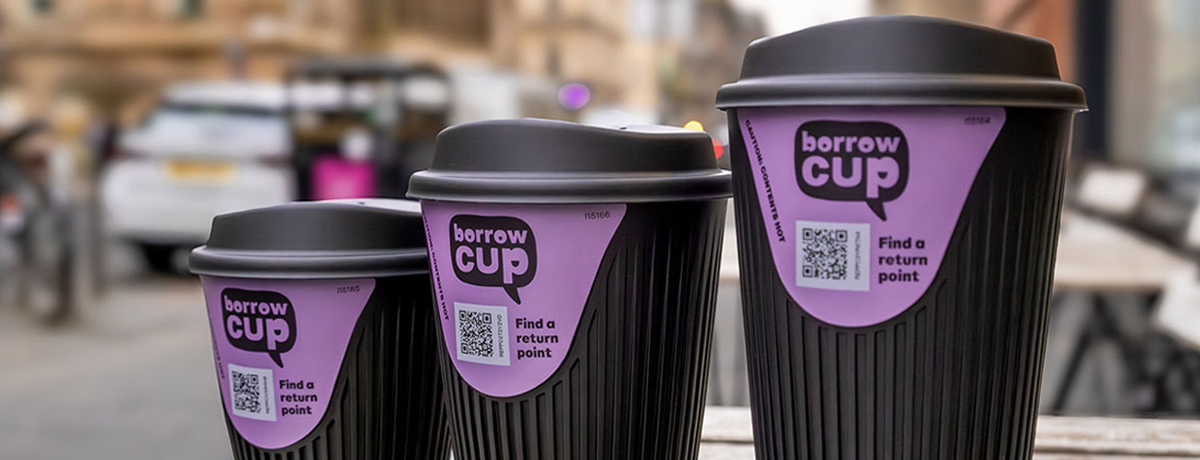
In the meantime, there’s a new idea on the block in the Scottish city of Glasgow: the Borrow Cup. Organised by circular economy pioneers Reposit, it’s an agreement between the city’s cafes that they will all use and accept back the same reusable cups. Customers who haven’t brought a cup of their own can order a drink in a Borrow Cup, and return it to any participating cafe. That won’t be hard, as the coalition has signed up independents and chains alike, with the multiple branches of Costa, Nero and Burger King among the 50 drop-off points. (Starbucks are notably absent, perhaps because they’ve been trialling their own cup borrowing scheme.)
Borrowing a cup costs £1 on the price of the drink, which you can get back when you return it. Or you can refill it and keep using it, or swap it for a clean one. Used cups are collected by Reposit, washed and redistributed to use again.
I’d be interested to know how this is funded, and whether it finds a user base – both with customers and businesses. It sounds like the kind of think that businesses might support when it’s new and there’s good PR to be had for participating, and no cost for quietly dropping it later. So it’ll be one to keep an eye on. It it proves sustainable and habit forming, it might be a useful middle ground between carrying your own cup and single use. Similar schemes in Germany in the past haven’t shown a proven reduction in cup waste, and so longer term solutions are surely going to need political action too.
How likely is legislation? That aforementioned government report was written in 2017 and recommended that “all single use coffee cups should be recycled by 2023. If this target is not achieved, the Government should ban disposable coffee cups.” The Conservatives ignored the recommendation and chose a voluntary approach, which went exactly nowhere. That’s not all their fault – the Covid pandemic made cafes wary of handling reusable cups, and the energy on the issue disappeared. Polystyrene cups were banned in 2023 and that’s as far as we’ve got.
One country that has acted is the Netherlands, where there is now a charge for disposable cups. There is now political pressure to scrap these rules because of the cost of living crisis, which shows that even the obvious solutions come with complications.
 The Earthbound Report
I cannot understand people – how are they not horrified by the waste they are creating and how can they not do everything they can to avoid it? And most of us grew up in a world where everything was washed and reused.