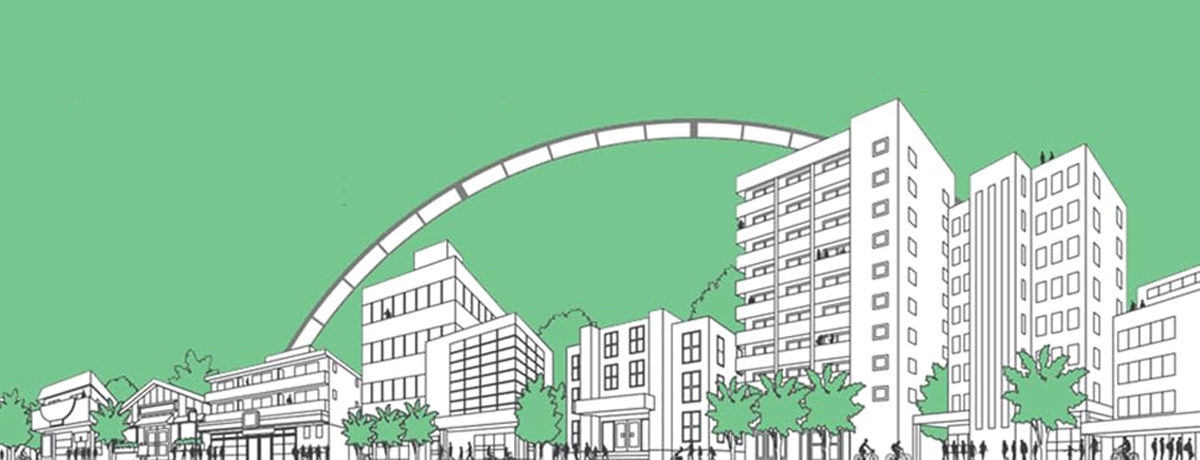

In the past, all cities were 15 minute cities. They were compact and human scaled. They were entirely walkable, because the proverbial shoe-cart was the only mode of transport available. Proximity was a necessity, and citizens would naturally expect to find their work and their home, the market or a place of worship within a walkable distance.
Motorised transport disrupted the pattern and opened up new forms of urbanism. Trams and trains made it possible to live in one place and work in another. Proximity wasn’t so important and so cities began to sprawl and extend. The car multiplied this again, with new visions of suburban living where people could live in an approximation of the countryside and work in the city. Everything was further away, and you could drive to the shops, to church, to the doctor.
Architects and planners re-designed cities with easy car travel in mind, prioritising movement between places. Older cities were carved up with new highways, and to see some of the unbuilt proposals for London or Paris is to glimpse a narrowly avoided dystopia.
“The successful city is the one that moves fast”, said Le Corbusier, the architect of some of these masterplans, but the end result was fragmented cities and scattered lives. Nevertheless, the new pattern was locked in through zoning laws. People will live here, work over there, entertain themselves here and shop there, and the traffic must be managed in-between.
Carlos Moreno, a Colombian-born urbanist now living in France, argues that it’s time to rebalance things in favour of proximity. The fracturing of cities has led to “alienation, loss of meaning and disconnection from our environment.” Many of the journeys we take are forced rather than chosen, and we need to “reclaim the time that has been snatched away from us by long commutes and forced travel.” His life’s work on liveable cities has led to a series of principles now known as the 15 Minute City, and his book details its spread around the world.
As the name suggests, the 15 Minute City is “an urban model in which the essential meeds of residents are accessible on foot or by bicycle within a short perimeter in high density areas.” Contrary to internet conspiracy theories – which Moreno ignores entirely in the book – these neighbourhoods are not enclosed in Hunger Games style walls. Quite the opposite: human freedom is at the heart of the idea, because it restores autonomy. It gives people choice, and it gives them their time back.
How? Through the twin strategies of diversification and densification. Reduce the distances between things. Plan services within easy reach, and create high quality public spaces that encourage people to slow down and inhabit a place. Make places that people love, and give them a stake in them.
One way to diversify neighbourhoods is with multifunctional spaces. A lot of buildings have one function and so they are only used 30-40% of the time. So how about lecture theatres that serve as cinemas in the evening, or cafes that re-open as nightclubs? Those school playgrounds in Paris that I admire are open to the public on the weekends, available for families to enjoy outside of school hours.
Paris features prominently in the book, as the city is several years into a 15 Minute City plan under mayor Anne Hidalgo. It has been a central feature of her election campaigns, extensively piloted and refined before being extended across the region. It means that the book is full of examples, not just theory. It works, and this is how you do it.
It’s also nice to see a really global set of ideas here. Moreno is based in France, but there are philosophical concepts of good urbanism from Japan, Latin America or the Ivory Coast. Since the 15 Minute City is now a global movement, there are chapters showing how it is being locally adapted in Portland, Milan, and Melbourne. It takes on a Korean twist in Busan, and a Tunisian one in Sousse. Scotland has a national plan, and Paris and others are adapting it to reconnect regions and suburbs in slightly different ways.
Whether it gets called the 15 Minute City or something slightly different, cities around the world are rediscovering proximity and undoing the damage from the age of the car. Moreno’s book is an excellent primer on why this is necessary and how it is done, firmly set in real places that are already benefitting from the transformation.
- You can order The 15 Minute City from Earthbound Books.
 The Earthbound Report
Thanks for the article, Jeremy Williams.
I believe the proximity-based city restores meaning to urban life. I suggest local implementation.