
A few years ago now there was a big drive to set more ambitious climate targets. Net zero emerged as the phrasing of choice, with the UK government aiming for 2050. I was involved in the Extinction Rebellion movement at the time, who were calling for net zero by 2025. Although that was clearly impossible as a nation, I figured it ought to be possible for us as a household.
If we reached net zero ourselves, we could test the ideas and the technologies that make it possible. We could demonstrate what a net zero lifestyle looks like, and prove that it isn’t the return to barbarism that the extremists say it is. It would bring an integrity to my own advocacy: I wouldn’t be calling on anyone to do anything I wasn’t prepared to do myself.
I set myself two targets: get the house to an A rating for energy efficiency by 2020, and reach net zero as a household by 2025. We met the first, with the EPC finding that our house produced 0.8 tonnes of CO2 a year, against a UK average of 6 tonnes. That was before the heat pump went in, which means it is now to all intents and purposes a zero carbon home. With that last big task done, I reckon we’ve met the second target too.
There are various ways that one could define a net zero household, and I chose a mainstream framework. I started with what the government thinks a net zero household might look like by 2050, and took that as my frame of reference. As I described in 2019, this was the Climate Change Committee’s best guess at the time:
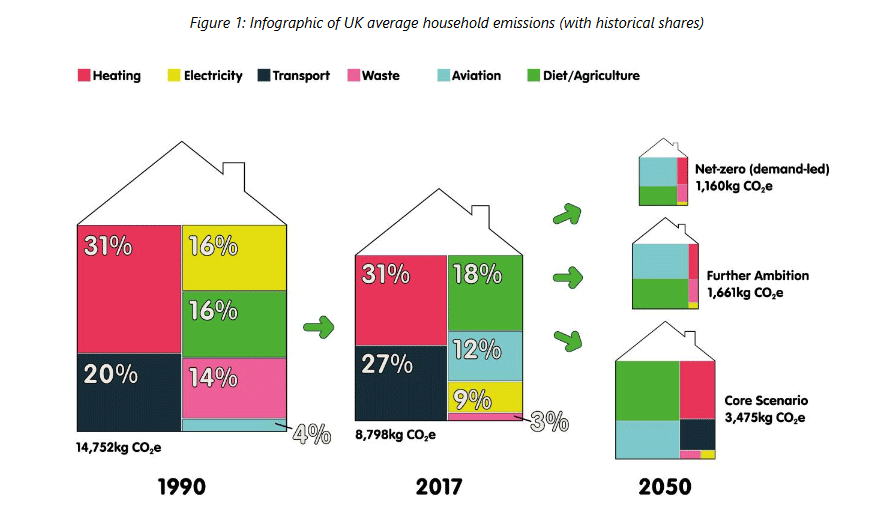
If we take these averages for a UK household, it gives us a series of priorities for heat, transport, electricity, etc. Here’s how we got on with each of those.
Heat – At 31% of average household footprints, heating and hot water is the biggest obstacle to sustainable homes. As I’ve written about in previous posts, we’ve installed external wall insulation, underfloor insulation, and a number of other features to reduce our heating needs. We were able to call on government support for some of this, which was very helpful. The EPC inspector scored the building at 94 out of 100, with the potential for 95, suggesting there was little more we could do.
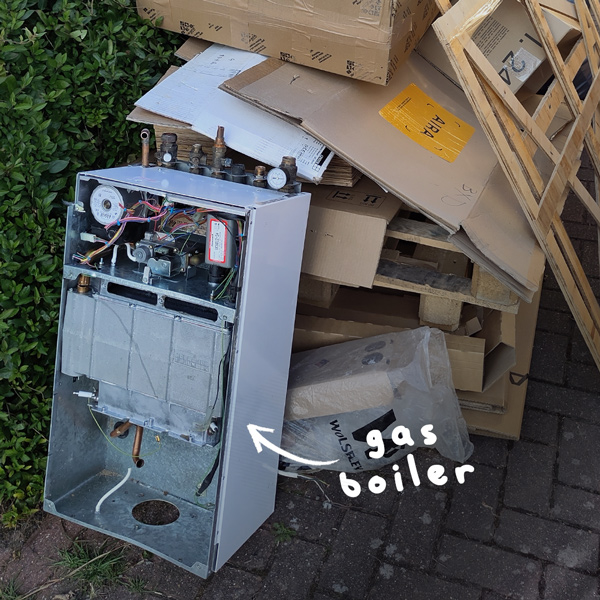
With the building fabric improved, we then had a heat pump installed as part of our recent extension. We already had an electric cooker and oven, so we were able to disconnect the gas pipe to the house entirely. So far our all-electric house is proving cheaper to run, though I’ll give it a year before drawing any firm conclusions. Even if it doesn’t result in a huge saving, hauling the old gas boiler out to the kerb was immensely satisfying. In fact, let me go and find a photo of it. There you go:
Transport – The next big category in the average household footprint is transport, most of which is from cars. We walk a lot as a family and use public transport when we can, but we can’t get away with being car-free. I need to travel all over the region for my job, and although it’s company policy to use public transport whenever possible, that falls down as soon as I need to go East or West. So we’ve got an electric car and that’s worked out pretty well for us. It charges overnight on cheaper electricity, or on surplus solar power in the summer. This has also worked out cheaper than a petrol or diesel car.
One thing that’s been missing from our lives is bikes, as we have a mid-terrace house with no side or rear access. My beloved elephant bike didn’t fit through the hallway and I sold it to a friend, who has cleverly electrified it. This term I will be experimenting with a folding e-bike that I can get on buses and trains, to see if that can reduce my car use. Even with an EV, all car use is traffic.
Electricity – With the UK moving slowly towards zero carbon electricity, everyone’s power supply has been getting cleaner – as the graph above shows in the 1990 comparison. We’ve reduced our carbon further by using energy efficient appliances, LED lighting etc. We installed as many solar panels as we could fit onto the roof, and they generate almost exactly the same amount of electricity as we use every year – though not evenly across the seasons and so with no hope of being off-grid. We used a council-run community buying scheme to get a battery added, which makes the most of the solar. For what it’s worth, we have a green energy tariff as well, though this obviously doesn’t change the electrons coming into the house.
Aviation – flying is one of the big compromises in the government’s official net zero estimates. It has decided not to challenge it, and the new Labour government is even more keen to boost economic growth through aviation than the Conservatives were. While I haven’t ruled it out forever, we’re yet to fly anywhere as a family. It hasn’t stopped us travelling. Sweden is the furthest we have gone by train so far, and we really enjoy stopping along the way and exploring different cities and cultures. As far as I’m concerned it’s a far more interesting way to travel and I don’t feel like we’ve given anything up by not flying. With no flights taken, this is one area where we can do better than the government’s estimates, even though I do anticipate flying occasionally in future when there’s no alternative.
Diet – At 18% of the average household carbon footprint, we can’t reach net zero without looking at what we eat. The big issue isn’t so much where food comes from but what you eat, and meat and dairy consumption are the big ones. I ate a vegan diet for a year as an experiment, and have settled on something more flexible. This is an area where we could definitely do more and have done in the past, but I think it’s important to resist extremes. Net zero is needs to be practical and achievable, and while there are arguments for veganism and vegetarianism, I’m with Michael Pollan and his advice to “eat food, not too much, mostly plants”.
Waste – Finally, there’s that 3% slice of household emissions that comes from waste. I feel like I wasted a lot of time trying to reduce our household waste before concluding that it’s a systemic issue and can’t be solved by individuals. There are some useful things we can do, such as buying secondhand and trying to pass things on when we’re done. I look for products with lifetime warranties or that are repairable. We recycle and compost. We are not in a place that does refill shops or farmers’ markets, and packaging waste remains a big problem. Having experimented at length with this, I feel like all the most meaningful solutions need action higher up the chain than households.
What remains of our carbon footprint is mainly food, stuff, and our share of wider emissions from government and services. There’s not much we can do about that, which is where the ‘net’ comes in. Rather than buying offsets, I have small investments in renewable energy, both in the UK and in several African countries.
Having worked through these categories over the last few years, we are well within the government’s expectations for net zero, 25 years ahead of schedule. And behold, I am not shivering in the dark eating insects, despite by best attempts to source insect based foods worth eating. My bills are a fraction of what my neighbours pay, and I don’t really feel like I’ve made any sacrifices.
Sure, there are 101 caveats to all this. Yes, I could do more, and everyone has their own red lines. Hypocrisy spotters will find their petty fodder. But I don’t wish to hold us up as paragons of green living. I don’t claim to have reached some kind of no-impact nirvana. Neither do I think that if everyone did what we’ve done, climate change could be halted – it’s bigger than that.
Here’s what I have done: I have followed my curiosity and am satisfied that net zero households are achievable, and that they can be cheaper and better. I have practiced what I preach, and can speak from experience about greener choices.
Now, what’s next?
 The Earthbound Report
Well done Jeremy, and all the family.
That’s a brilliant and very honest description of what you’ve achieved. I hope it inspires others to do the same.
Well done!
I really like your not black-white approach, while having a real good go at things.
I’m glad you’re not shivering in the dark, haha! it actually sounds like a pretty nice, cheaper life.
Really inspiring read! Net zero makes the idea of living more sustainably feel achievable and grounded in real experience.