
China is still regularly used as an excuse for inaction on climate change: if China isn’t doing its bit, then anything we do is pointless. This line became popular about 20 years ago and it had some validity at the time. It hasn’t been a serious argument for a while, as China has been doing far more than most people realise. It hasn’t necessarily been visible in their carbon emissions reporting, but 15 years of climate action in China is beginning to bear fruit.
As a reminder, China has been pursuing its own vision of ‘ecological civilization’ since 2017. It was confident enough in this idea that it wrote it into the constitution, with Xi Jinping describing it as “a new model of modernization with humans developing in harmony with nature.” Since then, China has come to lead the world in solar and wind power, electric cars, battery technology, electrolysers for hydrogen production and a host of other green technologies. Last year, China was responsible for almost a third of all the world’s spending on clean energy.
Why haven’t we seen a curb in emissions, with all this going on? Because unlike the countries of the global north, China is attempting a clean energy transition in the context of rising demand. In the UK, we’re moving to renewable energy in a mature economy. Use of electricity peaked in 2005 and we use less every year, due to efficiency and de-industrialisation. That is very much not the case in China, where hundreds of millions of people have escaped poverty within a generation and are consuming more. Industry has been growing rapidly. This is why China kept building new coal power capacity at the same time as low carbon generation.
However, if you build renewable energy capacity faster than fossil fuels, you can slow the growth of fossil fuels and catch up. This is what we’re seeing now. As a new Ember report on energy transition in China shows, the country has reached the turning point. Electrification, especially in industry, has pulled fossil use into a plateau. On electricity generation specifically, we can see the first signs of fossil fuel use slowing.
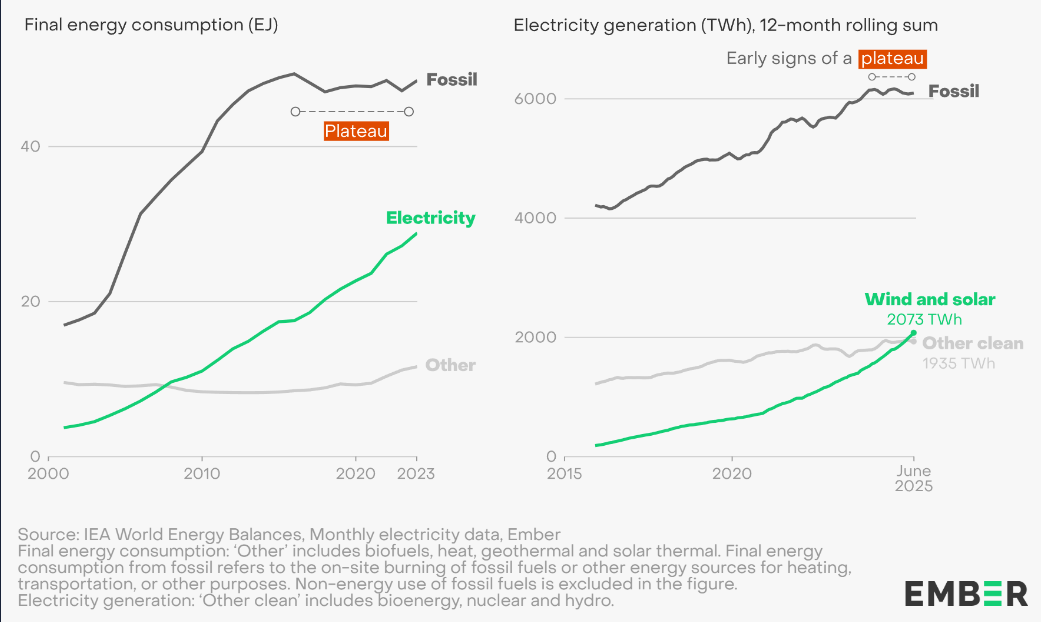
To be clear, this isn’t yet a decline in fossil fuel use in China. The coal fires are still burning, and emissions are still enormous. But the trend is very clear: wind and solar are taking a chunk out of fossil fuels, and don’t show any sign of slowing down. Why would they, when the clean energy sector is creating jobs, driving exports, and reducing the cost of importing fossil fuels?
What happens next is that the plateaus we see in the graphs above tilt gradually towards a decline, and then – hopefully – a sustained drop in fossil fuel use. Emissions in China begin to fall. With that, global emissions peak too.
Naturally, a positive story about China is not an endorsement of their government and all its policies. (That ought to go without saying, but have you been on in the internet?) Yes, it’s late in the day and may not be happening fast enough. But there are two lessons we should take from this.
First, it’s time to knock the Orientalism on the head and stop using China as a reason to delay our own climate action. While their own emissions still loom large, their gigantic investment in clean tech has brought down costs for everyone, enabling energy transitions across the world.
Second, there’s a prevailing narrative in the UK that climate action is a sacrifice and a burden. We’re being asked to give up things we like and being forced to pay for expensive things we don’t want. Right wing politicians endlessly repeat the lie that net zero is a crippling expense. The newspaper barons don’t challenge the lie, and thereby protect their fossil fuel investments. China is exhibit A in proving that the energy transition is an opportunity. While the global north prevaricated, China invested and now produces 60% of the world’s wind turbines and 80% of its solar panels. The green tech sector is growing three times faster than the Chinese economy overall. By turning their backs on net zero, Britain’s populists are shutting the door on similar opportunities for jobs, growth and energy security here.
The next time you hear someone trot out the lazy China trope, tell them that China’s rapid build-out of renewable energy is working, and that we could learn something from their pursuit of clean technology.
 The Earthbound Report
Good advice, Mr. Williams, thank you. BTW, may an American suggest a title for your next edition of Climate Change is Racist: Climate Change is Real. English-speaking people here in the U.S., even college educated people, missed out on a lot of science. U.K. people are highly oriented around being in the “successful” class, at least in my family. So easy to gloss over little Eva as out for show, and all about green-washing, even when you’re otherwise exceedingly nice. That book’s wisdom is too precious, and its writing, too compelling, to reach only the fringes. Obama wasn’t sure, but he finally went with the slogan, “yes we can.” Wonder what your publisher would say! ; ) ….
Or: for the American edition, Climate Change Abroad . Now that it’s fashionable to try to understand what people are all upset about, people might be tempted to pick up a slim edition like yours, and if they do, they’ll be hooked. Hope it’s helpful. Thank you!