
“God will ask us if we have cultivated and cared for the world that he created, for the benefit of all and for future generations, and if we have taken care of our brothers and sisters. What will be our answer?” Pope Leo has given his first speech on the climate. He also “noted that some have chosen to deride the increasingly evident signs of climate change, to ridicule those who speak of global warming.”
Meanwhile, the US Energy Department sent an email instructing staff to avoid “terminology that you know to be misaligned with the Administration’s perspectives and priorities”, with a list of banned words that includes climate change, green, carbon and sustainability.
Britain has a target to run on 100% clean energy by 2030, and the grid continues to set new records on the way to that. So far clean energy supply has exceeded demand for 87 hours this year.
Hannah Ritchie points out some positive news that hasn’t made any headlines: record breaking harvests are expected in most parts of the world this year.
Some book news: my online bookshop, Earthbound Books, now has ebooks. I’ve been waiting for this for a while. Fill your eboots.
Latest articles
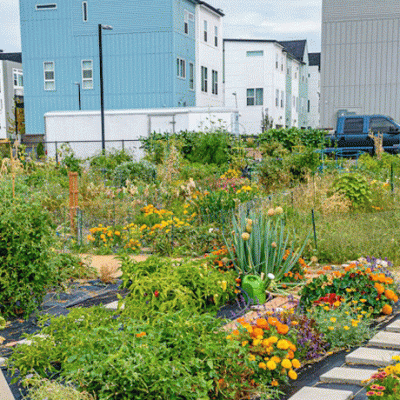
How to run projects that create bigger change
Now, more than ever, people need to see that environmental action makes a tangible improvement to their lives. These are febrile times. People want certainty and the safety of what they know. Politicians and the media can easily scapegoat climate policy and erode support for ‘new and untested’ low carbon technologies. Despite the urgency of…
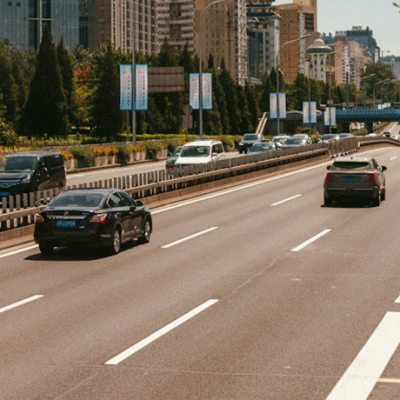
The globalisation of electric vehicles
Not so long ago Norway was the big story in electric vehicles. They were one of the earliest movers, with subsidies for EVs and privileged access to parking and bus lanes. It was the first country to cross the rubicon and sell more EVs than petrol and diesel cars. In a graph of global EV…
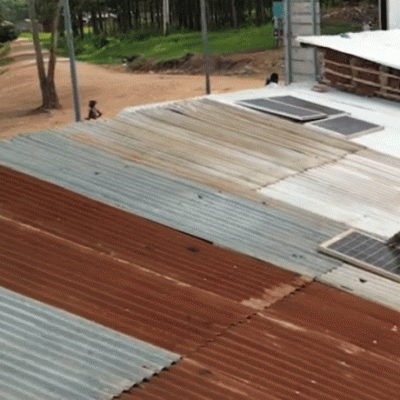
Clean energy for Uganda’s refugees
In the long walk towards universal energy access, refugees are among the hardest to reach. Across the world there are 120 million people living in refugee camps, and 94% of them don’t have clean and affordable power. That’s something that my colleagues at Ashden are working on, as part of a project called Transforming Humanitarian…
 The Earthbound Report
Am looking at data for Virginia’s crops. We had, between 2023 and 2024, 40 and 47% declines for corn and winter wheat yields, respectively. 12% decrease for tobacco. Increases for soybean yields by 22% and cotton, too. Need references for the past 60 months in order to see a pattern.