Just outside my office window is a heat pump, which provides our house with low carbon heating and hot water. It’s an air source heat pump, which means it draws heat from the air and channels it into the house. There are other forms of heat pumps, notably ground source, and less well known is the water source heat pump. I’ve written before about a scheme to use London’s underground rivers as a heat source, but it remains a fairly unusual technology.
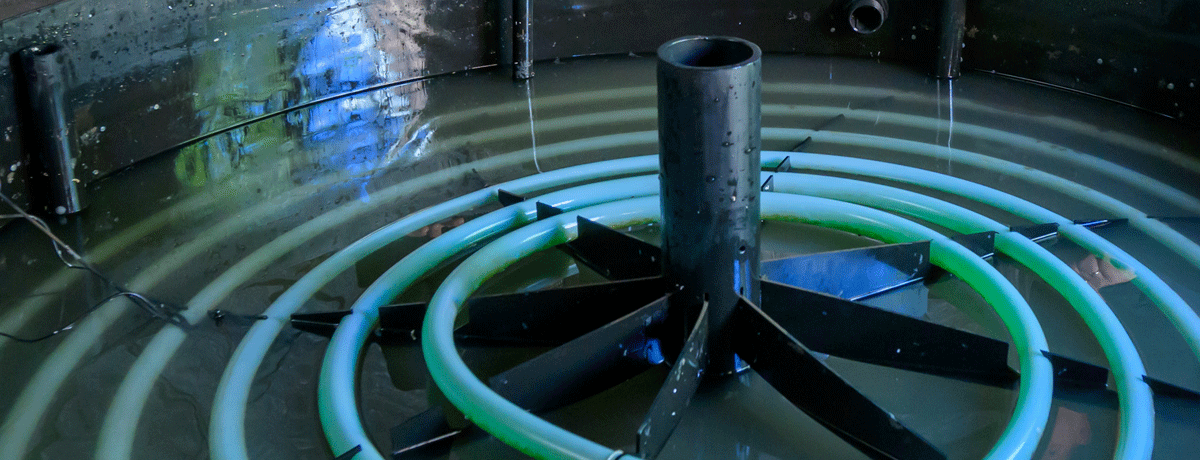
As the name suggests, water source heat pumps extract warmth from bodies of water, which could be rivers, ponds, or the sea. One company that is promoting the idea at the moment is Sea Warm, a Scottish start-up that has developed a new low cost heat exchanger. They can place one of their units in coastal locations, or set them up next to rivers or to tap into minewater. Whatever the water source, it flows through a long spiral of pipe to extract warmth for heating, which is then fed into the building’s heating through a heat pump.
What are the advantages here? For a start, it’s relatively simple and low maintenance. Because it’s a single water-sized tank, it’s a lot cheaper to install than a ground source system, which needs a borehole or groundworks. Water tends to have more stable temperatures than air, which makes it superior to air source heat pumps. It’s clearly not going to be for everyone, but it opens up a range of possibilities for any buildings or communities near water.
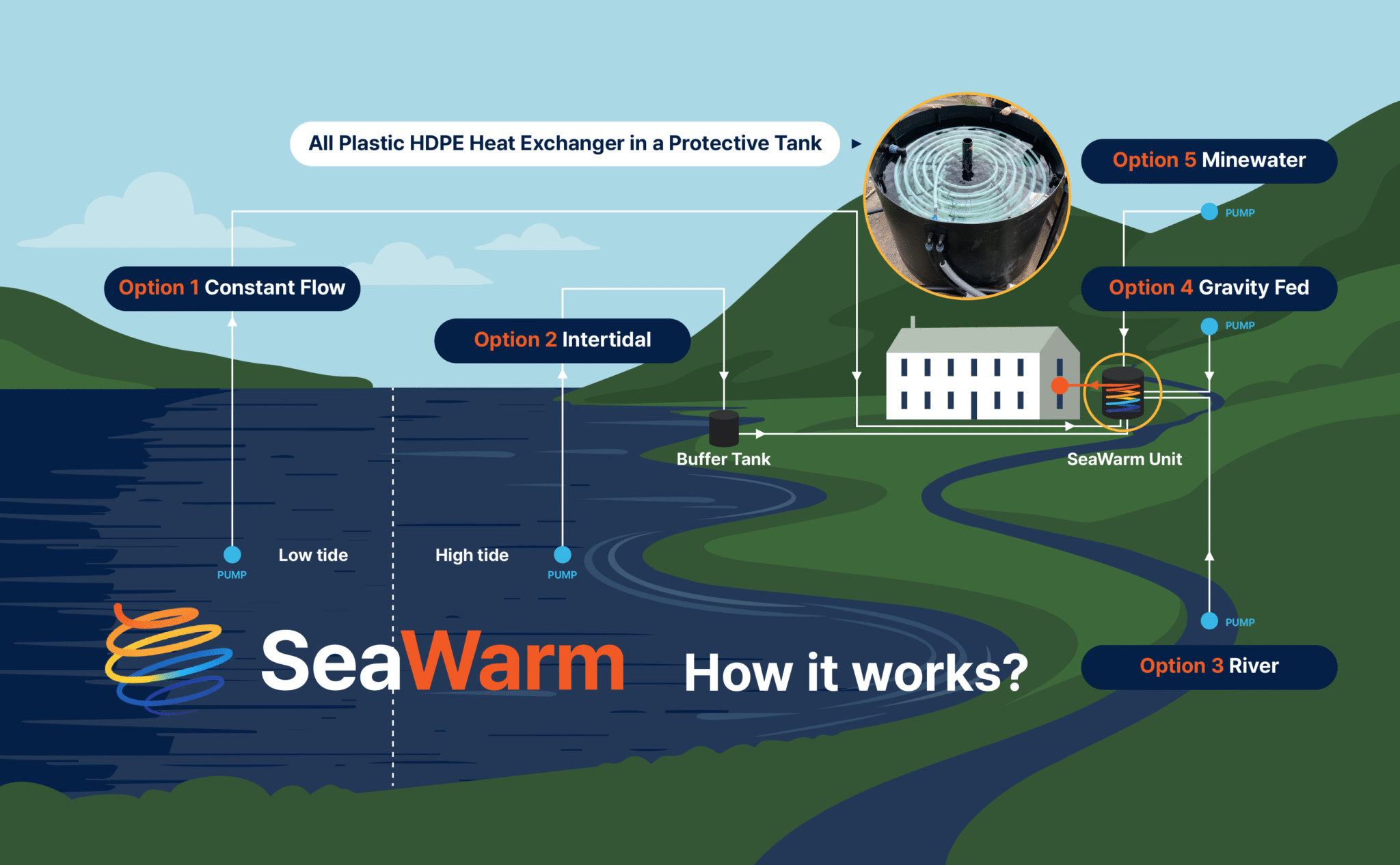
The company has a series of prototypes in operation at the moment and some proven successes. A small mining museum in Scotland’s highest village is using a Sea Warm unit to warm their cafe from a nearby stream. Port Edgar has an engineer’s shed at the marina that is heated from the seawater beneath the pier. Another demonstration project pipes water from a stream to warm the greenhouses at a plant nursery.
Early results show that they can cut emissions from heating by 90%, with significant financial savings too.
It’s early days for Sea Warm, and they plan to continue developing their tech at marinas, ports and community buildings in coastal locations, before moving into domestic properties later. It’s too soon to tell if the company will become a serious player, but it does illustrate the kind of innovation that is happening in low carbon heat at the moment. Gas heating has been installed by default in UK houses for decades, but that has to change. What comes next will be more diverse, with a range of technologies depending on context. I don’t know how many there will be or how long it will take, but I’d expect to see homes heated by seawater as part of the clean energy transition.
 The Earthbound Report
At York Minster, where I am a Guide, Alex McCallion, the Director of Works and Precinct, is considering using a huge war time static water tank under Deans Park as a water source heat pump. The Minster is huge and cold. The tank is big and warmish.
The Barbara Hepworth Museum in Wakefield has a water source heat pump linked to its adjacent river.
John D Anderson
Interesting – that’s an unusual feature and good insider knowledge!