“The way we are doing renewable energy in this country at the moment is an economic act of self harm,” Reform Party leader Nigel Farage told an audience in Scotland recently. “The more we rely on renewables, the higher our domestic and our industrial energy prices become.”
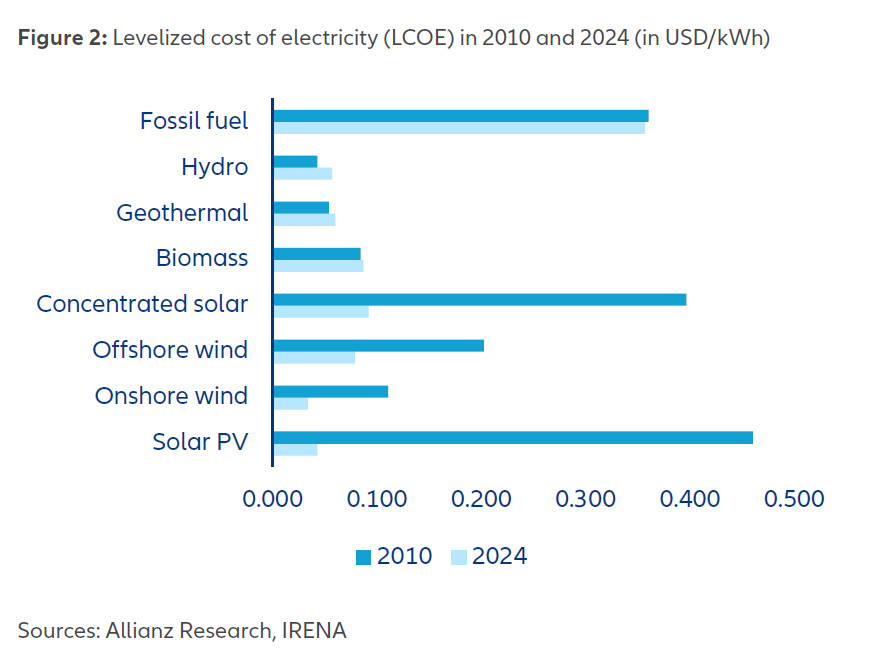
Here are the costs of renewable electricity in 2010 and 2024, taken from the recent Allianz Green Transition Tracker report:
Nigel Farage’s views are about twenty years out of date.
As the graph shows, the cost of renewable energy has tumbled spectacularly. Global wind power costs halved between 2010 and 2024. Solar costs fell by 87%. Fossil fuel prices, on the other hand, are no cheaper. The truth is the direct opposite of Nigel Farage’s view: the more we rely on fossil fuels, the higher our energy prices will be.
It doesn’t necessarily feel like that, because the build-out of renewable energy has an up-front cost. That pays for itself over time because the sun and the wind are free and boundless, whereas fossil power plants need a constant conveyor belt of stuff to burn.
Another reason that renewable energy feels expensive is that wholesale electricity prices in the UK are pegged to the price of gas. People see more and more wind turbines and solar farms being installed, but their bills are going up rather than down. Since they don’t teach the mechanics of energy market pricing at school, one could naturally conclude that all this renewable energy is pushing prices up. But it’s to do with our systems and the costs of the transition, not the technology itself. Spain is a good example of a country that’s a few years ahead of us in unlocking the potential for cheaper renewable energy. Their wholesale electricity prices are a third cheaper than the EU average.
“I believe that we are the practical, sensible people who are pro people having cheaper energy bills,” Farage told his audience. That’s a good thing to aspire to, and if he knew what he was talking about and was telling the truth, he wouldn’t advocate for an end to investment in renewable energy. He would call for more renewable energy, in forms that benefit voters as directly as possible – solar power in particular, on homes and schools and public buildings. And he would call for market reform to release the savings from renewable energy and cascade them down through lower bills.
His views on renewable energy are not the only thing that’s out of date about Nigel Farage. He said himself recently that he is “not computer literate,” and so it’s no great surprise that he doesn’t understand energy technologies either. But that’s no excuse for the rest of us persisting with the outdated idea that renewable energy is too expensive. When you come across this opinion, please gently correct it, and we’ll all the get the benefits of free sunshine and wind sooner.
 The Earthbound Report
Hi Jeremy, I am with you on this but do these costs include the costs of building a grid that works effectively with renewables? Isn’t this driving costs as well? I think Dieter Helm makes this point. cheers Henry
Yes, upgrades to the grid are part of the picture. I would include those as part of the cost of transition that I mention above, which is why I haven’t mentioned them separately.