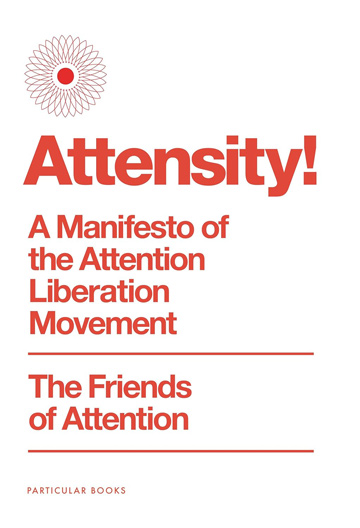
The great promise of social media was to make it easier than ever to make connections. It initially looked like it would help us make friends and build communities. And yet somehow social media has left us fragmented and isolated, more divided than ever. “How have we been separated from each other and the world – even from ourselves – at the absolute historical apex of global communicative interconnection?”
The artists’ collective The Friends of Attention believe they have identified an underlying reason. At the heart of any genuine connection, any relationship, is human attention. What social media has done is hijacked and commodified our attention, designing platforms to keep up scrolling and clicking. We get the dopamine hit of novelty and reward, and in return they collect our data and show us adverts.
The more time we spend on screens, the more money they make, and social media platforms are callously designed to draw us in and keep us there. This is like ‘psychic fracking’. Drive the slurry of content into our minds, and harvest our attention. This is terrible for our mental health, for society and community, for democracy and a shared understanding of the world. But it makes money and to hell with everything else.
This should make us angry, and it should be something we resist. Hence the Friends of Attention, and their Manifesto of the Attention Liberation Movement.
Resisting the ‘attention economy’ is often talked about as a matter of will, but the Friends insist that individual effort won’t get us very far. It’s a systemic problem, and it is best resisted together. How? Not through bans or restrictions on social media – those don’t get a look in here. Rather, the book calls for an amplification of those things that call our attention away from screens and out to each other.
The list of things that could be called ‘attention activism’ is long and familiar. People playing music or sports together. Reading. Arts and crafts. Studying, which needs us to attend to a subject. Church. Scouts. Dungeons and Dragons nights. Gardening or birdwatching. We need more of these things, especially since many community and collective activities never quite returned from the pandemic.
“Where in your life do you feel in control of the movement of your attention? What leaves you feeling better, not worse, after you give your mind, time and senses to it? When do you notice an experience of your attention leaving you feeling curious, energised, replenished? When do you feel closer to the reality of the world and other people?” the book asks. When you find these things, “can you build on it? Share it with others?”
What separates these existing activities from Attention Activism is simply an awareness of attention itself along the way, which brings us to the word in the title: Attensity. The authors think of it like the word ‘ecology’. In the 1960s ecology was a scientific term. It sprang to prominence in the 1970s as the environmental movement formed, coming to hold our objections to the destruction of what we value, and our hopes that things can be better. Attensity is a forgotten term – a “terminological orphan” – from the early 1900s, from a school of psychologists who were interested in attention. The friends want to reclaim it and use it in the same way that the environmentalists popularised the word ecology, as part of a new movement to protect attention. “We need a new environmental movement to care for inner environment of our minds, capacities, and relations.”
I don’t know whether the word Attensity will catch on. That seems like a bit of a long shot. But I see the value of talking more explicitly about attention in all its forms, how we nurture it, how we steward our own minds so that we attend to the things we value most. That feels like important work and I realise that some of my own projects, such as community gardens or little free libraries, are a whisker away from attention activism.
As you might expect from an artists’ collective, the physical book itself is a considered design object. It has a simple and uncluttered look, and thoughtful visual motifs. Uniquely, the book is summed up in a two page essay at the start, which is then repeated in-between each chapter, with a couple of sentences highlighted each time. The next chapter then explores those lines in more detail. This gives the book a visual and rhetorical rhythm, like a heartbeat.
I really enjoyed Attensity. It’s given me a different way of thinking about how attention operates in politics, and a new angle on community building. I will continue to mull it over, and if they’re recruiting, you can consider me a friend of attention.
- You can get Attensity from Earthbound Books
- See also The Attention Merchants, by Tim Wu
 The Earthbound Report