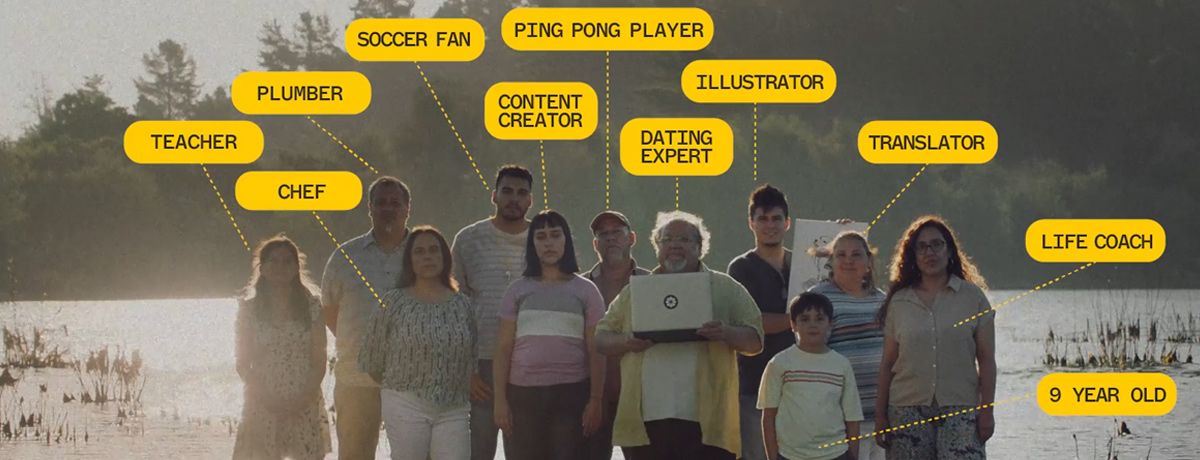
Quilicura is a community in Chile that is facing water scarcity, in large part because so many water-cooled AI data centres are located there. To raise awareness of the problem, they brought together a group of local experts to answer people’s AI queries for a day. It’s an imaginative campaign and a good reminder that humanity’s greatest reserves of true intelligence lie in people, relationships and community.
The Climate Fiction Prize has announced its shortlist for 2026. Some intriguing entries on this impressively international selection.
Earlier this week I mentioned that net zero requires a certain degree of offsetting for some essential industrial processes that can’t be decarbonised. For balance, here’s an example of offsetting as a disingenuous distraction: a new platform from Aerovolt allows people to buy carbon credits from electric plane flights. Someone flies an electric plane, and you can pay to pretend it was you – though that’s not how the marketing blurb describes it of course. No carbon has been reduced, so this isn’t real offsetting. Worse, at this point almost all electric planes are tiny and flown for leisure, so this scheme essentially subsidises wealthy hobbyists and calls it climate action.
Edible spoons are an idea that the internet got excited about almost exactly a decade ago, as an attempt to replace single use plastics. They’re available but haven’t exactly caught on. Now the first firm to make them in the UK is having another go, with Eddy’s providing edible spoons to a deli in London, with the hope of rolling them out more widely.
The world’s largest compressed air energy storage facility has come online in China. Air is pumped into salt caverns when renewable energy production is abundant, and released through a turbine to generate electricity when needed. It is large enough to power 600,000 homes.
Latest articles

What we learned this week
Trump’s war in Iran has driven a decline in gas and oil demand, and even with a rise in coal use in some places, global emissions from fossil fuels are expected to fall by 0.5% this year. He may be a climate denier and fossil fuel booster, but luckily for the world he is incompetent.…

How Fyffes is adopting regenerative agriculture
Regenerative agriculture is an approach to farming that maintains and even enhances nature. Much of the pioneering work on it has happened on small farms, often set in opposition to ‘big ag’. But to really make a difference, regenerative agriculture needs to be practiced at large scale and the big boys need to learn from…

Learning to live as a hot country: Madagascar
Earlier this year the Climate Change Committee, the UK’s climate advisory body, published a report on adaptation. Britain’s progress on reducing emissions has not been matched on the adaptation side. “There has been little progress on preparing ourselves for the changing climate,” they warn. As one of the guests at the launch event put it,…


Eddy’s Teaspoons of Change!! I remember the post from 10 years ago and still think it is a great idea… If only I was a capitalist marketing mogul 😉