Octopus, the UK’s leading green energy supplier, recently announced a move into trucking. Partnering with Chinese battery company CATL, they’re planning a network of battery swapping stations for trucks. It will be called Swaptopus – of course it will – and the first one will open next year. Eventually there will be a network of battery swapping stations across Europe, electrifying heavy goods vehicles.
We’ve seen these sorts of announcements before. The first I’ve come across was all the way back in 1938, a plan for a national EV battery swapping network that was overtaken by the war and never happened. There have been several attempts since in different parts of the world, and some high profile failures.
Why does the idea of battery swapping keep coming around? What do Octopus see in the idea? And what would it take to make a success of battery swapping when others have failed?
There have always been two main ways to recharge a battery electric vehicle. One is to plug it in. The other is to put new batteries in it. Although all our EV infrastructure in the UK is built around recharging today, there’s nothing inevitable about it as a superior technology. Right from the earliest days of electric vehicles in the early 1900s, there’s been a live debate over recharging or swapping batteries. It is not yet settled.
There are advantages to both. Recharging is simpler, and charging points are easier to accomodate. You need a parking space and a grid connection with sufficient capacity, but not much more than that. Once the industry has standardised connectors, all manufacturers can design their cars to use the network. The downside is that charging takes time. That’s fine if you’re charging overnight and not using the car, but it’s a pain when topping up on long journeys. It means waiting around, every long journey takes more time, and on busy travel days there’s the stress of finding a charger.
Battery swapping solves the time problem and gets you back on the road quicker. Despite that obvious advantage, batteries are heavy and the systems for swapping them quickly are complex. It’s far more expensive to develop and build out a network of switching stations than it is to build out a charging network.
Where charge networks just need a connector, you also need car manufacturers to standardise their entire battery system, and the chassis to accommodate it. You need to design the whole car around the idea. That’s a tall order and it’s where the most high profile start-up fell down. Better Place only persuaded one company to use their system, and it burned the best part of a billion dollars in venture capital on its way to nowhere.
On its own, history suggests that the speed factor isn’t enough to justify the expense and complexity of battery swapping for EVs. But the idea has more going for it than meets the eye, and there are some good reasons why it won’t go away.
First, if your car had swappable batteries, then you wouldn’t need to buy one of your own. You would just buy the vehicle, and pay to use batteries that were owned by a charge supplier. Since the battery is the most expensive component of an EV, this makes them much more affordable. This is less relevant at the luxury end of the market. Tesla developed battery swapping, opened just one swap station in 2013 and then closed it down because nobody cared.
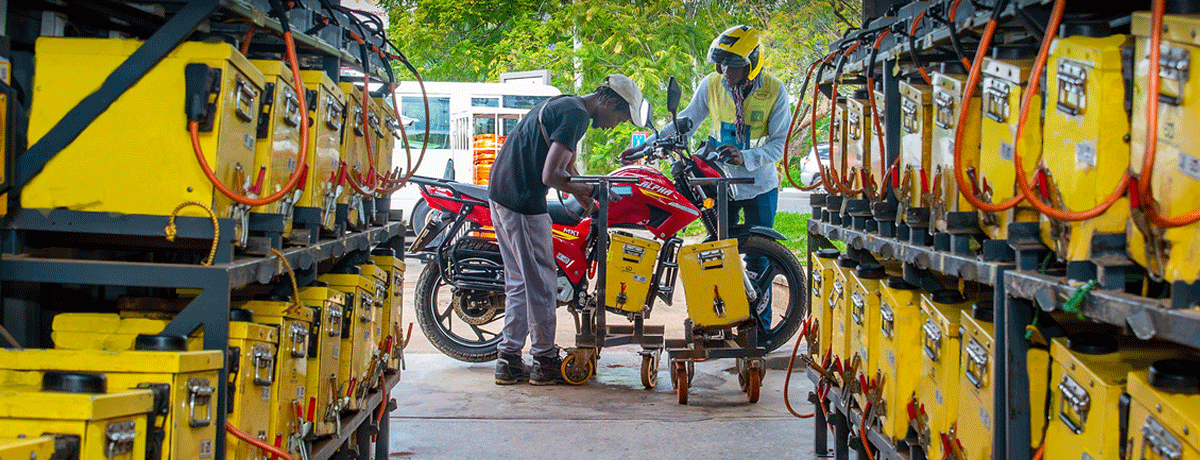
The luxury market is, however, small fry in the grand scale of things. Battery leasing is a business model that’s driving sales of electric scooters, motorbikes and three-wheelers in many parts of the world. It’s easy to forget this in the US or Europe, where most road traffic has four wheels, but there are many countries where cars are vastly outnumbered. Motorbikes and scooters dominate in East Asia, and it’s where the growth is in much of Africa. The transition to electric transport is a two-wheeled phenomenon in the Global South.
This is a good match for swappable batteries, because the battery for an electric scooter is the size of a shoebox. You can pick it up by hand and pass it over a counter for a new one. In a tuk-tuk or a micro-car, you might have two or three modular batteries of that size. A battery swapping station can serve hundreds of customers from a unit the size of a shipping container. This is a far cry from a battery swapping station for a car, with its larger land footprint and sophisticated robots to move and install charge packs.
If we shift our perspective from north to south, and from four wheels to two, battery swapping makes complete sense. It is far from theoretical, and is already a thriving industry. See SUN Mobility in India, for example, or Ampersand in Kenya and Rwanda.
There’s another big advantage to swapping networks to bear in mind, and that’s the ability to charge batteries when energy is cheap. Rather than plugging in and charging on demand, battery companies can take advantage of overnight rates or times of surplus, and this keeps costs down for everyone. As a bonus, slow and measured charging is much better for the battery than rapid charging, so batteries may well last longer. It shifts battery power towards a service model, bringing them into the circular economy.
This timing factor explains Octopus’ interest in the UK. They will be serving trucks, which means very large batteries. An electric HGV could have a battery with a capacity of 400 or 500kwh. Every battery swapping station will have a whole stack of these at various levels of charge, and so they will double-up as a grid-level energy storage facility.
What Octopus will be able to do is to charge these battery packs when energy prices are low, either overnight or during periods of high wind or solar production. Users get lower prices, and it will play an important part in integrating variable energy sources into the grid. The system will run in two directions, so that Octopus can sell power back to the grid during demand spikes. This is bread and butter stuff for Octopus, who began as a software company and already have the systems for managing energy storage and smart charging.
There’s a reason why this works with trucks too. Trucking is a more predictable business than individual motoring, and so battery swapping points can be at motorway service stations or at depots. You need fewer of them, and Octopus will be using a platform that’s already proven and profitable in China. Chinese HGV companies are designing for it, and European manufacturers such as Volvo and Scania are moving in that direction.
It’s in the interests of the logistics industry to move towards battery swapping too. They want to minimise the number of vehicles standing idle across their fleet, and the charging time on a 500kwh battery is going to be a major inefficiency. The same would be true of delivery vans, buses and taxis, where battery swapping will help keep vehicles on the road. This too is a proven approach in China and in a handful of other places.
Battery swapping for cars is still a difficult proposition, though possible. One car brand in China, NIO, is making it work already. CATL, the world’s largest battery company, are investing in the Chinese battery swapping market. It’s arguably mainstream already, and in the long term it looks likely that China is going to have the best of both worlds. You’ll be able charge your car at home for everyday use, but swap batteries on longer journeys, and outsource battery ownership to a service company. We’ll see.
For the rest of us, I’m not convinced this sort of hybrid system will be available to ordinary drivers in the UK any time soon, as fast-charging networks are expanding and eroding the case for them. Where swapping really makes sense is with fleets and with vehicles with larger batteries. And at the other end of the scale, it works with smaller vehicles in developing countries and is already playing a role in leapfrogging past fossil fuels.


Very useful information. I’ve shared this with my team.