
A record month for solar and wind power in the UK saved £1 billion in gas costs and the equivalent of 18 LPG tankers, currently stuck in the Strait of Hormuz. While you’re visiting Carbon Brief for that story, have a look at their broader work on Trump’s Iran crisis and how countries are responding. They’ve been busy.
“When America goes to war, the costs are distributed broadly, onto every American who drives a car or heats a home. The benefits are distributed narrowly, flowing to a small group of men whose compensation is designed to capture exactly this kind of windfall.” Emily Atkin on how oil executives profit directly from war.
I made a passing mention of how refills have failed to go mainstream in the UK in a post this week. Until they do, refill shops are holding a space for those wanting to bring their own containers, and Recycle Now just launched a refill locator to find your nearest shop. Still none near me.
The story of the fishing industry off the US West Coast demonstrates how fish stocks can recover when you just leave them alone. Having collapsed entirely by 2000, today it has a smaller and sustainable fishing industry.
Scientists have discovered that data centers produce so much waste heat that they can create local micro-climates and heat island effects. More reasons why we should locate them in cold places, and capture and use that heat.
It’s been a quiet couple of weeks round here with the Easter holidays and my writing time directed to other things, but here are some recent articles.
Recent highlights

The long road to reducing Britain’s plastic waste
Last week new national guidelines came into force on recycling in the UK. There will be some teething issues as not every council is quite ready. There will still be enduring questions around esoteric plastic items. But generally speaking recycling is much more straightforward. The postcode lottery of whether or not you can recycle something…

How to run projects that create bigger change
Now, more than ever, people need to see that environmental action makes a tangible improvement to their lives. These are febrile times. People want certainty and the safety of what they know. Politicians and the media can easily scapegoat climate policy and erode support for ‘new and untested’ low carbon technologies. Despite the urgency of…
The globalisation of electric vehicles
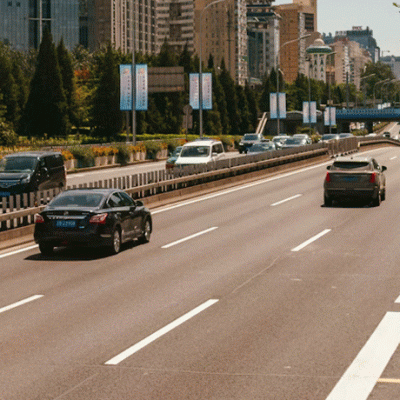
Not so long ago Norway was the big story in electric vehicles. They were one of the earliest movers, with subsidies for EVs and privileged access to parking and bus lanes. It was the first country to cross the rubicon and sell more EVs than petrol and diesel cars. In a graph of global EV…
 The Earthbound Report