
A record month for solar and wind power in the UK saved £1 billion in gas costs and the equivalent of 18 LPG tankers, currently stuck in the Strait of Hormuz. While you’re visiting Carbon Brief for that story, have a look at their broader work on Trump’s Iran crisis and how countries are responding. They’ve been busy.
“When America goes to war, the costs are distributed broadly, onto every American who drives a car or heats a home. The benefits are distributed narrowly, flowing to a small group of men whose compensation is designed to capture exactly this kind of windfall.” Emily Atkin on how oil executives profit directly from war.
I made a passing mention of how refills have failed to go mainstream in the UK in a post this week. Until they do, refill shops are holding a space for those wanting to bring their own containers, and Recycle Now just launched a refill locator to find your nearest shop. Still none near me.
The story of the fishing industry off the US West Coast demonstrates how fish stocks can recover when you just leave them alone. Having collapsed entirely by 2000, today it has a smaller and sustainable fishing industry.
Scientists have discovered that data centers produce so much waste heat that they can create local micro-climates and heat island effects. More reasons why we should locate them in cold places, and capture and use that heat.
It’s been a quiet couple of weeks round here with the Easter holidays and my writing time directed to other things, but here are some recent articles.
Recent highlights

What we learned this week
Chris Hatch at Covering Climate Now writes about something I’d noticed: Mark Carney was very forward thinking on climate change while at the Bank of England, and seems to have forgotten all about it as Prime Minister of Canada. More evidence that if you’re losing farmland to solar farms, you’re doing it wrong. The biggest…
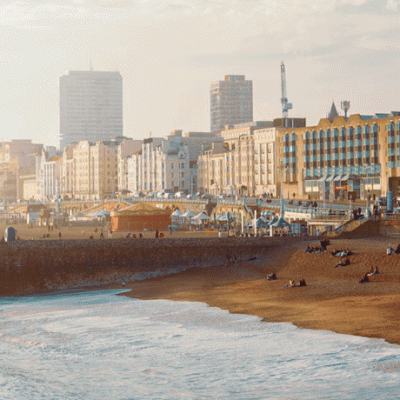
Mapping heat for a more resilient Brighton
Britain experienced its hottest ever summer this year, pending end-of-year verification. While you can never really point at something and say definitively that it is climate change, the Met Office tells us that climate change made this summer 130 times more likely, which is as good as you’re going to get. Climate change is transforming…
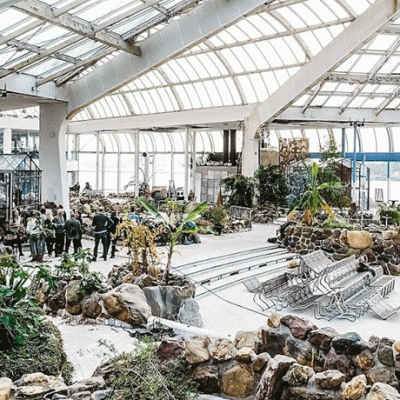
BlueCity’s circular economy hub
I’m reading a book at the moment called Don’t Build, Rebuild, by Aaron Betsky, all about reusing buildings in a circular economy. It’s taking me ages to get through because every couple of pages there’s an example that I can’t resist looking up on the internet before I read on. This has proved unusually distracting,…

