Last week I received a press release titled ‘the countries leading the world in clean electricity’. Like most of the press emails I get, it was a list put together to generate links rather than present new information, and so I won’t name the website involved. It did get my attention though, and not for a positive reason.
According to this new list, the countries leading the world on low carbon energy are Iceland, Norway, Sweden, Switzerland and France. Then they round out the top ten with Finland, New Zealand, Brazil, Denmark and Slovenia. By their reckoning it is Northern Europe that are the shining light of progress here.
I won’t argue with Iceland at the top there, because they have 100% low carbon electricity. But I have questions about the rest of that top ten. Drawing on Our World in Data, whose map appears below, it could look like this:
- Iceland, Albania, Bhutan, Democratic Republic of Congo, Ethiopia and Paraguay are all tied for first place on 100% clean energy.
- The rest of the top ten would read Norway, Sweden, Switzerland and Namibia.
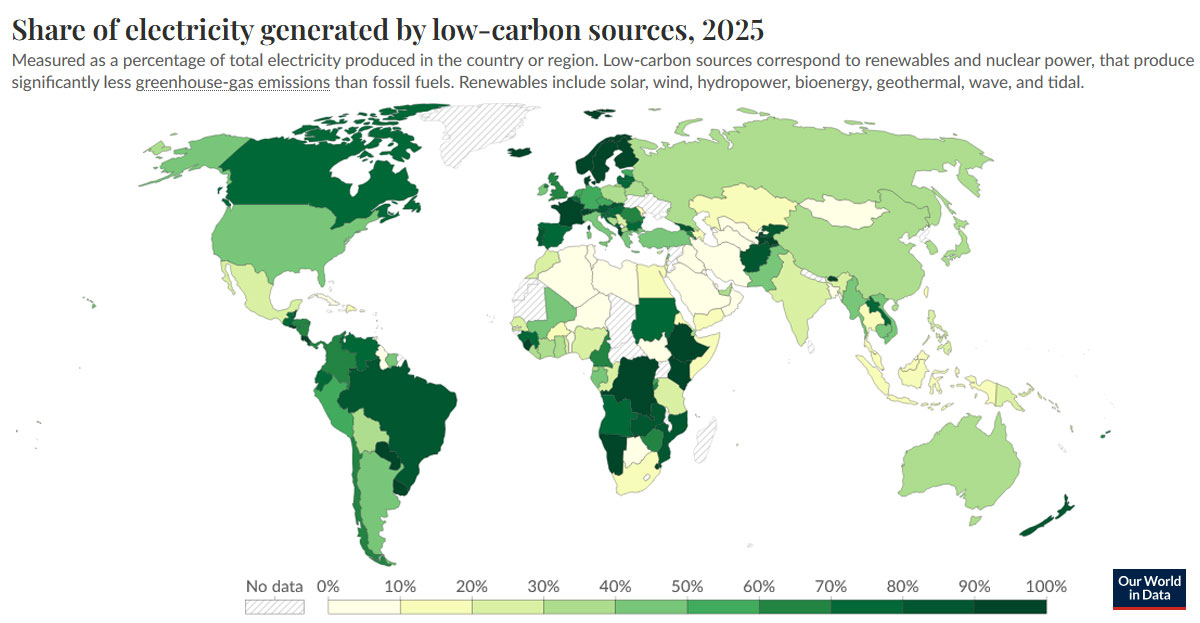
New Zealand are doing a fine job of rolling out low carbon energy, but they don’t come anywhere near the top ten with their 85%. Zambia, Afghanistan, Kenya, Eswatini, Sierra Leone, Belize, Costa Rica and several others all have higher percentages of low carbon power. They are invisible here, whitewashed out of the story.
To be fair to the headline writer, a high percentage of clean energy on the grid doesn’t automatically qualify as global leadership – there are places that are coasting on legacy hydropower projects and failing to expand energy access. We can hardly call DR Congo a world leader when four out of five citizens don’t have electricity. But the list is clearly more diverse than is suggested here.
This is a recurring pattern, and I’ve written about this before. There are just as many countries in the Global South with high rates of clean energy as there are in the Global North. There are various reasons why this gets missed. Sometimes it’s to do with methodology and whether or not they include hydropower. Sometimes it’s to do with investment or capacity, which overlooks smaller power grids in low income countries.
Sometimes however, as in this particular study, countries get left out because the researchers just didn’t ask. They ran the numbers for 76 countries and prioritised the richest – and presumably most likely to run the press release. There were only four African countries in their dataset and six from Latin America. They missed a whole lot of clean energy action because they didn’t bother to look.
When we do look, we find that the story of clean power is more complex and interesting. In the UK it is framed as an energy transition – a term I use all the time. It’s all about moving from polluting fossil energy to more sustainable forms, swapping, upgrading and phasing out. Let’s not take anything away from the Nordic countries that are doing this well, often with a big role for nuclear power. But that’s not the only narrative to clean energy.
From a global perspective there’s a parallel story that is about leapfrogging fossil fuels entirely and building clean energy from the beginning. It’s about countries choosing to avoid the mistakes of richer countries and proactively choose something better, energy that is more democratic and more resilient to global shocks.
That’s what we see in places like Ethiopia or Costa Rica, which have mainly hydropower and are committed to only adding renewable capacity alongside it. Or Kenya, a leader on geothermal power with ambitions to reach 100% energy access with 100% low carbon electricity by 2030. This is real leadership too, and leaving out this Global South dimension gives us a shallower and paler version of the truth.
That press release did inspire an article, and I’m not sorry that it wasn’t the one they hoped for. I’ve sent them some notes on what they can do better next time, and maybe then I’ll drop them a link.
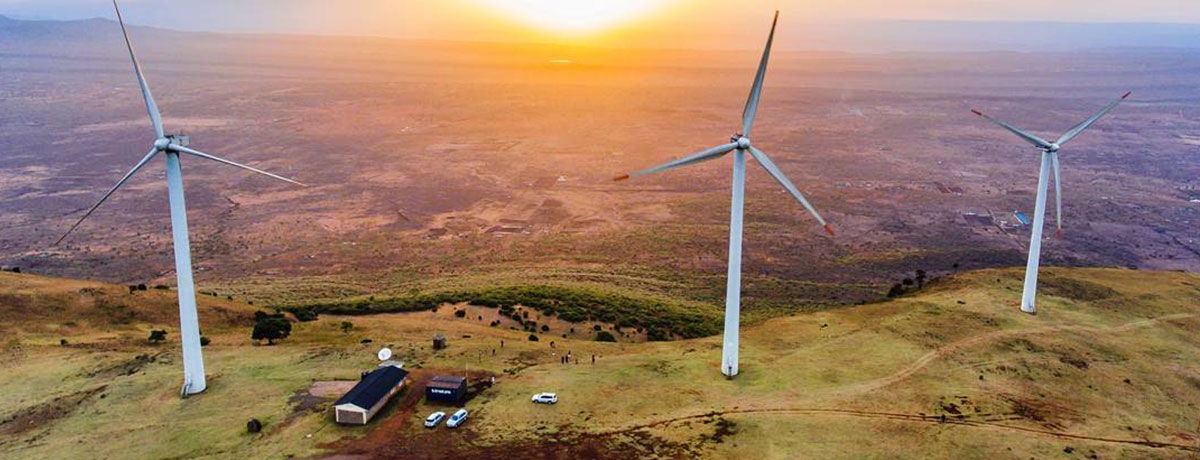
- Header photo by Mwangi Kirubi, Flickr, licensed as CC BY-NC 2.0


I have lived in Ethiopia for two years. By far the most energy produced in Ethiopia is by the burning of wood and dung. While its work with hydroelectricity is laudable, in no way can Ethiopia be seen as among the ‘leaders on clean energy’. The same is true of Namibia, which I have visited, and the estimable Botswana where I have lived for three years.John D Anders
I think you’ve missed the point John. Yes, it’s starting from a low base, but what leadership looks like in a Sub-Saharan country is different to leadership in a Nordic country.
Ethiopia has pioneering policies on electric vehicles and renewable energy. It’s played an important role in international climate negotiations in the past. It has chosen a development pathway quite different to those that have gone before and relied on fossil fuels.