Human lives, both individually and collectively, unfold in a built environment. Generally speaking we don’t get to shape that environment all that much. Most of us don’t get to design our own homes, let alone streets and public spaces. Unless you have a particular interest in architecture or urban design, you might never really think about the built environment all that much. It’s just there as a backdrop to other things.
When you do stop to think about it, it doesn’t take long to realise that the built environment is political. Everything ever built is an expression of power in some way, because building needs resources and labour and funds. The nature of that power is reflected in what we build, in who has access and who belongs, in who is served, in what sorts of behaviours are enabled or precluded.
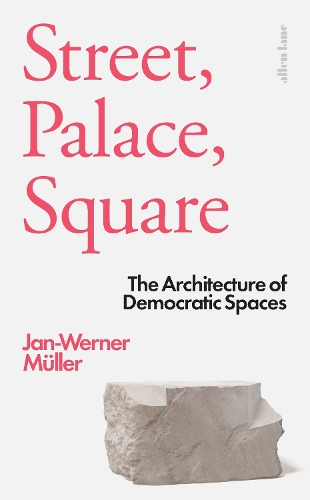
Taking this view, Princeton politics professor Jan-Werner Müller invites us to consider the connections between the built environment and democracy. How are democratic ideas rendered in buildings and spaces? In turn, how do buildings and spaces shape our politics?
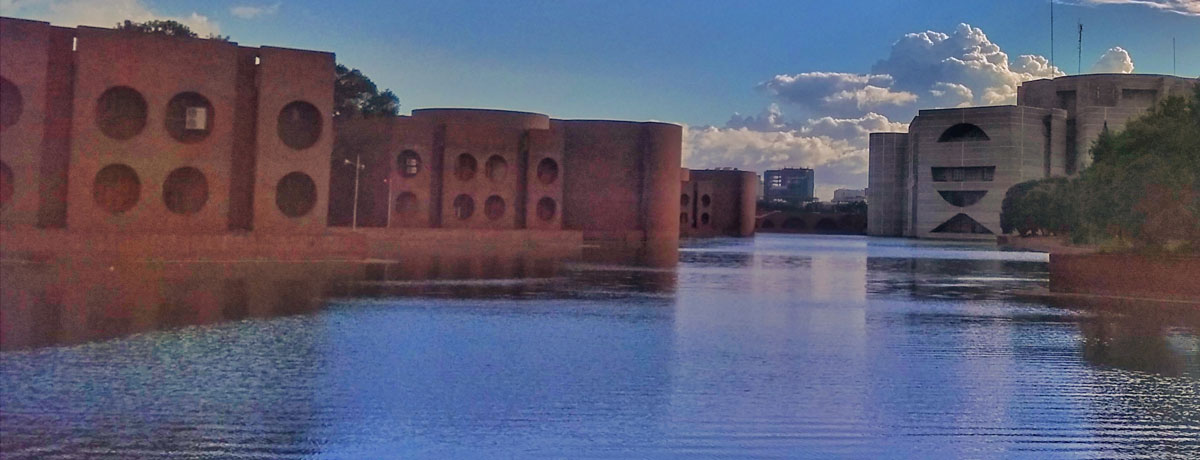
The book begins in Dhaka and the Parliament of Bangladesh, which is housed in a striking building by architect Louis Kahn. It looks like a medieval castle with cut away geometric shapes, suggesting strength and commitment, but also openness. Müller compares this ‘citadel’ approach with other visions for democratic buildings. Some want a monumental statement or a show of power. Others think that the values of democracy are best expressed by functional and modest buildings, perhaps even boring ones, like the almost apologetic structures that are home to the EU bureaucracy.
For others, government buildings best represent democracy by harking back to ancient Greece. Usually this is a visual reference, a matter of sticking pillars on everything, rather than an actual attempt to replicate Athenian public spaces. As Müller explains, these were diverse, combining large spaces for listening to public debate, to smaller arches where citizens could hold semi-private conversations. It’s fair to say that nobody has anything like an Athenian democracy today – especially since positions of power were chosen by lot – but it still gets referenced. Donald Trump is a fan, and signed an executive order last year to “make classical architecture the preferred architectural style” for federal buildings.
Which begs a question that Müller raises: can a building lie? Can you create the illusion of shared power, transparency and accountability through your buildings, while doing nothing of the sort in practice? He looks at Nicolae Ceaușescu’s Romanian ‘People’s House’ as an example. It’s the heaviest and most expensive building in the world, displaced 40,000 residents of central Bucharest to build and was home to a notorious dictatorship – but it’s still ‘the People’s House’.
As the name suggests, the book isn’t just about buildings. It’s also interested in the politics of the street, where ordinary people often express their views in one way or another. Public space dictates the kinds of protests and movements that will arise, Müller suggests. He compares the politics of streets and of squares. Streets are fine for protests, where the main purpose is to flow through the city and display your message. Prefigurative politics, like Occupy or the Arab Spring, needs squares and larger gathering spaces.
If you have an interest in architecture or democracy, or better yet both, there’s a lot to enjoy in Street, Palace, Square. It’s full of insights and observations, such as the difference between a street and a road, the nuance of designs that “dignify, but not glorify”, or whether online spaces can ever take the place of physical ones. There are examples from all over the world, from Tahir Square to Saudi Arabia’s The Line, to modernist Brasilia. It’s not prescriptive, and Müller insists there’s no true democratic style. Instead, we get the benefit of history, and some hints at how we might create and curate spaces that support better decision making, and that tell people they matter.
- Street, Palace, Square is available from Earthbound Books.

