Last week I wrote about how Britain was built for a different climate, and how a growing number of buildings are overheating in the summer. In order to do anything about that, we’re going to need to understand the causes of overheating. Buildings don’t just overheat because it’s hot outside. Design plays a big part, and once we understand that we can take steps to reduce temperatures.
The National House-Building Council has a guide for architects and designers, and it includes this graph that shows five different factors:
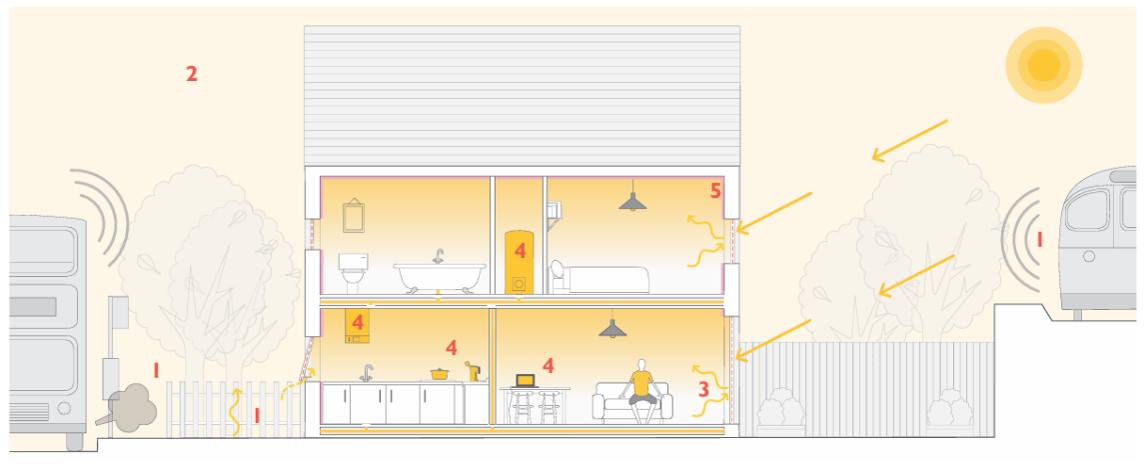
1 – The first consideration here, marked with the number 1 in the image, is external factors. In the example above, the house has passing trains and buses. Residents keep windows closed because of the noise and the air pollution, and this makes it harder to ventilate the house. This is a familiar problem where I live in Luton. Open your windows at night to cool the house, and you’ll be kept awake by the noise from the airport.
A second external factor here is the ground outside the building. In this case there is solid paving at the front of the house that is heating up and releasing more warmth through the open window. This is something I see all the time with schools, where black tarmac playgrounds can heat up in the sun – I’ve seen them reach 50C. If you open the windows onto that you’ll only make things worse.
2 – The second factor in the graph is external temperatures, which is the one we’re generally going to think of first. A hot, cloudless day with little wind is going to present the biggest challenge, and it’s something we can’t do anything about.
3 – Next we have solar gain, indicated with the rays of sun hitting the back of the property, expecially the large windows onto the garden. Large windows let in lots of natural light, but they also let in the summer heat and trap it behind the glass.
4 – We also have to consider heat sources within the building. In homes these are likely to be from cooking and from hot water systems. In workplaces a lot of heat is generated from IT equipment or machines. A less obvious heat source is people, and it’s a highly relevant one for the schools I work with. Every child contributes 75 to 100 watts of heat. Fill a classroom with 30 kids and you have the equivalent of a three-bar fire, and a good case for outdoor education.
5 – Finally, there’s the design of the building itself. Unless cooling has been carefully considered – and it often isn’t in the UK – modern efficiency standards that save on heating in the winter work against us in the summer. A highly insulated property can keep the heat in during the summer months, building up over successive hot days.
Some of these things are beyond our control – particularly the weather, and surrounding noise. Other factors present some solutions, with solar gain being the most promising. Shade solutions keep the sun off the windows, preventing the heat from entering the building in the first place. Last year I wrote about the shading techniques I use in my own house, but I’m frustrated at how difficult it is to source more permanent solutions. I was in France last week and every other house had shutters or awnings or screens of some kind. These are vanishingly rare here, to the point that some of the best solutions just aren’t on the market at all. (This – a word to the wise – is a massive business opportunity.)
I’ll come back to this to look at how other countries create shade and keep buildings cool, because a big part of the overheating challenge in the UK is that this is a new problem. If you’re building houses in a hot country, you know what to do already. If your country becomes hot, even for just part of the year, you’re not ready. Architects and house builders haven’t had any training on the topic. You have to catch up, and learning from warmer countries might be a good place to start.


Thanks for the detailed breakdown. Really appreciate the effort!