It’s fifty years since the famous 1976 heatwave which broke records as the driest and hottest British summer of the 20th century. From a weather perspective it was a true freak occurrence, and it’s left a lasting legacy. Some of that is benign – lots of people have very happy memories of an ‘endless summer’. Less positively, it’s also a touchstone of climate denial in the UK. “I was there in 1976” has served as convenient shorthand to dismiss the idea of global warming, and a way of talking down to younger climate activists.
Both of those aspects have been on display in recent weeks as the anniversary coincides with another heatwave. The right wing press have trotted out a series of articles about how everyone had a wonderful time in 1976 and we should all calm down. Not bothering to check the facts, some have insisted that schools stayed open throughout. Nobody panicked, everyone was fine, and hydration hadn’t even been invented then.
Some of this is climate denial by implication. Some of it is starkly explicit, such as an editorial in the Daily Mail that somehow uses the heatwave as an excuse to go after the “climate cultists” and their “suicidal rush to net zero.”
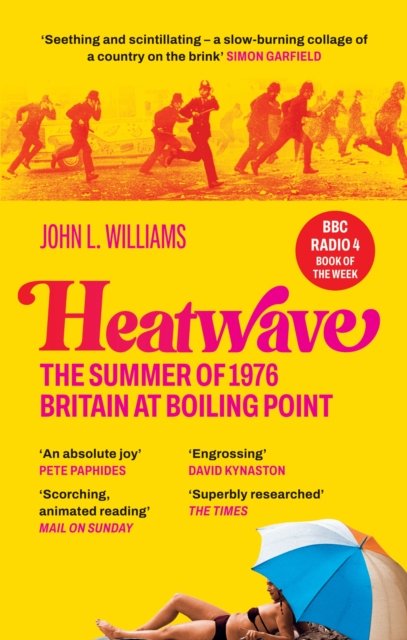
Since I wasn’t there in 1976, I picked up a copy of Heatwave by historian John Williams (not my Dad), to get a bit more perspective on what really happened. It’s fair to say that not everyone was having a lovely time. There was water rationing, farming was devastated and the government had to appoint a Minister for Drought. There was a simmering threat of violence in some cities, and that summer saw race riots and murderous gang warfare. Racial minorities and the LGBTQ community are likely to remember the summer differently. Police call-outs for domestic violence spiked by 600 extra calls a day in London alone. A teenager with special needs was murdered at an overcrowded outdoor swimming pool and somehow no suspect was ever identified. The NHS struggled to cope with the heat itself and the rise in demand from heatstroke, heart attacks and other heat-related conditions.
So no, not everything was fine.
It is also true that a lot of people were experiencing a uniquely wonderful summer. Those most likely to be enjoying themselves were children and young people, who had more freedom at the time. The book has plenty of their stories too, as they’re out swimming or riding their bikes and meeting their friends. My favourite anecdote is an interviewee remembering how the sun melted the yellow lines on the roads, and children peeled it off and competed to see who could scrape up the most. “My ball of paint was the size of a football”, she claims.
That raises an interesting question about the age and background of newspaper columnists, and whose stories get told fifty years on. The prevailing story today is from those who were children in 1976. We hear far less from the adults who were dealing with pupils fainting in their classrooms, or nurses trying to keep vulnerable patients cool in overheated hospital wards. For those of us who weren’t there, I think it’s important to recognise that different stories can be told about the same event.
Standing back from individual perspectives of the heatwave, Williams’ book conveys a powerful sense of a changing culture. 1976 was a turning point for the UK. It was the year that Britain had to be bailed out by the IMF, leading to emergency austerity measures and paving the way for Margaret Thatcher and her economic reforms. It was a breakthrough year for a number of social movements, including the Trico strike for equal pay for women, and the Southall Youth Movement of young asians. In the counterculture, 1976 was also the year that punk emerged.
The book is actually more about these cultural shifts than anything else, with the heatwave serving as a backdrop to explorations of culture and politics. It’s written almost like a scrapbook or a collage, with short sections on items in the news or songs in the charts, interspersed with longer chapters on specific events or trends. There’s a chapter on sleaze cinema and the ‘confessions’ series, which sounds like the worst of 70s trash but usefully illustrates how norms have changed. Another chapter looks at Joan Armatrading and how she bucked the trend as a popular black singer-songwriter – someone I didn’t know much about and am listening to as I write. Williams, who was 15 at the time, writes about his fascination with Soul Boy fashion, the Entebbe raid, or the West Indies cricket tour. As a child of the Francophonie with very near zero interest in cricket, it’s a testament to his writing that I found this chapter rivetting.
As a book, Heatwave is an engaging piece of social history, a mosaic of stories from a specific and memorable summer. As an event, the summer of 1976 is a complicated story that we should neither romanticise nor catastrophise. And given how much has changed in that fifty years, I’m not sure glib comparisons between today’s heatwaves and that one are remotely useful. What matters is today is what we do and how we treat each other in our hotter world, where such events are going to be more frequent.
- Heatwave is available from Earthbound Books

