
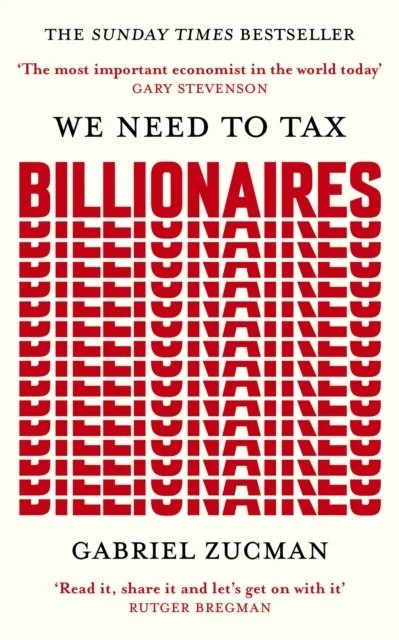
This was the year that we saw the world’s first trillionaire, a state of imbalance so absurd that it really ought to rewrite how we talk about inequality. I don’t see any sign of that yet, but this book might have one practical and popular answer: tax billionaires.
An important thing to note here: first, this is a call to tax billionaires, not the rich more generally. Those who would be affected are a tiny fraction of one percent of citizens, and there is nothing to fear for the rest of us mere mortals. If governments don’t do it, we will all know why and it will only reinforce the case for the next government to do it.
Neither is it an argument to take more from billionaires than from everyone else. As the book points out, most people pay somewhere near the average level of tax, until we get to the very top. Then the rules go out the window, and billionaires pay less than everyone else. In France, the average tax level is around 50% of income. Billionaires pay half that, despite fair and proportional taxation being written into the constitution.
The book explains some of the reasons why billionaires are so hard to tax. One of the main reasons is that billionaires pay very little income tax, and corporation taxes don’t make up the shortfall. Where most of us get our money through earnings, billionaires accrue wealth through ownership. They can easily funnel assets and dividends through holding companies, often offshore, allowing very rich people to claim that they actually earned very little. The Bezos, while remaining a billionaire throughout, has been known to file so little taxable income that he has received child tax credits. To stop that kind of nonsense, we need wealth taxes instead of income taxes.
Taxing billionaires fairly isn’t a punishment. Nor is it the politics of envy, though no doubt the think-tanks will dutifully say it is. To Zucman, it’s a matter of completing the “unfinished revolution” of income taxation. It would take away an unfair advantage that drives the gap between rich and poor – the less tax you pay, the easier it is to accumulate wealth. And it would help to reduce the deficit, because billionaires’ contribution to government revenues is currently miniscule.
Wealth taxes haven’t always been successful in the past, and the last sections of the book look at examples that we can learn from. Tax rules in some countries are better than others, and we can identify best practice that would make it harder for people to squirrel their fortunes away. There are loopholes that have scuppered previous efforts to tax billionaires, and we know to avoid them this time. Zucman’s favoured solution is a global minimum tax on billionaire wealth, and he sets out how it might work.
Gabriel Zucman is a professor at the Paris School of Economics, and so the main arguments in the book are made from a French context, with comparisons to other countries along the way. Unfortunately the UK doesn’t feature at all, as it hasn’t been possible to replicate the research into billionaire taxation that underpins Zucman’s work. That is telling in itself, of course.
We Need to Tax Billionaires is short and to the point, making its case in 96 pages and we’re done. (This is a mercy – I can think of notable books by French economists that weigh in at ten times that.) It’s got one central idea, and the prospect of having to tax trillionaires now should sharpen political resolve to get it done.
- We Need to Tax Billionaires is available from Earthbound Books

